

Drawings and documents
National Archives restored drawings: drawing
Thomas Gilpin's Patent Drawing for a Machine for Finishing Paper

National Archives, Restored Patent Drawings (Record Group 241) · Full-size scan at the National Archives · Catalog record
Text on the drawing
Words on the drawing as machine-read by the National Archives; not checked. Useful mainly for searching.
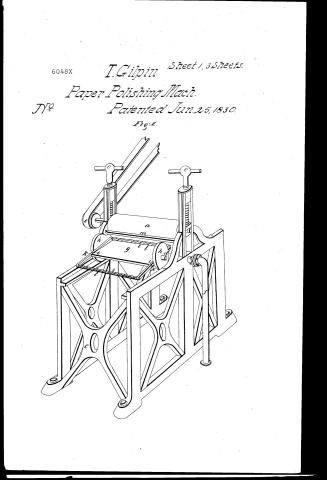
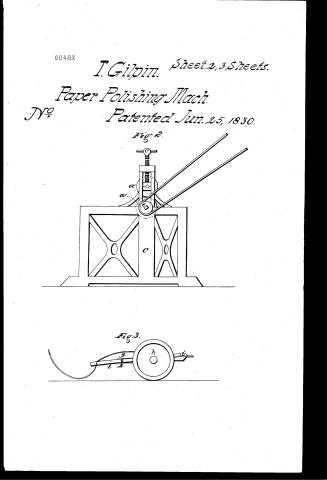
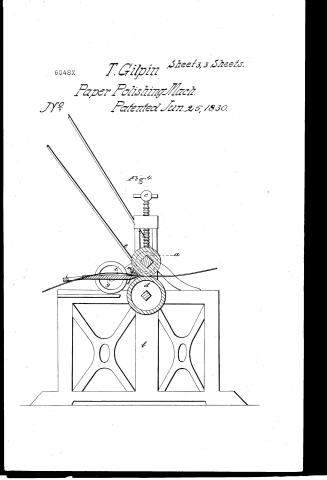
92 / on / CLASSI TION / 6048. x / Thomas Silpin / C Machinery for Finishing Paper. / Vot is pg. 5% / Intented June 25. 1630. / The Preferences. paper roller Jel Jij. 1. / The iron frame. / C.C. adjusting screws / Figil. / d the ho llow iron cylinder / e the pulley and band. / Fig.2 / f the steampipe. / Fig.2. a'. á two paper rollers. / KE / Fig 3.The conductor / g the flat board. / h.h. the wheels. / Figh. / 4. / i.i.i.i. the open frame / K.K its pivots. / l.l woolen cloth round the frame. / m the permanent iron far Fig. 1 / Tigh Section / Fig.3 / Patent office June 29 th / made under the direction of the Comm / ch. L. Aleischmann fact. / in conformity with act of 3d Mare / Commis Ley
USPTO scan
The patent as scanned by the USPTO
-
 Page 1
-
 Page 2
-
 Page 3
-
 Page 4
-
 Page 5
-
 Page 6


U.S. Patent and Trademark Office · Google Patents
Published accounts: specification
Specification printed in the Journal of the Franklin Institute
Journal of the Franklin Institute, new ser., vol. 6 (1830), p. 237 · View the page
Text of the specification as printed in the Journal, from OCR; not proofread.
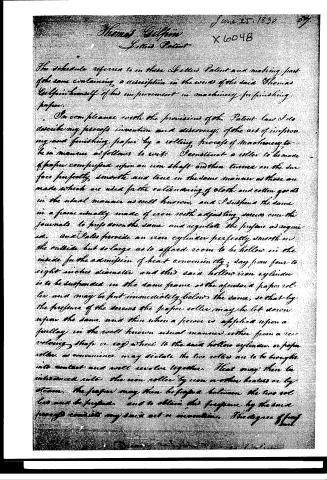
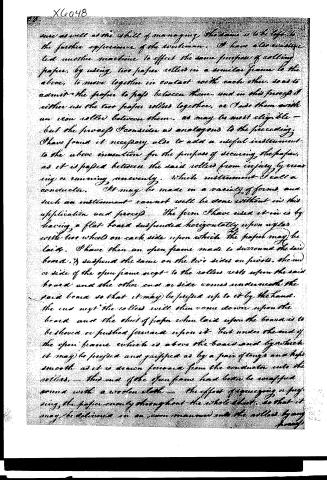
Specification of a patent for an improvement in the mode of Finishing Paper. Granted to THOMAS GILPIN, Philadelphia, Pennsylvania, June 25th, 1830. I CONSTRUCT a roller, to be made of paper compressed upon an iron shaft, and then turned on the surface perfectly smooth and true, in the same manner as those are made which are used for the callendering of cloth and cotton goods in the usual manner, as well known, and I suspend the same in a frame usually made of iron, with adjusting screws over the Journals, to press down the same and regulate the pressure as required; and I also provide an iron cylinder perfectly smooth on the outside, but so large as to afford room to be hollow in the inside for the admission of heat conveniently; say from four to eight inches diameter, and this said hollow iron cylinder is to be suspended in the same frame as the aforesaid paper roller, and may be put immediately below the same, so that by the pressure of the screws, the paper roller may be let down upon the same, and then, when a power is applied upon a pulley in the well known usual manner, either from a revolving strap or cog wheel, to the said hollow cylinder, or paper roller, as convenience may dictate, the two rollers are to be brought into contact, and will revolve together. Heat may then be introduced into the iron roller by iron or other heaters, or by steam. The paper may then be passed between the two rollers and be pressed, and to obtain this pressure by the said process, consists my said art or invention. The degree of pressure as well as the skill of managing the same, is to be left to the further experience of the workman. I have also constructed another machine to effect the same purpose of rolling paper, by using two paper rollers in a similar frame to the above, to move together in contact with each other, so as to admit the paper to pass between them, and in this process I either use the two paper rollers together, or I use them with an iron roller between them, as may be most eligible, but the process I consider as analogous to the preceding. I have found it necessary also to add a useful instrument to the above invention for the purpose of securing the paper, as it is passed between the said rollers, from injury by creasing, or running unevenly, which instrument I call a conductor. It may be made in a variety of forms, and such an instrument cannot well be done without in this application and process. The form I have used it in, is by having a flat board suspended horizontally upon axles, with two wheels on each side, upon which the paper may be laid. I have then an open frame made to surround the said board, and suspend the same on the two sides or pivots, the end or side of the open frame next to the rollers rests upon the said board, and the other end or side comes underneath the said board, so that it may be pressed up to it by the hand, the end next the rollers will then come down upon the board, and the sheet of paper when laid upon the board is to be shoved, or pushed forward upon it, but under the end of the open frame which is above the board, and by which it may be pressed and gripped, as by a pair of tongs, and kept smooth as it is drawn forward from the conductor into the rollers; this end of the open frame had better be wrapped round with a woollen cloth. The effect of squeezing or pressing the paper evenly throughout the whole sheet, so that it may be delivered in an even manner into the rollers by any process, is part of my discovery, as it has never been done in any manner; and I describe the above as one way I have adopted to effect it. It may be done also by pressing a straight edge or cushion up to one of the rollers, and passing the sheet of paper between the straight edge or cushion, so as to gripe the paper against the roller in order to pass it evenly into the action at the contact of the rollers. Another part of my invention consists in fixing a permanent iron bar, or rod, opposite to the contact or conjunction of the two rollers, so that accidents may be prevented by things going into them, or persons being caught and hurt by them; the said bar to be connected to the standard or sides of the iron frame in which the rollers are suspended. THOMAS GILPIN.
Published accounts: journal notice
Notice in the monthly list of patents, with remarks
Journal of the Franklin Institute, new ser., vol. 6 (1830), p. 232 · View the page
38. For an improvement in Finishing Paper; Thomas Gilpin, Philadelphia, Pennsylvania, June 25.
Remarks. (See the specification.)
Published accounts: journal notice
Notice in the monthly list of patents, with remarks
Journal of the Franklin Institute, new ser., vol. 6 (1830), p. 237 · View the page
Any enlargement or contraction of the rod, below the valve seat, will have no more influence upon the pressure of the steam than will the area of the upper surface of the float, the pressure upon which is balanced by the pressure of the water upon its lower surface. The space contained between two circles struck from the centre of the under side of the float, the smaller of which is equal in diameter to the hole drilled through the valve seat, and the larger to the diameter of the lower part of the cone of the valve seat, will represent the area acted upon by the steam, without being counteracted by the atmosphere; from the area of the inner circle must be subtracted the pressure of the atmosphere upon an equal surface. Specification of a patent for an improvement in the mode of Finishing Paper. Granted to THOMAS GILPIN, Philadelphia, Pennsylvania, June 25th, 1830.
Remarks. I CONSTRUCT a roller, to be made of paper compressed upon an iron shaft, and then turned on the surface perfectly smooth and true, in the same manner as those are made which are used for the callendering of cloth and cotton goods in the usual manner, as well known, and I suspend the same in a frame usually made of iron, with adjusting screws over the Journals, to press down the same and regulate the pressure as required; and I also provide an iron cylinder perfectly smooth on the outside, but so large as to afford room to be hollow in the inside for the admission of heat conveniently; say from four to eight inches diameter, and this said hollow iron cylinder is to be suspended in the same frame as the aforesaid paper roller, and may be put immediately below the same, so that by the pressure of the screws, the paper roller may be let down upon the same, and then, when a power is applied upon a pulley in the well known usual manner, either from a revolving strap or cog wheel, to the said hollow cylinder, or paper roller, as convenience may dictate, the two rollers are to be brought into contact, and will revolve together. Heat may then be introduced into the iron roller by iron or other heaters, or by steam. The paper may then be passed between the two rollers and be pressed, and to obtain this pressure by the said process, consists my said art or invention. The degree of pressure as well as the skill of managing the same, is to be left to the further experience of the workman. I have also constructed another machine to effect the same purpose of rolling paper, by using two paper rollers in a similar frame to the above, to move together in contact with each other, so as to admit the paper to pass between them, and in this process I either use the two paper rollers together, or I use them with an iron roller between them, as may be most eligible, but the process I consider as analogous to the preceding. I have found it necessary also to add a useful instrument to the above invention for the purpose of securing the paper, as it is passed between the said rollers, from injury by creasing, or running unevenly, which instrument I call a conductor. It may be made in a variety of forms, and such an instrument cannot well be done without in this application and process. The form I have used it in, is by having a flat board suspended horizontally upon axles, with two wheels on each side, upon which the paper may be laid. I have then an open frame made to surround the said board, and suspend the same on the two sides or pivots, the end or side of the open frame next to the rollers rests upon the said board, and the other end or side comes underneath the said board, so that it may be pressed up to it by the hand, the end next the rollers will then come down upon the board, and the sheet of paper when laid upon the board is to be shoved, or pushed forward upon it, but under the end of the open frame which is above the board, and by which it may be pressed and gripped, as by a pair of tongs, and kept smooth as it is drawn forward from the conductor into the rollers; this end of the open frame had better be wrapped round with a woollen cloth.
About this record
- Patentee
- DATAMP
- Date
- the Name and Date index of patents, DATAMP, USPTO records
- Invention
- DATAMP
- Listed in
- the Name and Date index of patents, DATAMP, USPTO records, Jim Shaw's X-patent list, the Journal of the Franklin Institute, Burke's List of Patents (1847)
- in_burke