

Drawings and documents
National Archives restored drawings: drawing
Alpheus Babcock's Patent Drawing for a Stringing Piano

National Archives, Restored Patent Drawings (Record Group 241) · Full-size scan at the National Archives · Catalog record
Text on the drawing
Words on the drawing as machine-read by the National Archives; not checked. Useful mainly for searching.
arts - Piano Nortes / A* / I' / 84. MUSIC, / [112] Stringing Pianos. / apl- / Alphas Babecch / CLASSIFICATION / 5995-+ / Stringing Piuno. / Vol.10 pg.219 / DI ISION. / Putented May 1830 / OIR / 01 / Preferences. a Juning pin block. b. sounsing board bridge C small pin small to separate the strings. / d. strings e loop " eye of pin block. g.g.pins. h. hook. / Patent affice December y.1541. / made under the direction of the commipioner / ch. facit. / of Patents in Can formity with act of 1857 3 march / nd / Nommiprence of Patents.
USPTO scan
The patent as scanned by the USPTO
-
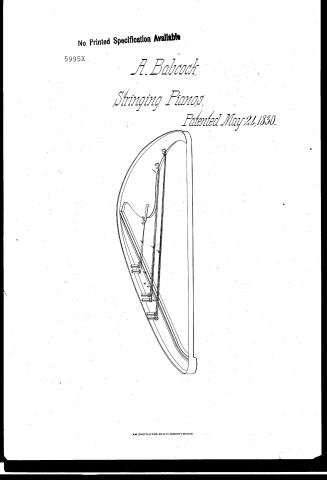 Page 1
-
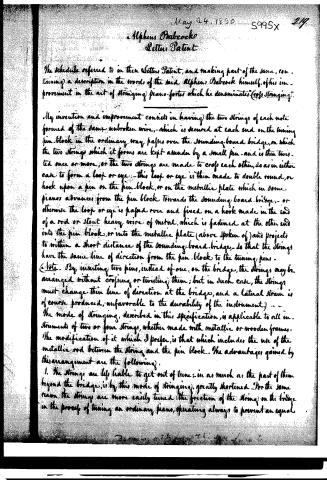 Page 2
-
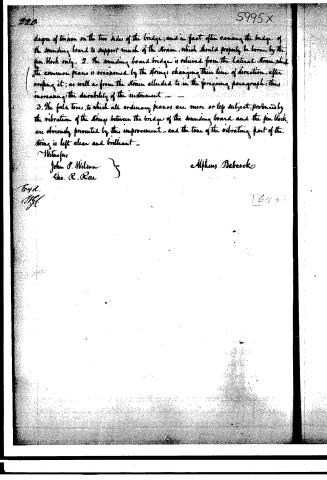 Page 3


U.S. Patent and Trademark Office · Google Patents
Published accounts: journal notice
Notice in the monthly list of patents, with remarks
Journal of the Franklin Institute, new ser., vol. 6 (1830), p. 151 · View the page
47. For an improvement in the art of Stringing Piano Fortes, denominated "Cross Stringing;" Alpheus Babcock, Philadelphia, Pennsylvania, May 22.
Remarks. (See the specification.)
Published accounts: journal notice
Notice in the monthly list of patents, with remarks
Journal of the Franklin Institute, new ser., vol. 6 (1830), p. 159 · View the page
We claim as our invention, the mode in which the above frame was put together; and we claim as new, and as our invention, this method of making the foundations, and the fixing of marine rail-ways under water, without the driving of piles, the making of coffer dams, the using of diving bells, or any similar structures, as usually employed for that purpose. If the rail-way is intended for large vessels, the having five railways, viz. one under the keel, one under each bilge, and one on each side for the support support of the upper works of the vessel with shores, are all considered modifications of the principle herein described, and we accordingly claim this method also as our invention. JAMES RONALDSON. JOHN L. NEILL. Specification of a patent for an improvement in the art of Stringing Piano Fortes, denominated by the patentee "Cross Stringing." Granted to ALPHEUS BABCOCK, Philadelphia, Pennsylvania, May 24th, 1830.
Remarks. My invention and improvement consist in having the two strings of each note formed of the same unbroken wire, which is secured at each end on the turning-pin-block, in the ordinary way, passes over the sounding board bridge, on which the two strings which it forms are kept asunder by a small pin, and is then twisted once or more; or the two strings are made to cross each other, so as in either case to form a loop, or eye. This loop, or eye, is then made to double round, or hook upon a pin on the pin-block, or on the metallic plate, which in some pianos advances from the pin-block, towards the sounding board bridge; or otherwise the loop, or eye, is passed over and fixed on a hook made in the end of a rod, or stout heavy wire of metal, which is fastened at the other end into the pin-block, or into the metallic plate, (above spoken of,) and projects to within a EVANS' machine for Lifting Ships. short distance of the sounding board bridge; so that the strings have the same line of direction from the pin-block to the turning pins. (Note. By inserting two pins instead of one on the bridge, the strings may be arranged without crossing, or twisting them; but, in such case, the strings must change their line of direction at the bridge, and a lateral strain is of course produced, unfavourable to the durability of the instrument.) The mode of stringing described in this specification is applicable to all instruments of two or four strings, whether made with metallic or wooden frames. The modification of it which I prefer, is that which includes the use of the metallic rod between the strings and the pin-block. The advantages gained by this arrangement are the following. 1st. The strings are less liable to get out of tune; inasmuch as the part of them beyond the bridge is by this mode of stringing greatly shortened. For the same reason the strings are more easily tuned; the friction of the string on the bridge, in the process of tuning an ordinary piano operating always to prevent an equal degree of tension on the two sides of the bridge, and in fact often causing the bridge of the sounding board to support much of the strain which should properly be borne by the pin-block only.
About this record
- Patentee
- DATAMP
- Date
- the Name and Date index of patents, DATAMP, Burke's List of Patents (1847)
- Invention
- DATAMP
- Listed in
- the Name and Date index of patents, DATAMP, USPTO records, Jim Shaw's X-patent list, the Journal of the Franklin Institute, Burke's List of Patents (1847)
- The sources give different dates; the date shown is the one most of them agree on.
- The Franklin Institute's journal gives a different date.
- in_burke