

Drawings and documents
National Archives restored drawings: drawing
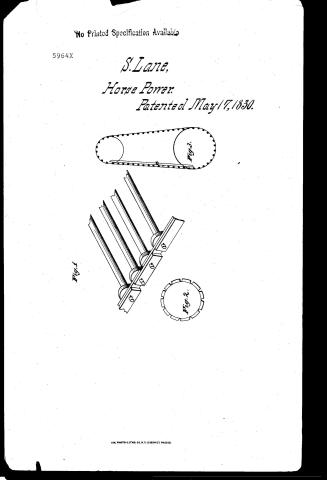
Samuel Lane's Patent Drawing for an Endless Chain and Railway Horsepower


National Archives, Restored Patent Drawings (Record Group 241) · Full-size scan at the National Archives · Catalog record
Text on the drawing
Words on the drawing as machine-read by the National Archives; not checked. Useful mainly for searching.
Sheet 1. [v / Horse Horse-powers / Sam Lanes. / late / Endless Chain and Railway Hersepener / CLASSIFICATION CLASSIF / Patented 19th May / 5964-X X / 1830 / Fy 1. / 06 / 0. / Fig. 2. / Figs. / 1.00
Sheet 2. Horse powers / SAML LANE'S. / Endless Chain and Railway Honsepower. / Patented 17 May 1830 / CLASSIFICATION / 5964-X / Figh / Fry / 2. / Fig 3.
USPTO scan
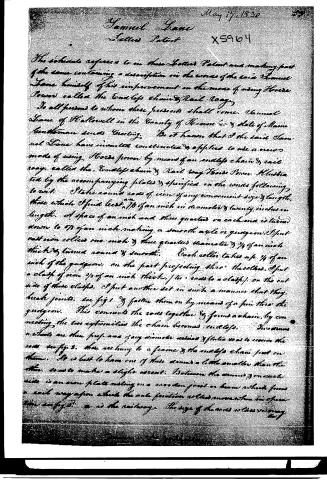
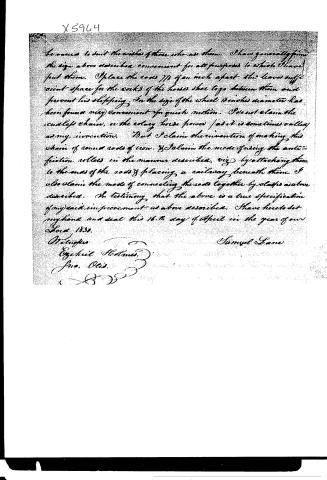
The patent as scanned by the USPTO
-
 Page 1
-
 Page 2
-
 Page 3


U.S. Patent and Trademark Office · Google Patents
Published accounts: journal notice
Notice in the monthly list of patents, with remarks
Journal of the Franklin Institute, new ser., vol. 6 (1830), p. 79 · View the page
19. For a new mode of Using Horse Power by means of an endless Chain and Rail-way, called "the Endless Chain and Rail-way Horse Power;" Samuel Lane, Hallowell, Kennebeck county, Maine, May 17.
Remarks. 80Horses walking upon inclined floors, the pieces of which are linked together and form an endless chain, or floor, is a well known means of applying animal power; motion being communicated to machinery by one of the drums over which the endless floor passes. The floors are usually made of strips of wood, which, by the treading of the horse, soon wear down, and become so elastic as to consume much of the power applied to them. The mode in which they are sustained is also, in general, very defective. We think this invention of Mr. Lane a real improvement upon this apparatus; we are also informed that it has answered perfectly well in practice, and have no doubt of the correctness of the information. The floor instead of being made of wood, is formed of round bar iron of seven-eighths of an inch in diameter, and twenty inches in length. The rods are placed about seven-eighths of an inch apart, which leaves the proper space for the cork of the horse's shoe. The iron rods are turned down to five-eighths of an inch at each end, and receive a true cast iron roller, to serve as a friction roller, leaving beyond this, sufficient length of the turned down part to serve as a gudgeon to couple the rods together, which is done by flat links of iron, forming an endless chain at each side; the outer ends of these gudgeons drop into notches on the head of one of the drums, to prevent slipping. A wooden rail, faced with iron, is placed under the rollers, at each side, and form a rail-way upon which they run. The claim is to this mode of forming the floor of iron rods, and the attaching the rollers in the way described, to run upon the railway, with the mode of connecting them.
About this record
- Patentee
- DATAMP
- Date
- the Name and Date index of patents, DATAMP, USPTO records
- Invention
- DATAMP
- Listed in
- the Name and Date index of patents, DATAMP, USPTO records, Jim Shaw's X-patent list, the Journal of the Franklin Institute, Burke's List of Patents (1847)
- in_burke