

Drawings and documents
National Archives restored drawings: drawing
Elijah Skinner's Patent Drawing for a Saving Lock

National Archives, Restored Patent Drawings (Record Group 241) · Full-size scan at the National Archives · Catalog record
Text on the drawing
Words on the drawing as machine-read by the National Archives; not checked. Useful mainly for searching.
5. FURNITURE / [62] Drawers. / 5916-X / Drawers, / Elijah Skinner's / Saving Lock. / Lat ted: 13 April. 1830! / d 8 / be / OLA / References. / Patent Office. April 13th 1839. / Slide. / f. batches on pins. / b. Block of wood / g. Pin or cog of wood. / Made under the direction of the Commipioner of Patents / c. groove to receive the slide. / h. / the / frim. / a. Common lock / i. Head or bap by which to / in conformity with act. 3d March 1837. / k. Staples. / raise / let / down / the / slide. / brofe piece. / l. / Drawers / MLSunooth / Commiprioner of Patent
USPTO scan
The patent as scanned by the USPTO
-
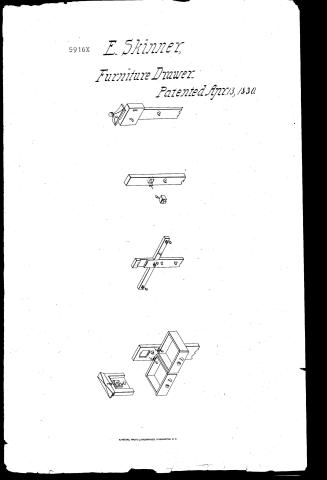 Page 1
-
 Page 2
-
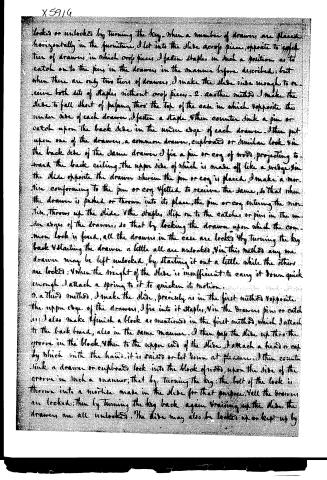 Page 3
-
 Page 4


U.S. Patent and Trademark Office · Google Patents
Published accounts: journal notice
Notice in the monthly list of patents, with remarks
Journal of the Franklin Institute, new ser., vol. 6 (1830), p. 8 · View the page
18. For a mode of Locking Drawers of Furniture, called the "Saving Lock;" Elijah Skinner, Sandwich, Strafford county, New Hampshire, April 13.
Remarks. What is claimed as new " is the attaching of such slides, staples, pins, &c. to the drawers and furniture, that with one common drawer lock I can lock and unlock any number of drawers in the same piece of furniture, in an easy and cheap manner." The mode is by causing the lock of one drawer in a tier, or case, to operate in various ways upon a slide extending from the top of the case to the bottom, and furnished with pins or staples to catch upon corresponding parts on each drawer. B It may be that to the patentee this is a novelty, but we can inform him that it has been long known and used. The neatest and most simple mode of effecting it which we have seen, was in two nests of drawers, making part of the stand of a lathe manufactured by Dyerleine and Hoptzaffel, of London, and purchased by us in Philadelphia, in the year 1817. A strip, of which A is a side view, was placed in a groove on the inside of the case, so that it could slide up and down freely at the ends of the drawers; a number of iron pins projected from this strip, so that one might fall into a notch in each drawer. The upper drawer was furnished with a lock; when this drawer was unlocked, and drawn out about an inch, it raised the slide, by the inclination of the notch in the upper drawer, as shown at B, and relieved all the other drawers. This lathe was afterwards sold to Professor Gibson, of Philadelphia, and is probably still in his possession. We have since had the same principle applied to side board, and other drawers.
About this record
- Patentee
- DATAMP
- Date
- the Name and Date index of patents, DATAMP, USPTO records
- Invention
- DATAMP
- Listed in
- the Name and Date index of patents, DATAMP, USPTO records, Jim Shaw's X-patent list, the Journal of the Franklin Institute, Burke's List of Patents (1847)
- Burke's 1847 Patent Office list gives the same patent.