

Drawings and documents
National Archives restored drawings: drawing
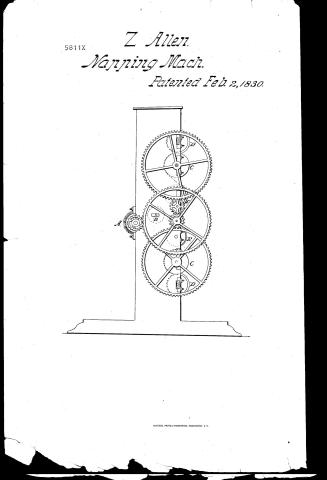
Zachariah Allen's Patent Drawing for a Napping Machine

National Archives, Restored Patent Drawings (Record Group 241) · Full-size scan at the National Archives · Catalog record
Text on the drawing
Words on the drawing as machine-read by the National Archives; not checked. Useful mainly for searching.
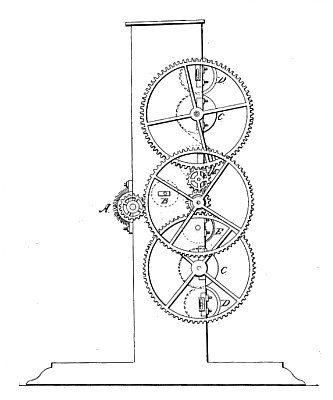
3. CLOTH. / [37] Napping. / $2- / ZACHARIAH ALLIEN'S / CLASSIFICATION / 5811 X / DIVISION. / Patented2 1830. is / 5811 X / Explanation / A. A.The cylinder covered with wire Dr cards / B.a solid a rbor or edge overwhich the cloth is formly extended / by the two self-acting spreading rollers or temples. / E.E. over which the cloth is made to Traverse by the frection of it / against the Tower semi-circumference of the rollers C.C moved / from the pinion onthe arbor A. and calculated tohanca reversed / motion from clutches on the Shafts C.C. thrown into gear alternately / by a lever: after passingthalf around the rollers C.C. The cloth is iswound / upon the rollers D.D. Turned bybearing against the rollers C.C. meir / gudgeons moving free 272 the Slots.
USPTO scan
The patent as scanned by the USPTO
-
 Page 1
-
 Page 2


U.S. Patent and Trademark Office · Google Patents
Published accounts: specification
Specification printed in the Journal of the Franklin Institute
Journal of the Franklin Institute, new ser., vol. 5 (1830), p. 310 · View the page
Text of the specification as printed in the Journal, from OCR; not proofread.
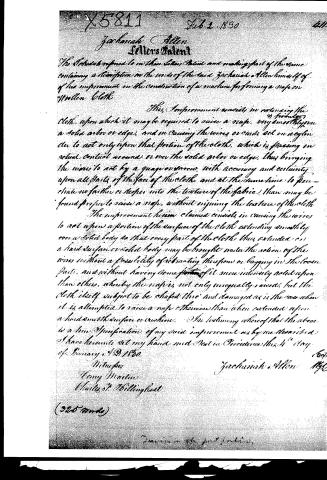
Specification of a patent for an improvement in forming the Nap upon Woollen Cloths. Granted to ZACHARIAH ALLEN, Providence, Rhode Island, February 2nd, 1830. THIS improvement consists in extending the cloth, upon which it may be required to raise a nap, very smoothly and firmly over a solid arbor, or edge, and in causing the wires, or cards, set in a cylinder, to act only upon that portion of the cloth which is passing in actual contact around, or over, the solid arbor or edge; thus bringing the wires to act by a gauge or screw with accuracy and certainty upon all parts of the face of the cloth, and at the same time to penetrate no farther or deeper into the texture of the fabric, than may be found proper to raise a nap without injuring the texture of the cloth. The improvement herein claimed consists in causing the wires to act upon a portion of the surface of the cloth extended smoothly over a solid body, so that every part of the cloth, thus extended on a hard surface or solid body, may be brought under the action of the wires without a possibility of retracting therefrom, or bagging in the looser parts, and without having some portions of it more intensely acted upon than others, whereby the nap is not only unequally raised, but the cloth itself is subject to be chafed through and damaged, as is the case when it is attempted to raise a nap otherwise than when extended upon a hard, smooth surface or cushion. ZACHARIAH ALLEN.
Published accounts: journal notice
Notice in the monthly list of patents, with remarks
Journal of the Franklin Institute, new ser., vol. 5 (1830), p. 290 · View the page
4. For an improvement in Forming the Nap upon Woollen Cloths; Zachariah Allen, Providence, Rhode Island, Feb. 2.
Remarks. (See the specification.)
Published accounts: journal notice
Notice in the monthly list of patents
Journal of the Franklin Institute, new ser., vol. 5 (1830), p. 310 · View the page
E. The slide which retracts the point F, which point is screwed into the sliding tube; within this the female screw is shown, and the male screw of the propeller. Mr. Philip Garret, watch maker of Market street, Philadelphia, is the proprietor of the above patent, and manufactures the cases. Fig. B C D E F Specification of a patent for an improvement in forming the Nap upon Woollen Cloths. Granted to ZACHARIAH ALLEN, Providence, Rhode Island, February 2nd, 1830.
Published accounts: journal notice
Notice in the monthly list of patents, with remarks
Journal of the Franklin Institute, new ser., vol. 5 (1830), p. 312 · View the page
THIS improvement consists in laying the folds of woollen cloths smoothly between metallic plates, and in this state immersing the cloth in steam or heated water, and in subjecting the cloth, whilst thus immersed, in steam or hot water, to a heavy pressure, by means of a screw or otherwise. After remaining for a short time in this state, the cloth is allowed to become cold, or may be suddenly cooled by cold water, when it is to be withdrawn from the press. The cloth is then to be again folded in such a manner that those portions of the edges of the folds which were not subjected to pressure in the first instance, may be exposed to pressure in the second operation, which is to be completed in the same manner as the first. To prevent any marks, or impressions upon the cloth, from the edges of the plates, the cloth may be laid in folds of its full width, and made to extend together with the edges of the plates of metal by means of thin boards introduced between them, and of less superficial dimensions than the plates. After undergoing the process, all sorts of woollen cloths are found to be rendered permanently more compact in texture, and consequently more serviceable in retaining warmth and excluding mois ture, although comparatively more thin and light, whilst at the same time the cloth is rendered more smooth and glossy. The improvement here claimed, and the advantages of this process over the usual mode of pressing woollen cloths, in a dry state, either cold, or with hot plates of metal, consist in the following circumstances, or parts-wool being a material very similar in its nature and properties to horn, (of which combs and other articles are formed,) if it be required to make any permanent alteration or impression on the texture of any fabric composed of it, the fibres of wool PATTON'S Improvement in Steam Navigation. must be rendered pliable by remaining immersed in hot water or steam. Whilst in this pliable and yielding state it may be easily compressed, or moulded to the desired form, and if allowed to become cold before this compression is removed, the form impressed will remain permanently. On the contrary, when pressed in a dry state the fibres of wool retain all their elasticity, and however intense the pressure may be upon them, they will soon recover their former position, and the effects will be transient. ZACHARIAH ALLEN. Specification of a patent for an improvement in Steam Navigation generally. Granted to JOHN M. PATTON, Milton, Northumberland County, Pennsylvania, February 4th, 1830.
Remarks. To all to whom these presents shall come, be it known, that I, John M. Patton, in the county of Northumberland, and state of Pennsylvania, have invented a new and useful improvement in steam navigation generally, being applicable to steam ships, steam boats, &c. and particularly applicable to the navigation of canal boats by means of steam power. This improvement consists in the use of a spiral or screw wheel, or wheels, to operate wholly under water-partly in the water and partly in the air-or wholly in the air, as resisting media, for the purpose of propelling or drawing the ships, boats, or craft of whatever description they may be, to which the said spiral or screw wheel or wheels may in any wise be attached for the purposes above specified; that is, to operate against air, or water, or both, and connected with steam power &c. for the purpose or purposes of propelling, or drawing ships, or boats, and craft of any description on any waters, or canals, within the United States. The spiral, or screw wheel is an old invention, and admits of a variety of construction, known to all practical and intelligent engineers, but as it is no particular construction, but the application of the spiral principle in all its various modifications to the purposes and in the manner above specified, that is claimed as a discovery, or new invention, hence I do not confine myself to any particular variety of the spiral, or screw wheel; to no particular dimensions, nor to the materials of which the same may be constructed; leaving myself full scope in the field of the mechanic arts to apply general and known materials and principles, in the construction of the spiral, as the nature of the case may require. The preferable mode of applying the machine is believed to be at the stern of the vessel, or boat; the shaft of the spiral in the direction of the travel of the vessel, or boat; its size, the number of turns of the wing, or wings, of the spiral on the shaft, or whether the wing, or wings of the spiral be in a continued thread, or threads, or whether the same be formed in disjoined sections, embracing the spiral principle in any manner, is intended to be included in this specification, VOL. V.-No. 5.-MAY, 1830. 40 MAGAW'S Preparation of Straw, &c. for Paper. and must be regulated to suit the power applied, and motion to be acquired. JOHN M. PATTON.
DATAMP: illustration
Illustrations from DATAMP

DATAMP (Directory of American Tool and Machinery Patents), via the Internet Archive · Archived DATAMP page
About this record
- Patentee
- DATAMP
- Date
- the Name and Date index of patents, DATAMP, USPTO records
- Invention
- DATAMP
- Listed in
- the Name and Date index of patents, DATAMP, USPTO records, Jim Shaw's X-patent list, the Journal of the Franklin Institute, Burke's List of Patents (1847)
- in_burke