

Drawings and documents
National Archives restored drawings: drawing
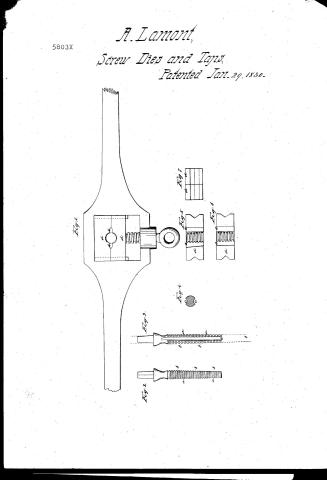
Archibald Lamont's Patent Drawing for Taps and Dies for Cutting Screws

National Archives, Restored Patent Drawings (Record Group 241) · Full-size scan at the National Archives · Catalog record
Text on the drawing
Words on the drawing as machine-read by the National Archives; not checked. Useful mainly for searching.
RIVETS. / i Archibald Lament mg. / Metals / Japs J Dies for outting screws. / Vol.10 / Patented / 5803.X / Fist. / DIVICION / Jig. 6. / Patent offiee March 11. 1842. / made under the direction of the / Pre fevences. a Tapbody spiral thread. c.c.groours. de Dier. oc circular opening afflutes / of Paten f in conformity with act of 3rd Tharah 1837. / fig. the serew ofigih xody.3 laps. NEW views / ofthe dies. diy.7 the Dies. / nh / Commissiona of Patents.
USPTO scan
The patent as scanned by the USPTO
-
 Page 1
-
 Page 2


U.S. Patent and Trademark Office · Google Patents
Published accounts: journal notice
Notice in the monthly list of patents, with remarks
Journal of the Franklin Institute, new ser., vol. 5 (1830), p. 228 · View the page
32. For an improvement in Taps and Dies; Archibald Lamont, Pittsburgh, Allegheny county, Pennsylvania, January 29.
Remarks. The peculiarity in the taps consist, principally, in the body, or solid part of the tap, within the thread, being perfectly cylindrical, whilst the whole form would be conical, were the spaces between the threads filled up. At the point of the tap the thread commences at nothing, as it is technically termed, whilst at the upper part the thread is of the full depth required. The diameter at the top, there-. fore, exceeds that at the bottom by double the depth of the thread. Two flutes are made on opposite sides of the tap, in order to form the cutting edges, and to allow of space to receive the cuttings. This appears to us to be a good form for a tap, especially for a square threaded screw, such as is represented in the drawing acAmerican Patents for January, with Remarks. companying the patent; it, however, is spoken of as applicable to such as are rounded or mitred; but the formation of these certainly would be attended with much greater difficulty. "Of the dies. The cavity of the dies by which the screw is made forms an entire and complete circle, having two circular openings across the centre of the dies, which form the cutters and also prevent the passing off of the chip. The screw in the dies also commences at nothing, or a plain surface, and gradually increases until the thread acquires the full size." According to the drawings, the "two circular openings" are two flutes on each die, filed along side of the screw, to form a cutting edge. These dies do not appear to us to promise so fairly as the taps; if a thread could be cut the whole depth at once, they would act well, but this, generally, is out of the question; only one cutting thread can be in action at once, and that the most prominent. A complete circle, offers no small practical difficulty in cutting deep threads with dies.
DATAMP: illustration
Illustrations from DATAMP


DATAMP (Directory of American Tool and Machinery Patents), via the Internet Archive · Archived DATAMP page
About this record
- Patentee
- DATAMP
- Date
- the Name and Date index of patents, DATAMP, USPTO records
- Invention
- DATAMP
- Listed in
- the Name and Date index of patents, DATAMP, USPTO records, Jim Shaw's X-patent list, the Journal of the Franklin Institute, Burke's List of Patents (1847)
- in_burke