

Drawings and documents
National Archives restored drawings: drawing
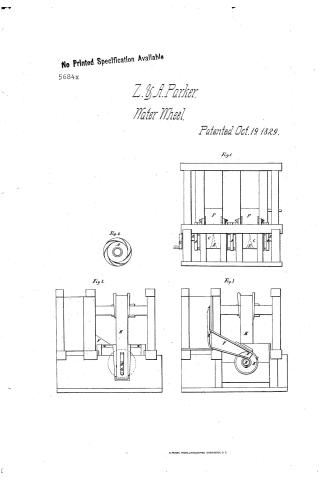
Z. and A. Parker's Patent Drawing for a Means of Applying Hydraulic Power

National Archives, Restored Patent Drawings (Record Group 241) · Full-size scan at the National Archives · Catalog record
Text on the drawing
Words on the drawing as machine-read by the National Archives; not checked. Useful mainly for searching.
WATER WHEELS. / [100] Tarbine. / f2 / Z&A PARKER'S. / HYDRAULIC power. / Patented op 19 Oct 1829. / 5684-+ / Fig 1. / Fig 1 / Figh. / Fig 3. / LB / References. / Fight front Figlend Frig 3 transverse section Fig 4 sectionthrough buckets / the rhed B shuft. C.Outer cylinder D Inner cylinder / Patent office 15th July 181 / E partition dividing the øylinder F sport G brank / H sminging post / Gate / Made under the direction of the Commipioner / Satents in conformity with act March 19 / Commisions of / Pate
USPTO scan
The patent as scanned by the USPTO
-
 Page 1
-
 Page 2


U.S. Patent and Trademark Office · Google Patents
Published accounts: journal notice
Notice in the monthly list of patents, with remarks
Journal of the Franklin Institute, new ser., vol. 5 (1830), p. 33 · View the page
29. For an improvement in the Application of Hydraulic Power; Zebulon and Austin Parker, Coshocton county, Ohio, October 19.
Remarks. The patentees claim to have invented improved methods of using water, by " combining percussion with reaction, applied and exemplified in, "1st. A compound vertical percussion and reaction water wheel for saw mills and other purposes, with the method of applying the water on the same. "2nd. An improved horizontal reaction water wheel, with the method of combining percussion with reaction in it. "3d. A method of combining percussion with reaction on common reaction wheels, or those already in use." After describing the particular manner in which they construct their wheels, the patentees say, "the parts of the above described machinery claimed as original, are as follows: 1st. The compound vertical percussion and reaction wheel for saw mills and other purposes, with two, four, six, or more wheels on one horizontal shaft. The concentric cylinders enclosing the shaft, with the manner of supporting them. The spouts which conduct the water into the wheels, from the penstock, with their spiral terminations between the cylinders. 2nd. The improvement in the reaction wheel by making the buckets as thin at both ends as they can safely be made, and the rim no wider than sufficient to cover them. The inner concentric cylinder. The spout that directs the water into the wheel; and the spiral termination of the spout between the cylinders.3d. VOL. V.-No. 1.-JANUARY, 1830. 5 The rim and blocks, or planks, that form the apertures into the wheel, and the manner of forming the apertures. The conical covering on the blocks, with the cylinder, or box, in which the shaft runs; and the hollow, or box gate, in any form, either cylindrical, square, rectangular, or irregular." It will be seen from the foregoing, that there is considerable complexity in the apparatus patented; and it may be collected, that the plan proposed consists, mainly, of enclosed wheels, with curved buckets, and certain spiral convolutions in the openings through which the water is to act. It is in fact a modification of the principles of Barker's and the tub wheel. The patentees state that they have, with great advantage, put their plan into operation. We apprehend that if this be the fact, the mills with which they have made a comparison are not such as are constructed upon the best principles for economizing water. The ordinary tub wheel is recommended by its simplicity, where water is abundant, but where it is necessary to save water, and it can be applied to an overshot, pitch-back, or breast wheel, we despair of seeing it more efficiently employed; these, it is true, may be, and generally are, badly constructed, or improperly geared; but where their velocity is duly regulated, their buckets properly formed, and the water delivered upon them at as great a height as possible, its whole effect, which is due to its gravity, will be obtained. In practice Barker's mill has been abandoned.
About this record
- Patentee
- Jim Shaw's X-patent list
- Date
- the Name and Date index of patents, USPTO records, Jim Shaw's X-patent list
- Invention
- the Name and Date index of patents
- Listed in
- the Name and Date index of patents, USPTO records, Jim Shaw's X-patent list, the Journal of the Franklin Institute, Burke's List of Patents (1847)
- in_burke