

Drawings and documents
USPTO scan
The patent as scanned by the USPTO
-
 Page 1
-
 Page 2
-
 Page 3
-
 Page 4
-
 Page 5
-
 Page 6


U.S. Patent and Trademark Office · Google Patents
Transcription
Machine transcription (LightOnOCR) of the pages as scanned by the USPTO, most of them the handwritten copies made when the records were restored after the 1836 fire. Not checked; it can misread handwriting, so compare it with the scan.
Page 2.
United States Patent
Patent No.: X5547
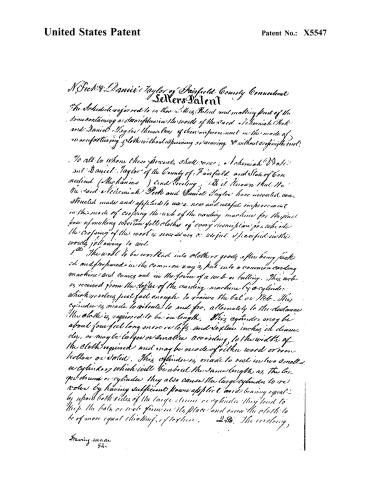
N. Peck & Daniel Taylor of Fairfield County Connecticut
Letters Patent
The Schedule referred to in this Patent and making part of the same containing a description in the words of the said Ichomiah Peck and Daniel Taylor themselves of their improvement in the mode of manufacturing cloth without spinning or weaving & without cutting the wool.
To all to whom these presents shall come: Ichomiah Peck and Daniel Taylor of the County of Fairfield and State of Connecticut (Mechanics) Send Greeting. Be it known that the said Ichomiah Peck and Daniel Taylor have invented constructed made and applied to use a new and useful improvement in the mode of crossing the web of the carding machine for the purpose of making woven felt clothes of every description and which the crossing of the wool is necessary or useful as specified in the words following to wit:
1. The wool to be worked into cloth or goods after being picked and prepared in the common way is put into a common carding machine and comes out in the form of a web or falling. This web is received from the top of the carding machine by a cylinder which revolves just fast enough to receive the web or Net. This cylinder is made to revolve to and fro, alternately to the distance the cloth is required to be in length. This cylinder may be about four feet long more or less and fifteen inches in diameter, or may be larger or smaller according to the width of the cloth required and may be made of either wood or iron hollow or solid. This cylinder is made to rest in two small cylinders which will be about the same length as the large drum or cylinder they also cause the large cylinder to revolve by having sufficient power applied and bearing equally upon both sides of the large drum or cylinder they tend to keep the web or net firm in its place and cause the cloth to be of more equal thickness of texture.
2. The revolving,
Drawing made 9th.
Page 3.
United States Patent
Patent No.: X5547
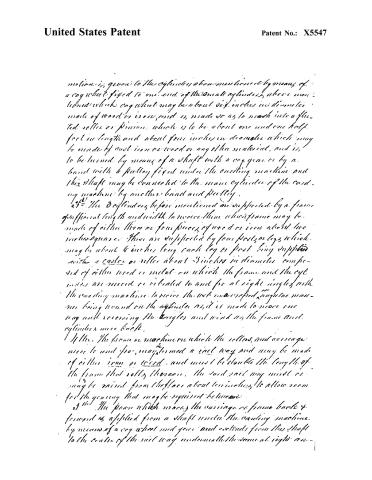
motion is given to the cylinders above mentioned by means of a cog wheel fixed to one end of the small cylinders, above mentioned which cog wheel may be about 2½ inches in diameter made of wood or iron, and is made so as to mesh into a fluted roller or pinion, which is to be about one and one half feet in length and about four inches in diameter which may be made of cast iron or wood or any other material, and is to be turned by means of a shaft with a cog gear or by a band with a pulley fixed under the carding machine and this shaft may be connected to the main cylinder of the carding machine by another band and pulley.
The 3 cylinders before mentioned are supported by a frame of sufficient length and width to receive them which frame may be made of either three or four pieces of wood or iron about two inches square. These are supported by four posts or legs which may be about 6 inches long each leg or post being supported with a caster or roller about 3 inches in diameter composed of either wood or metal on which the frame and the cylinders are moved or vibrated to and fro at right angles with the carding machine to receive the wet unscraped angular manner being wound on the cylinders as it is made to move one way and reversing the angles and wind as the frame and cylinders move back.
The frame or machine on which the rollers and carriage move to and fro, may be formed a rail way and may be made of either iron or wood, and must be double the length of the frame that rolls thereon, the said rail way must or may be raised from the floor about ten inches to allow room for the gearing that may be required between.
The power which moves the carriage or frame back & forward is applied from a shaft under the carding machine by means of a cog wheel and gear and extends from this shaft to the centre of the rail way underneath the same at right an-
Page 4.
United States Patent
Patent No.: X5547
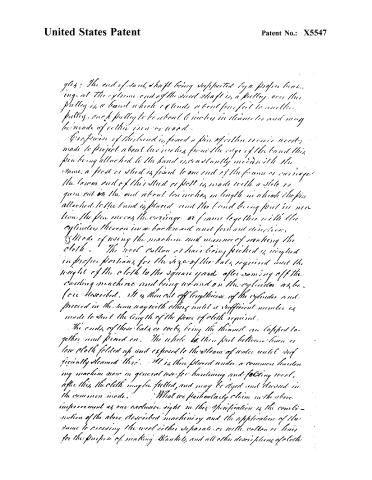
gles; The end of said shaft being supported by a proper bearing, at the extreme end of the said shaft is a pulley, over this pulley is a band which extends about four feet to another pulley, each pulley to be about 6 inches in diameter and may be made of cotton or wood.
For purpose of this band is fixed a pin of cotton or wire wires made to project about two inches from the edge of the band this pin being attached to the band is constantly moved with the same, a post or stud is fixed to one end of the frame or carriage the lower end of this stud or post is made with a slot or groove cut in the end about ten inches in length in which the pin attached to the band is placed and the band being put in motion the pin moves the carriage or frame together with the cylinder thereon in a back and forth and circular direction.
Mode of using the machine and manner of making the cloth. The wool cotton or hair being picked is weighed in proper portions for the size of the bales required and the weight of the cloth to the square yard after coming off the carding machine and being wound on the cylinder as before described. It is then cut off lengthwise of the cylinder and proceed in the same way with others until a sufficient number is made to suit the length of the piece of cloth required.
The ends of these bales or coots being the thinnest are lapped together and pinned on. The whole is then put between linen or tow cloth folded up and exposed to the steam of water until sufficiently steamed thus: It is then placed under a common hardening machine now in general use for hardening and felting wool, after this the cloth may be fullled, and may be dyed and dressed in the common mode.
What we particularly claim in the above improvement as our exclusive right in this specification is the combination of the above described machinery and the application of the same to crossing the wool either separate or with cotton or hair for the purpose of making Blankets, and all other descriptions of cloth
Page 5.
United States Patent
Patent No.: X5547
and table spreads for which the rooping of the wool by machinery is useful or necessary without spinning or weaving.
We also claim the principle of rooping the wool, cotton, or hair by machinery, also the use of one or more carding machines placed in a row or at right angles, as applied to the making of cloth or felt out of wool, wool and cotton, or cotton alone, without spinning or weaving, in the mode above specified by our machinery.
We also claim the above mode specified for hardening and the application of fulling as applied to the above description of felted cloths.
In witness whereof we have hereunto set our hands this twenty fifth day of April 1829.
Ford Wilhipes
Mrs. Chas. G. Ruggles
William Underdonk Jr.
Schemiah Keese
Daniel Taylor
(1296 Words)
(Patented 27 June 1829)
Page 6.
United States Patent
Patent No.: X5547
NO PRINTED SPECIFICATIONS AVAILABLE
Peck & Taylor.
Forming Bats.
Patented Jun. 27, 1829
Fig. 1

Fig. 2

Published accounts: journal notice
Notice in the monthly list of patents
Journal of the Franklin Institute, new ser., vol. 4 (1829), p. 191 · View the page
60. For an improvement in manufacturing and Ornamenting of Combs; Ebenezer Mustin, Philadelphia, June 27.
About this record
- Patentee
- the Journal of the Franklin Institute, Journal
- Date
- the Name and Date index of patents, USPTO records, Jim Shaw's X-patent list
- Invention
- the Name and Date index of patents
- Listed in
- the Name and Date index of patents, USPTO records, Jim Shaw's X-patent list, the Journal of the Franklin Institute, Burke's List of Patents (1847)
- The patentee's full name comes from the Franklin Institute's journal.
- The residence comes from the Franklin Institute's journal.
- Burke's 1847 Patent Office list gives the same patent.