

Drawings and documents
National Archives restored drawings: drawing
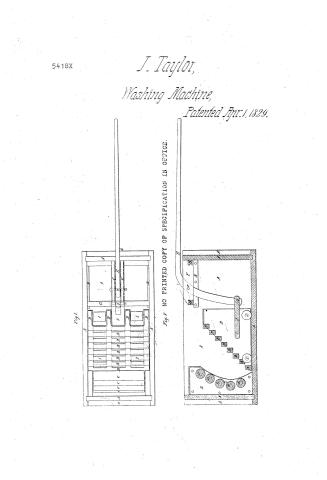
John Taylor's Patent Drawing for a Washing Machine

National Archives, Restored Patent Drawings (Record Group 241) · Full-size scan at the National Archives · Catalog record
Show the text on the drawing Hide (92 words)
Words on the drawing as machine-read by the National Archives; not checked. Useful mainly for searching.
LAUNDR / LaWashing Mach's / POUNDERS. / 2. / JOHN TAYLOR'S S / 5418-+ / WASHING machine. / Patented 1st April. 1829. / FIG. 1. / PLAN. / A. / D. / I. / I. / GE. / A. / D. / F. / C. / C. / C. / C. / B. / B. / B. / J. / Jr / E. / b. / D. / I. / I. / D. / H. / A. / FIG. 2. / SECTION. / "aken from a to b, on the plan. / E. / OIR / Oe. / F. / G. / G. / O 19. / K. / A. / A. / A.A. / D. / Scale. 3 inches to a foot. / J. / oj / I. / I. / A.
USPTO scan
The patent as scanned by the USPTO
-
 Page 1
-
 Page 2


U.S. Patent and Trademark Office · Google Patents
Show the transcription Hide (135 words)
Machine transcription (LightOnOCR) of the pages as scanned by the USPTO, most of them the handwritten copies made when the records were restored after the 1836 fire. Not checked; it can misread handwriting, so compare it with the scan.
Page 1.
5418X
J. Taylor,
Washing Machine,
Patented Apr. 1, 1829.
Fig. 1.
Fig. 2.
NO PRINTED COPY OF SPECIFICATION IN OFFICE.
Page 2.
United States Patent Office
PTO - BOYERS, PA Duty Station
MISSING PAGE TEMPORARY NOTICE
PATENT # 5418X FOR ISSUE DATE 4-1-1829
HAS BEEN SCANNED, BUT WITH MISSING PAGE(S). UPON RECEIVING OF MISSING PAGE(S), THE ENTIRE DOCUMENT WILL RE RESCANNED.
PLEASE CALL IMAGE DATA ADMINISTRATION STAFF OF 557-6154 IF YOU HAVE A QUESTION. ASK FOR DAVE GROOMS, ANITA YOUNG OR POLA JONES.
THIS NOTICE IS FOR THE MISSING PAGE CONTAINING:
COLUMN # All Text
Data Conversion Operation
Boyers, Pa
Published accounts: journal notice
Notice in the monthly list of patents, with remarks
Journal of the Franklin Institute, new ser., vol. 4 (1829), p. 44 · View the page
4. For a Washing Machine; John Taylor, Amherst, Hillsborough county, New Hampshire, April 1.
Remarks. This differs considerably from most of the washing machines which we recollect to have seen. A box, or trough, is made to hold the water and the clothes; across one end of this box, five or more rollers are placed, turning freely on their axes; these stand one above the other, either vertically, or forming a concave towards the body of the trough; against these, the clothes are to be pressed, by means of a carriage running backward and forward within the trough. This carriage traverses upon wheels or rollers; the front of it, or that part which is toward the rollers, is formed of square bars of wood, usually eight in number; these retire back, so as to give to that part of the carriage the form of a step-ladder; the lower step may pass up to the line of the rollers, when the upper one will recede to a considerable distance, as the retiring steps form an angle of about 45° with the horizon. This carriage is worked backwards and forwards, by means of a bent lever attached to it, and working upon a pin towards the back end of the trough, beyond which it projects, and is actuated like a pump handle: between the rollers, and the bars, which form the front of the carriage, spaces are left to allow the soap-suds to pass freely. > "The box should be about half filled with water, or lixivium, for washing. Then, as many clothes as on experience shall be found convenient, are to be put into the machine. The lever should then be moved with a moderate motion. When the end is depressed, the lower bar will be brought near to the lower roller; in doing this, the clothes will rise upon or against the rollers, which readily turn on their gudgeons, and facilitate the rising of the clothes. When the bars recede, the top part of the clothes will fall over, and on the return of the bars, the lower ones will come first in contact with the clothes fallen over. By repeating this, each part of the clothes will, in turn, be pressed by each part of the bars and rollers, and with a small portion of the time and labour bestowed in the modes hitherto in use, the clothes will be perfectly cleansed."
About this record
- Patentee
- the Journal of the Franklin Institute, Journal
- Date
- the Name and Date index of patents, USPTO records, Jim Shaw's X-patent list
- Invention
- the Name and Date index of patents
- Listed in
- the Name and Date index of patents, USPTO records, Jim Shaw's X-patent list, the Journal of the Franklin Institute, Burke's List of Patents (1847)
- The patentee's full name comes from the Franklin Institute's journal.
- Burke's 1847 Patent Office list gives the same patent.