

Drawings and documents
National Archives restored drawings: drawing
John Thorp's Patent Drawing for a Machine for Winding Yarn on Shuttle Bobbins

National Archives, Restored Patent Drawings (Record Group 241) · Full-size scan at the National Archives · Catalog record
Text on the drawing
Words on the drawing as machine-read by the National Archives; not checked. Useful mainly for searching.
28. CORDAGI / WINDING BOBBINS / 2. Weft Wind. / Hift Hand Winding / Vol. 8.7173, / 01- / CLASSIFICATION / John Therpe / 5408-+ / of / Winding yam on Shuttle botins. / patented 20th March 1829. / References / A. bobin showing the manner of winding / the spire from end to end. / B. spendle. C cop rail. rod for elevating / the cop rail. / E leaver for dilto. E. cam wheel acting on leaver E E' / 1/2 / Patent office 20. Apl 1841 / Made under the direction of the Commisioner / of Patients in conformity with acts March / 1837. / Commitsioner of Patents / G-hdelt delt
USPTO scan
The patent as scanned by the USPTO
-
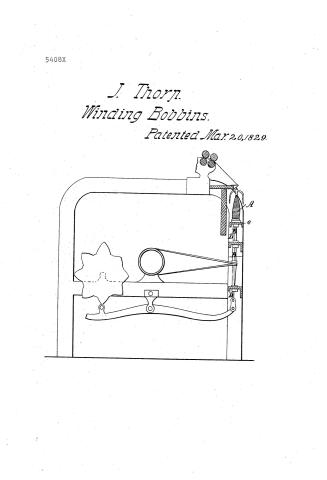 Page 1
-
 Page 2


U.S. Patent and Trademark Office · Google Patents
Transcription
Machine transcription (LightOnOCR) of the pages as scanned by the USPTO, most of them the handwritten copies made when the records were restored after the 1836 fire. Not checked; it can misread handwriting, so compare it with the scan.
Page 1.
5408X
J. Thorn.
Winding Bobbins.
Patented Mar. 20, 1829.

Page 2.
United States Patent Office
PTO - BOYERS, PA Duty Station
MISSING PAGE TEMPORARY NOTICE
PATENT # 5408X FOR ISSUE DATE 3-20-1829
HAS BEEN SCANNED, BUT WITH MISSING PAGE(S). UPON RECEIVING OF MISSING PAGE(S), THE ENTIRE DOCUMENT WILL BE RESCANNED.
PLEASE CALL IMAGE DATA ADMINISTRATION STAFF OF 557-6154 IF YOU HAVE A QUESTION. ASK FOR DAVE GROOMS, ANITA YOUNG OR POLA JONES.
THIS NOTICE IS FOR THE MISSING PAGE CONTAINING:
COLUMN # All Text
Data Conversion Operation
Boyers, Pa
Published accounts: journal notice
Notice in the monthly list of patents, with remarks
Journal of the Franklin Institute, new ser., vol. 3 (1829), p. 417 · View the page
26. For the manner of Forming the Spire, or Roll of Yarn, on a Weaver's, or Shuttle, Bobbin; John Thorp, Providence, Rhode Island, March 18.
Remarks. Several of Mr. Thorp's improvements will be made known in an early number, agreeably to our several notices to that effect. They are now in the hands of the engraver: the above will appear among them.
Published accounts: journal notice
Notice in the monthly list of patents, with remarks
Journal of the Franklin Institute, new ser., vol. 4 (1829), p. 125 · View the page
The claim is to all these, and we fear, therefore, that it is too broad. Cranks have been balanced a thousand and one times; faced wheels to work by their friction are acknowledged not to be new, but are claimed as applied to heavy machinery. Query, at what increase of size does an old contrivance become a new invention? The veneer saw wedge for a straight saw, appears to us to be the best of these arrangements, but if not found in good company, its influence will not be sufficiently redeeming even to save itself from legal condemnation, whatever may be the goodness of its physical properties. : SPECIFICATIONS OF AMERICAN PATENTS. Specification of a patent for an improvement in the manner of forming the Spire, or Roll of Yarn, on a Weaver's, or Shuttle Bobbin. Granted to JOHN THORP, of Providence, Rhode Island, March 18th, 1829.
Remarks. THE usual method, now practised, of forming the roll of yarn on a shuttle bobbin, is, to begin at the head of the bobbin, and fill it to its full diameter, and then proceed onward towards the point of the bobbin, keeping the point of the yarn all the way in a conical shape; this is done by short vibrations of the bobbin-rail, or lifter, (so called,) together with one other slow and regular motion moving the bobbin downward, as it fills with yarn. And when the bobbins are filled to the point, or, in other words, when the bobbin-rail has fallen to its lowest position, the machinery then requires to be placed back again as it originally was, at the commencement of filling the bobbin; consequently all the bobbins require shifting at one time, whether they are full or not; and, in altering the size of the yarn, require an alteration in said regular motion. But, in the improvement, no alteration is necessary, either in the commencement of filling the bobbin, or in the different sizes of the yarn, as the vibrating, or traverse, motion, which spreads the yarn over the bobbins, always traverses the whole length of them, varying only at the point of the bobbin, at which place the traverse motions reach, or extend, one beyond another, for six or more vibrations in succession, and then returning, alternately forming a conical point to the spire of the yarn. This motion and manner of filling a bobbin, is nearly the same as that used in the common throsel or spinning frame, (excepting that the bobbins are filled moderately tapering, and with the above described variations.) There are various ways to produce the above described variations in the traverse motion-the following is one selected from a number, as being the most handy and convenient, and requiring but little alteration from the common throsel, or spinning frame-that is, to substitute a cam-wheel (in the place of the common heart) of sufficient size to contain on its surface, six or more cams, projecting from the wheel, and acting on the same lever, or levers, which said heart acted on. These cams are similar in shape to the point of a common heart, and are of different lengths, each one projecting further from the wheel, or its centre, than the former, carrying the vibrating, or bobbin-rail, further, or lower down, at one time than at another, forming a conical point to the spire, or roll of yarn, as above described. It is necessary that the point of the yarn should be formed by the points of the cams, so that a quicker motion may be gained, which is necessary in forming such point. The above described manner of forming the spire, or roll of yarn, on a weaver's, or shuttle bobbin, and the application of the above improvement to the filling frame and throsel, I claim as my invention, desiring an exclusive property therein, and in the application of said invention and improvements to all and any spinning frame, or frames, that are, or may be, constructed for the purpose of spinning on a weaver's, or shuttle bobbin, &c. JOHN THORP. THORP'S Improvement in forming the Spire, &c. : 127 Fig. 1. Fig. 2. E D G E A B F A FEDCHA Description of the Figures. Fig. 1. Represents a sketch of the lever and appendages of a common heart motion (so called) used in the common spinning frames, for the purpose of elevating, and giving to the bobbin the proper traverse, or vibrating, motions; also of a cam wheel, which is substituted for the common heart, for the express purpose of varying the length of the traverse, or vibrating motions at the point of the bobbin, so that a conical form should be given to the point, or spire, of yarn at that place.
About this record
- Patentee
- Jim Shaw's X-patent list
- Date
- the Name and Date index of patents, USPTO records, Jim Shaw's X-patent list
- Invention
- the Name and Date index of patents
- Listed in
- the Name and Date index of patents, USPTO records, Jim Shaw's X-patent list, the Journal of the Franklin Institute, Burke's List of Patents (1847)
- The Franklin Institute's journal spells the name differently.
- The residence comes from the Franklin Institute's journal.
- The Franklin Institute's journal gives a different date.
- Burke's 1847 Patent Office list gives the same patent.
- Burke's 1847 Patent Office list gives a slightly different date; the date shown follows the standard lists.