

Drawings and documents
USPTO scan
The patent as scanned by the USPTO
-
 Page 1
-
 Page 2
-
 Page 3
-
 Page 4


U.S. Patent and Trademark Office · Google Patents
Transcription
Machine transcription (LightOnOCR) of the pages as scanned by the USPTO, most of them the handwritten copies made when the records were restored after the 1836 fire. Not checked; it can misread handwriting, so compare it with the scan.
Page 2.
United States Patent
Patent No.: X5405
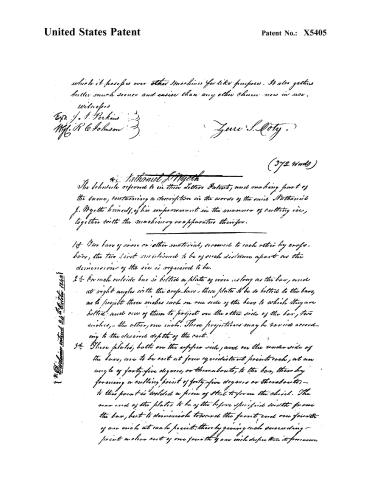
which it possesses over other machines for like purposes. It also gathers butter much sooner and easier than any other churn now in use.
Witnesses
Expt. J. T. Perkins
Maj. R. C. Johnson
Gene S. Coty.
(372 words)
Jathaniel J. Myerth
The schedule referred to in this Letters Patent, and making part of the same, containing a description in the words of the said Nathaniel J. Myerth himself, of his improvement in the manner of cutting ice, together with the machinery or apparatus therefor.
1st Two bars of iron or other material, secured to each other by cross-bars, the two bars mentioned to be of such distance apart as the dimension of the ice is required to be.
2d On each outside bar is bolted a plate of iron as long as the bar, and at right angles with the cross-bars—these plates to be so bolted to the bars, as to project three inches each on one side of the bars to which they are bolted, and one of them to project on the other side of the bar, two inches,—the other, one inch. These projections may be varied according to the desired depth of the cut.
3d These plates, both on the upper side, and on the under side of the bars, are to be cut at four equidistant points each, at an angle of forty-five degrees, or thereabouts, to the bar, thereby forming a cutting point of forty-five degrees or thereabouts;—to this point is welded a piece of steel to form the chisel. The inner end of the plates to be of the before specified widths from the bar, but to diminish toward the front end one fourteenth of an inch at each point; thereby giving each succeeding point a clear cut of one fourteenth of an inch deeper than its predecessor.
This Specification entered 24th October 1865
Page 3.
United States Patent
Patent No.: X5405
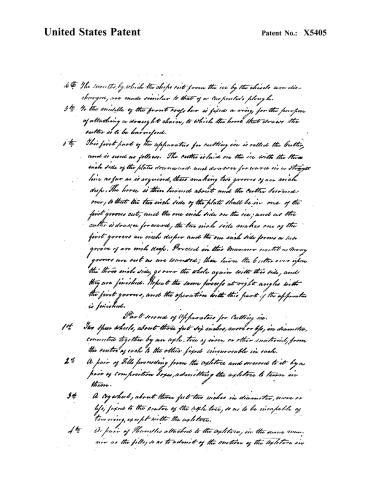
4th The irons, by which the chips are cut from the ice by the chisels are dis-
charged, are made similar to that of a carpenter’s plough.
5th To the middle of the front cross bar is fixed a ring, for the purpose
of attaching a straight chain, to which the horse that draws the
cutter is to be harnessed.
6th This first part of the apparatus for cutting ice is called the cutter,
and is used as follows. The cutter is laid on the ice with the three
inch side of the plate downward and drawn forward in a straight
line as far as is required, thus making two grooves of an inch
deep. The horse is then turned about and the cutter turned
over, so that the two inch side of the plate shall be in one of the
first grooves cut, and the one inch side on the ice; and as the
cutter is drawn forward, the two inch side makes one of the
first grooves an inch deeper and the one inch side forms a new
groove of an inch deep. Proceed in this manner until as many
grooves are cut as are wanted; then turn the cutter over upon
the three inch side, go over the whole again with this side, and
they are finished. Repeat the same process at right angles with
the first grooves, and the operation with this part of the apparatus
is finished.
Part second of Apparatus for Cutting ice.
1st Two gear wheels, about three feet six inches, more or less, in diameter,
connected together by an axle-tree of iron, or other material, from
the centre of each to the other, fixed immovable in each.
2nd A pair of fells proceeding from the axle-tree and secured to it by a
pair of composition boxes, admitting the axle-tree to turn in
them.
3rd A cog-wheel, about three feet two inches in diameter, more or
less, fixed to the centre of the axle-tree, so as to be incapable of
turning, except with the axle-tree.
4th A pair of flanges attached to the axle-tree, in the same man-
ner as the fells, so as to admit of the motion of the axle-tree in
Page 4.
United States Patent
Patent No.: X5405
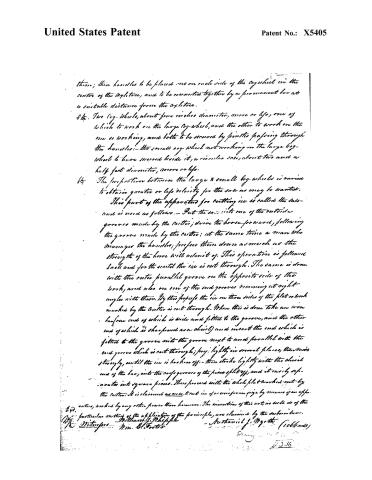
therein; these handles to be placed one on each side of the cog-wheel in the center of the axle-tree, and to be connected together by a permanent bar at a suitable distance from the axle-tree.
5th. Two cog-wheels, about four inches diameter, more or less, one of which to work on the large cog-wheel, and the other to work on the one so working, and both to be secured by pins passing through the handles: the small cog-wheel not working on the large cog-wheel to have secured beside it, a circular saw, about two and a half feet diameter, more or less.
6th. The proportion between the large & small cog-wheels is varied to obtain greater or less velocity for the saw as may be wanted.
This part of the apparatus for cutting ice is called the saw—and is used as follows.—Put the saw into one of the outside grooves made by the cutter; drive the horse forward, following the groove made by the cutter; at the same time a man who manages the handles, forces them down as much as the strength of the horse will admit of. This operation is followed back and forth until the ice is cut through. The same is done with the other parallel groove on the opposite side of the work, and also on one of the end grooves running at right angles with these. By this process the ice on three sides of the flat is work marked by the cutter is cut through. When this is done take an iron bar (one end of which is wide and fitted to the groove, and the other end of which is sharpened as a chisel) and insert the end which is fitted to the groove into the groove next to and parallel with the end groove which is cut through; pry lightly in several places, then more strongly, until the ice is broken off—then strike lightly with the chisel end of the bar, into the corresponding parts of the piece split off, and it easily separates into square pieces. These proceed with the whole flat marked out by the cutter. It is claimed as new, to cut ice of a uniform size by means of an apparatus, worked by any other power than human. The invention of this art, as well as of the particular method of the application of the principle, are claimed by the subscriber.
Witnesses: William J. McFadden
Mr. E. Foster
- Nathaniel J. Myotte (106666)
Published accounts: journal notice
Notice in the monthly list of patents, with remarks
Journal of the Franklin Institute, new ser., vol. 3 (1829), p. 417 · View the page
27. For the Manner of Cutting Ice, together with machinery therefor; Nathaniel F. Wyeth, Cambridge, Middlesex county, Massachusetts, March 18.
Remarks. The machinery for cutting ice described in this patent, consists principally of two distinct instruments, the first operating as a straight, the second as a circular saw, both to be acted upon by horse power. The first consists of a quadrangular frame of iron, about three feet in length, and twenty inches in width. Plates of steel, or of iron pointed with steel, are fastened along the two opposite edges of this frame, so as to project from, and stand at right angles with each side of it, forming the plough, or saw, with which the ice is first to be cut. At the first angle, this saw projects but one inch from the frame, and increasing an inch in each successive angle, projects four in the last. On each edge there are but four cutting points, or teeth, each cutting one-fourth of an inch deeper than that which precedes it. This frame is to be drawn along upon the surface of the ice, when two grooves will be cut about twenty inches apart, and one inch deep. By turning the frame so that the saws may successively run in these grooves, they are cut to the depth of four inches. The field of ice is then crossed, and thus divided into squares, when the second instrument is to be used. The second instrument consists of a two wheeled carriage; the wheels having iron teeth on their rims, to take hold of the ice, and VOL. III. No. 6. -JUNE, 1829. 53 1 cause them to revolve. These wheels are firmly fixed upon a common axle; upon the middle of this axle is a toothed wheel, from which motion is communicated to a circular saw, at the tail of the carriage; this saw is about two feet in diameter. The whole is to be drawn like a plough, a man following, and by means of handles guiding, and depressing or elevating the saw. "It is claimed as new, to cut ice of a uniform size, and by means of an apparatus worked by any other power than human; the invention of this art, as well as the particular mode of the application, are claimed by the subscriber."
About this record
- Patentee
- DATAMP
- Date
- the Name and Date index of patents, DATAMP, USPTO records
- Invention
- DATAMP
- Listed in
- the Name and Date index of patents, DATAMP, USPTO records, Jim Shaw's X-patent list, the Journal of the Franklin Institute, Burke's List of Patents (1847)
- Burke's 1847 Patent Office list gives the same patent.