

Drawings and documents
National Archives restored drawings: drawing
Willard Robinson's Patent Drawing for a Machine for Grinding Steel Dies for Metal Buttons


National Archives, Restored Patent Drawings (Record Group 241) · Full-size scan at the National Archives · Catalog record
Text on the drawing
Words on the drawing as machine-read by the National Archives; not checked. Useful mainly for searching.
Sheet 1. ING & POLIEHING / 3 POLIZIEMI / DO / plut / Metal: / METAL: / to, / shut / Angular Surfaces. / Curved Surfaces. / 2 Steets, Sheet 1. / Willard Robinson. / Also / Grinding Steel Dies for Metal Buttons. / Patented March 3.1829. / CLASSIFICATION / 5385-7 / DIVISION. / Fig.1 / maybe social / wir, n fit of mulal or prefers capper crocus & H.O. / Planer with oil ozwata. May grind numers or buses
Sheet 2. W ROBINSON / Grinding Steel Dies used in the Manufacture / 2,Sheets, Sheet2. / CLASSIFICATION / metal curved / 5385-4 / DIVISION / Palented 3d March 1829. / B. A. Chuck Gradualed. with. Die Esution-Tiod ma u. of a equare read of stid ser other smitable + is about 1/2 inch gaus / C. D. The End Fit of do not re de civing of any the shank hand of Fit material as wood, copper proferred. / II. Shaing-rest 07 standard / Q pration- / F. Joint of de / The die is placed in the check A. the lit D / G. Upper Hoop of de with 11011115 to enter Dents in Rod / by moving the rod B. The check and being / of the rodBand Ca the moved hudi olved / H. Stiding-rest with.Horizantal Ber / a concane receives ground in lower surface and of the as / K. Bor of Is athe / F low of amery and fer grinding crocus for falishing. / This instrument may be used for guinding concane wirrow / of gluss on metal. alsofor aftical glasses. / OR / Patent Office Ma ch 29th 339 / cllade una it direction of the commission 07 natures / in conformuly with ach 3d March 1837- / Mmr / Commissioner of Na
Sheet 3. 11. POLISHING, / SOFTAL / Bet 2shuts shut 2 2. / VH / Curved Surfaces. / 5385Y Melecl SCleroes / Willard Robinson / Grinding Steel Dies for Metal Buttons. Patented 3Ma / Patented March 3.1829. / Vol,8,p.81. / Figh2, / Eig.3. / Made under in der the direction of the Commip / Patent Office 31ˢᵗ / of patents in conformity with act of bongrefs 3.Marg / Md / Commiponer of Paten
USPTO scan
The patent as scanned by the USPTO
-
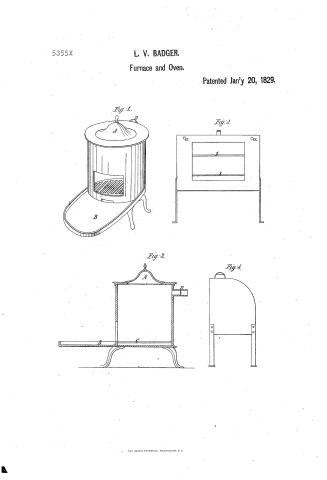 Page 1
-
 Page 2
-
 Page 3


U.S. Patent and Trademark Office · Google Patents
Published accounts: journal notice
Notice in the monthly list of patents, with remarks
Journal of the Franklin Institute, new ser., vol. 3 (1829), p. 407 · View the page
5. For an improvement in the mode of Grinding Steel Dies used in the manufacture of metal buttons; Willard Robinson, Attleborough, Bristol county, Massachusetts, March 3.
Remarks. "Dies for stamping buttons, are made of hardened steel of a cubical shape, one side of which being formed to the figure intended to be impressed, and to the shape intended to be given to the button. This process has, heretofore, been effected with the use of the graver and lap; a mode slow of operation, and subject to inaccuracies. My improved method of making said dies, is simple, much more perfect, and more especially so, when a rim perpendicular to the face of the button is to be raised upon its edge." After these preliminary remarks, the patentee states that the first steps in forming the die, are the same as those heretofore known; that is, the cubical block is fixed in a chuck in the lathe, with its face side sufficiently exposed to be turned nearly to the form intended, by means of the graver, after which the improved apparatus is to be employed for giving an accurate finish. This apparatus is called the "graduated button rod," which is made and used as follows:There is a rod of iron, steel, or other metal, about half an inch square, and from three inches to several feet in length. This rod has indentations made by a prick punch, on opposite sides of it throughout its whole length, and at small distances apart. One end of it is drilled to the depth of an inch, to receive a piece of copper, or other metal, called a fit, which, by the aid of emery and crocus, serves to grind and polish the die. A front centre, or head, capable of sliding upon the bar of the lathe, has a perforation, or mortise, through which the rod may pass, and sufficiently large to admit of the motion which it is to receive. By means of a steel point projecting upwards, and an adjusting screw through the top of this head, the rod may be confined so as to vibrate laterally, in consequence of the points taking into opposite prick punched holes; the distance from the set being regulated according to the concavity of the face of the die. A rest, standing in front of the die, supports the end of the rod, containing the fit, and serves as a guide in moving it backwards and forwards. There is a sort of hinge joint in the front head, to admit of raising the rod, to examine the die, without the necessity of altering its adjustments. "Although my said improvement is intended principally to be used in the formation of steel dies, for stamping buttons, it may also be usefully applied to the purpose of grinding concave mirrors of glass, or metal, also for optical glasses." Without intending to intimate that a suggestion like the foregoing would vitiate the patent, we will observe that the validity of these instruments is frequently endangered by the desire to claim as much as possible. The safe course in all cases, is, to claim no more than the essential features of the new machine, as applied to purposes with which the patentee is familiar. We have no doubt, that an arrangement something like that described, has been applied to various purposes in the lathe. The two large brass mirrors made for Dr. Hare, of Philadelphia, and used by him in his experiments on the radiation of heat, were, at the suggestion of the Editor, turned and ground to a true curvature, by tools fixed upon a rod, and vibrating like that used for grinding the dies as above described.
DATAMP: illustration
Illustrations from DATAMP


DATAMP (Directory of American Tool and Machinery Patents), via the Internet Archive · Archived DATAMP page
About this record
- Patentee
- the Journal of the Franklin Institute, Journal
- Date
- the Name and Date index of patents, DATAMP, USPTO records
- Invention
- DATAMP
- Listed in
- the Name and Date index of patents, DATAMP, USPTO records, Jim Shaw's X-patent list, the Journal of the Franklin Institute, Burke's List of Patents (1847)
- The patentee's full name comes from the Franklin Institute's journal.
- in_burke