

Drawings and documents
National Archives restored drawings: drawing
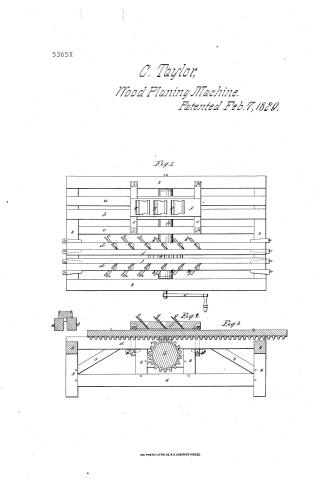
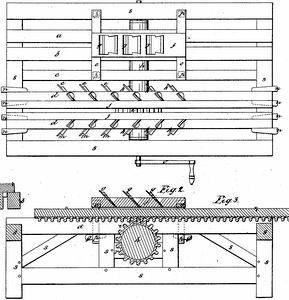
Caleb Taylor's Patent Drawing for a Machine for Planing, Matching, and Grooving Boards

National Archives, Restored Patent Drawings (Record Group 241) · Full-size scan at the National Archives · Catalog record
Text on the drawing
Words on the drawing as machine-read by the National Archives; not checked. Useful mainly for searching.
143. WOOD WORKING / 2. GENERAL WORK MACHINES / [173] Planing. / $250 / Caleb Saytor of / 5365-/ / Machine for plancing, matching & grooring boards Sumber / Patented Feb: ofth 1829 / Fig 1. / Fig 2 / Section of larriage / and Bed- timbers. / Carriage / Figs / fe / is / is / Benne / del / a.b. a Bed timbers c. Plate e.e brofs timbers References. for raising the top plane by means ofpp.-f.Top- / plane stock g.g.g. Plane irons - h shaft i Spur wheel. jj Bed-timbers. - d.d. Plane stocks / K.K.K.K.Kk. Jointers 1.1.1 Grove m Fongue n Wedges a Crank. / p.p.p.p Tongued - 9.9 Keys r. Head block se. Frame tembers. / atent of Office 14 July 1838 / Made under the direction of the Commipion or / Patents in conformity with act 3. March 1834 / Name L Ellmor / Commifsioner of Patent
USPTO scan
The patent as scanned by the USPTO
-
 Page 1
-
 Page 2


U.S. Patent and Trademark Office · Google Patents
Published accounts: journal notice
Notice in the monthly list of patents, with remarks
Journal of the Franklin Institute, new ser., vol. 3 (1829), p. 335 · View the page
6. For a Machine for Planing, Matching, or Grooving Boards; Caleb Taylor, Collins, Erie county, New York, February 7.
Remarks. A long frame is made, with strong parallel timbers, passing from end to end, and dressed with great truth. The boards to be planed are placed upon carriages, which slide between these timbers. A carriage consists of a single piece of timber, of sufficient width to receive the board; it may be about 20 feet long, and five or six inches thick; on the under side of the carriage, there are cogs to be acted upon, by a spur wheel, in the manner of the carriage of a saw mill. The plane stock is to be fixed in its place, by wedges or screws; it is to be from one to two feet wide, and four or five feet long; the plane American Patents for February, with Remarks. irons are to be the whole width of the board to be planed; three, four, or five irons are to stand one behind the other, being set so that each successive iron shall cut the thickness of a shaving deeper than the preceding. The irons are to be fixed in the stock, in the usual way; the board, or plank, is held in its place by hooks, with teeth, resembling those in common use. There is to be a second carriage, for the purpose of jointing, grooving, or matching, the edges of flooring plank; the jointers, with their successive irons, are placed so as to operate on each edge of the plank at the same time, whilst the match planes, with a sufficient number of irons to cut the tongue and groove to the proper depth, succeed to the jointers. For the lighter kinds of work, the machine is to be moved by hand; but water, or other power, is in general to be employed. There are some patented machines in operation, and which have been very successfully used, for making sash, and other small work, which, in their general operation, resemble the foregoing; but, although we may cut a twig, by a single stroke of a penknife, we should be foiled, in the attempt to fell the sturdy oak, by a single blow of an axe, however large we made it, and whatever power we applied; and we think that, in like manner, the patentee must fail in using four or five plane irons, from a foot to eighteen inches wide, each of which is to take a shaving, at the same time, from the same plank. The power to be applied must be immensely great, and were the frame of iron, instead of wood, its spring would be likely to defeat the hopes of the projector, were this the only difficulty; but these, upon the plan proposed, appear to us to be numerous and insurmountable, as they arise not from the structure of the machine merely, but from the nature of the stuff which is to be acted upon. There are but few boards, which do not require some coaxing, when planed by hand, and these, we apprehend, would exhibit strong evidences of their perverseness, if forcibly assailed in the way proposed by the patentee.
DATAMP: illustration
Illustrations from DATAMP

DATAMP (Directory of American Tool and Machinery Patents), via the Internet Archive · Archived DATAMP page
About this record
- Patentee
- DATAMP
- Date
- the Name and Date index of patents, DATAMP, USPTO records
- Invention
- DATAMP
- Listed in
- the Name and Date index of patents, DATAMP, USPTO records, Jim Shaw's X-patent list, the Journal of the Franklin Institute, Burke's List of Patents (1847)
- in_burke