

Drawings and documents
National Archives restored drawings: drawing
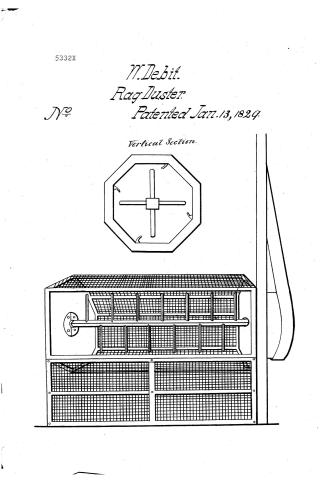
William Debit's Patent Drawing for a Rag Duster

National Archives, Restored Patent Drawings (Record Group 241) · Full-size scan at the National Archives · Catalog record
Text on the drawing
Words on the drawing as machine-read by the National Archives; not checked. Useful mainly for searching.
10. CARDING, / Pickers. / 2. / CLASSIFICATION / 5332 X / WILLIAM DEBIT'S / DIVISION. / Rad. Duster / a Vertica / Section / Patented 13th January 1829.00 S / a View of The Clachine for cleaning Mags; invented / by William L 6 ebit. - One Octagonal side of the / I uster being thrown open
USPTO scan
The patent as scanned by the USPTO
-
 Page 1
-
 Page 2


U.S. Patent and Trademark Office · Google Patents
Published accounts: specification
Specification printed in the Journal of the Franklin Institute
Journal of the Franklin Institute, new ser., vol. 3 (1829), p. 270 · View the page
Text of the specification as printed in the Journal, from OCR; not proofread.
Specification of a patent for a machine for the Cleaning of Paper Rags, by which great expense and labour are saved. Granted to WILLIAM DEBIT, East Hartford, Connecticut, January 13, 1829. ATTACH several knives horizontally to the ribs of the screen, or duster, which may be varied in number, length, and width, according to the size of the screen, or duster. The screen, or duster, then revolves in the common way, by water or other power, on hollow axles. In addition to this, an iron shaft passes through the centre of the screen, or duster, and hollow axles; this shaft has a number of knives inserted in it, which are secured by wedges, or nuts, and revolves in a contrary direction to the screen, or duster. Twelve knives in the iron shaft, and six knives on the ribs, I have found well adapted to accomplish the object; with a revolution of the screen, or duster, from 15 to 20 times a minute, and of the iron shaft, from 40 to 50 times a minute, but the exact number of either is not thought to be material. The drawing deposited in the patent office, will show the improvements, as well as the external form of the screen, or duster. The latter, of course, is not claimed as my invention. By my improvement, there is effected a great saving of labour in the cleaning of rags, and preparing them for use in the manufacture of paper. WILLIAM DEBIT. Remarks on an article in the Journal of the Franklin Institute for February last, on Fulminating Powders, and their use in Fire Arms. By JOSHUA SHAW, Esq. TO THE EDITOR. SIR, I am induced, from reading an article in the Journal of the Franklin Institute, on the subject of certain fulminating powders, written by Lieut. P. Schmidt, of the Prussian service, to send you some remarks, which are the result of much experience upon the point in question. I hope, however, that you will not expect from an operative artist, any thing which is very systematic or scientific, for in this case you will be disappointed, as I am equally far from possessing either the ability or the inclination to furnish it. To me, and to many more practical men, the learning which writers appear anxious to evince, seems to predominate over every thing else, and thus to destroy the utility of their labours. It is in vain to attempt to give instruction, excepting a language be used with which the pupil is in some degree familiar. In the paper to which I have alluded, Lieut. Schmidt, in speaking of the powder made from oxymuriate of potash, sulphur, and charcoal, observes, that it is made by adding together twelve parts of sulphur, ten of charcoal, and one hundred of the oxymuriate, and then proceeds to give the result of his experiments. My object at present, is, not to treat of the best mode of preparing the different fulminating powders, but rather to correct the false statements which are made respecting the utility of the different kinds. I will observe, however, that from long experience, I can aver that the proportions above given are not such as will produce the strongest powder from these materials. It is perfectly clear to me, that at the time the Lieutenant wrote, the subject was new to him, and, indeed, he speaks of the recent use of the copper caps in Germany. I have been in the habit of using copper caps for at least thirteen years, and for the last seven years have manufactured and sold them, at the rate of two millions annually. After speaking of various contrivances, he says, "besides these, other devices have been used for the purpose of igniting this kind of powder, yet they have all their defects, and offer so many difficulties in practice, as to have prevented their general introduction." It would then appear that we are, in this respect, much in advance of Germany, as we have had the prepared caps in almost universal use, for many years, and have never met with the difficulties complained of; this may have arisen, in a great degree, from our having fewer prejudices to contend with than the inhabitants of that country. Lieut. Schmidt alludes to the observations of Mr. Wright, of London, on the use of fulminating mercury, mentions his mode of filling the caps with this material, by means of an ivory rod, to which he objects as being both laborious and dangerous; he then recoinmends a plan of his own, as being much more safe and expeditious. Although this may be a subject of serious discussion between England and Germany, it must here create a smile only. The Lieutenant speaks of filling several thousands in a week; by means of an apparatus which I have invented, and long had in use, a little girl fills several thousand in the course of a few hours, every morning. In about four seconds, 500 of the caps are collected together and arranged for filling, and in about the same time an equal quantity of the powder is deposited in each; it is then, with great rapidity, secured by a cement which renders it impervious to water. It is said that difficulties have been experienced in England, in igniting gunpowder, by the fulminating mercury, and it appears that the labours of the German professors upon this subject, have resulted in their drawing conclusions altogether erroneous respecting the kind of fulminating powder which should be used in fire-arms. Fulminating silver may be considered as out of the question, on account of its price, and need not, therefore, be further noticed. With respect to that prepared with the oxymuriate, its destructive effects are such, as to forbid its use entirely. It soon rusts the lock, penetrates the pores of the iron, rendering it carious, and, consequently, liable to burst. We have long since abandoned the use of it altogether, and are not likely to resume it, in deference either to English or German opinions. It is plain that Lieut. Schmidt mistakes the meaning of the word effect, as used by Mr. Wright. The fulminating quicksilver makes a louder report than the ordinary fulminating powder, but will not fire the magazine at so great a distance. Its fire is rapid, but not elastic, or expansive, as it quickly condenses, and returns to the state of mercury: it is, however, certain, and presents no difficulties whatever. The most extraordinary part of the statement is, that the fulminating quicksilver is more corrosive than the oxymuriate preparation! With what difficulty do we sometimes arrive at the most simple truths. Nothing can be more gratuitous and false than the above conclusion. Mr. Forsyth of England expended, it is said, a hundred thousand pounds in his attempts to establish the use of the percussion magazine lock, in which he failed altogether, from the corrosive effects of the powder; the whole 14 years of his patent were devoted to this point. As soon as this period had terminated, Mr. Wright introduced the fulminating mercury, since which there has been no complaint whatever of the corrosion of locks and barrels, excepting from the use of imported caps, charged with the old materials. The cement used, is a point of much importance; gum benjamin and gum arabic, have been principally employed; the first is always soft, the latter attracts moisture; neither of them answers well. The French, to obviate the defects of both these, sought the remedy by enlarging the caps at the bottom, so that when the powder is introduced and dry, it is, as it were, dove-tailed in, and a smaller quantity of either of the foregoing ingredients will retain it. This lessened, but did not remove the evil. In America, the percussion gun has, in consequence of the manner in which the caps have been made here, been more generally employed than in England, although the guns themselves are the manufacture of that country. We have, it is true, ran counter to the rules established by the German officer and professors; for, although we may be less scientific in these matters, we know enough of the amusements of the field, to derive from our experience that information which suits us better than the most learned theories, and we even venture to adopt the suggestions of the former, although opposed by the deductions from the latter. Should you think proper, sir, to give this a place in your Journal, I shall again request a small place for some future observations, containing the practical results of my own experience, as it may interest a certain portion of your readers. Philadelphia, March 20, 1829. Yours, &c. JOSHUA SHAW.
Editor's remarks. We are glad that Mr. Shaw proposes to make some additions to the foregoing, as without such an intention we should not think the subject usefully handled as regards the public. What has been given, we are disposed to consider merely as a preface to what is to follow, and under this impression we have willingly inserted it. Mr. Shaw has told us that the recipe of Lieutenant Schmidt for the fulminating powder is not the best; that the modes of filling caps previously pursued, are inferior to his; that he has a more perfect cement than any which has been heretofore used, &c. &c.; all of which we are prepared to believe, and do indeed admit as a fact, and we hope that his next paper will be one of recipes and processes. We know that Mr. Shaw is able to communicate much useful information, and we presume that his next paper will justify this judgment in the opinion of our readers. ENGLISH PATENTS. To WILLIAM HALL, Merchant, for his invention of certain improvements in Machinery, or Apparatus, for Propelling Vessels. Enrolled June, 1827. THE object of the patentee, is, to dispense with the ordinary paddles employed for propelling vessels, and, indeed, of all machinery or apparatus applied on the outside of the vessel for the purpose of rowing or driving the vessel forward, by the mechanical force exVOL. III.-No. 4.-APRIL, 1829. 35 \ Improvements in the Construction of Furnaces. erted by paddles or oars against the water; to substitute in place of such contrivances, a jet or volume of water, driven out with force in a horizontal direction at the stern, the reaction of which against the water shall produce the impelling effect required, and drive the vessel in the opposite direction. In the lowest part of the vessel below the water line, a cylinder is placed vertically, which is open at the lower end to admit water into it through an aperture in the bottom of the vessel, but having a grating to exclude weeds, or any other floating substances. The top of this cylinder is closed with a cap, and rendered perfectly airtight. Within the cylinder there is a large screw placed vertically, the edges of the worm of which nearly touch the periphery of the cylinder. The screw is intended to revolve upon its axis, or upon pivots at top and bottom, and acting in the way of an Archimedes pump, to raise and force the water through the horizontal tube abovementioned, which leads from the upper part of the cylinder. The screw pump is made to revolve with great rapidity by a rigger affixed to the upper end of its axle, which is driven by a band, leading from a steam engine. A jet or volume of water is, by these means, projected with great force from the stern of the vessel, and by striking against the surrounding mass of fluid, in which the vessel floats, causes the vessel to be propelled forward, that is, in the opposite direction to the jet. It is proposed, under some circumstances, to employ reciprocating pumps to be driven by the steam engine within, which shall raise a volume of water from the bottom, and force it out at the stern. The attempt to propel vessels by the force of a jet of water driven from the stern, is not new; various modes of effecting this have been devised. Mr. Stedman Adams, of America, in 1811, obtained a patent for such a contrivance; and in 1820, Messrs. Lilley and Fraser obtained a patent for the same object (see the second volume of our first series, page 101.) If there is any novelty in the present plan, it is the introduction of the screw pump in a vertical position, for raising or forcing the water; although paddles of this form have been applied horizontally on the outsides of vessels. There is, however, no question but that the power expended in this way to raise the water, will have a considerable less beneficial effect than if applied directly to the working of paddles. [Lond. Journ. TO JAMES GILBERTSON, Grocer, for his having
Published accounts: journal notice
Notice in the monthly list of patents, with remarks
Journal of the Franklin Institute, new ser., vol. 3 (1829), p. 257 · View the page
8. For a machine for the Cleaning of Paper Rags, by which great expense and labour are saved; William Debit, East Hartford, Connecticut, January 13.
Remarks. (See the specification.)
Published accounts: journal notice
Notice in the monthly list of patents, with remarks
Journal of the Franklin Institute, new ser., vol. 3 (1829), p. 269 · View the page
A PAIR of stones is put in operation (by water, or any other convenient power,) somewhat similar to those of a grist mill, except that the lower stone is the runner, instead of the upper one, and DEBIT'S Machine for Cleaning Paper Rags. the face of the upper stone is concave, and the lower one convex, that they may clear themselves of the pummage the more readily, and thereby facilitate the grinding. The acclivity of the face of the convex stone forms an angle with the horizon, of about thirty degrees; the concavity in the face of the upper stone, is sufficiently greater than the convexity of the lower one, to admit an apple of the largest size between them at the eye, while they operate closely enough at the outer edge, or periphery, of the stone, to grind the apples to the required fineness. The eye of the upper stone, into which the apples feed, is twelve or fifteen inches in diameter; the hopper is placed directly over it, and the apples, by their gravity, are forced into the eye of the stone. By the motion of the lower stone, aided by the dress and the surfaces, each regularly descending from the eye to the periphery, the apples are passed rapidly through between them, and ground in a very superior manner. The puminage passes out freely on all sides, and falls into a vat beneath. A dress is given to the stones similar to grist mill stones, only rather deeper. Circular pieces of cast-iron, properly shaped as before described, or blocks of wood faced with cast-iron, or rods of wrought iron firmly bolted on the face of the said blocks, so as to give them the appearance and effect of dress, may be used instead of stones. The stones may be more or less concave or convex, as it may be desired to have the apples more or less rapidly passed through the mill. The diameter and dimensions of the stones may be varied to suit convenience, and the power intended to be applied. Less power is required to propel the mill when grinding apples than when grinding grain. DAVID D. DEMAREST. Specification of a patent for a machine for the Cleaning of Paper Rags, by which great expense and labour are saved. Granted to WILLIAM DEBIT, East Hartford, Connecticut, January 13, 1829.
Remarks. ATTACH several knives horizontally to the ribs of the screen, or duster, which may be varied in number, length, and width, according to the size of the screen, or duster. The screen, or duster, then revolves in the common way, by water or other power, on hollow axles. In addition to this, an iron shaft passes through the centre of the screen, or duster, and hollow axles; this shaft has a number of knives inserted in it, which are secured by wedges, or nuts, and revolves in a contrary direction to the screen, or duster. Twelve knives in the iron shaft, and six knives on the ribs, I have found well adapted to accomplish the object; with a revolution of the screen, or duster, from 15 to 20 times a minute, and of the iron shaft, from 40 to 50 times a minute, but the exact number of either is not thought to be material. The drawing deposited in the patent office, will show the improvements, as well as the external form of the screen, or duster. The latter, of course, is not claimed as my invention. By my improvement, there is effected a great saving of labour in the cleaning of rags, and preparing them for use in the manufacture of paper. WILLIAM DEBIT. Remarks on an article in the Journal of the Franklin Institute for February last, on Fulminating Powders, and their use in Fire Arms. By JOSHUA SHAW, Esq. TO THE EDITOR. SIR, I am induced, from reading an article in the Journal of the Franklin Institute, on the subject of certain fulminating powders, written by Lieut. P. Schmidt, of the Prussian service, to send you some remarks, which are the result of much experience upon the point in question. I hope, however, that you will not expect from an operative artist, any thing which is very systematic or scientific, for in this case you will be disappointed, as I am equally far from possessing either the ability or the inclination to furnish it. To me, and to many more practical men, the learning which writers appear anxious to evince, seems to predominate over every thing else, and thus to destroy the utility of their labours. It is in vain to attempt to give instruction, excepting a language be used with which the pupil is in some degree familiar. In the paper to which I have alluded, Lieut. Schmidt, in speaking of the powder made from oxymuriate of potash, sulphur, and charcoal, observes, that it is made by adding together twelve parts of sulphur, ten of charcoal, and one hundred of the oxymuriate, and then proceeds to give the result of his experiments. My object at present, is, not to treat of the best mode of preparing the different fulminating powders, but rather to correct the false statements which are made respecting the utility of the different kinds. I will observe, however, that from long experience, I can aver that the proportions above given are not such as will produce the strongest powder from these materials. It is perfectly clear to me, that at the time the Lieutenant wrote, the subject was new to him, and, indeed, he speaks of the recent use of the copper caps in Germany. I have been in the habit of using copper caps for at least thirteen years, and for the last seven years have manufactured and sold them, at the rate of two millions annually. After speaking of various contrivances, he says, "besides these, other devices have been used for the purpose of igniting this kind of powder, yet they have all their defects, and offer so many difficulties in practice, as to have prevented their general introduction." It would then appear that we are, in this respect, much in advance of Germany, as we have had the prepared caps in almost universal use, for many years, and have never met with the difficulties complained of; this may have arisen, in a great degree, from our having fewer prejudices to contend with than the inhabitants of that country. Lieut. Schmidt alludes to the observations of Mr. Wright, of London, on the use of fulminating mercury, mentions his mode of filling the caps with this material, by means of an ivory rod, to which he objects as being both laborious and dangerous; he then recoinmends a plan of his own, as being much more safe and expeditious. Although this may be a subject of serious discussion between England and Germany, it must here create a smile only. The Lieutenant speaks of filling several thousands in a week; by means of an apparatus which I have invented, and long had in use, a little girl fills several thousand in the course of a few hours, every morning. In about four seconds, 500 of the caps are collected together and arranged for filling, and in about the same time an equal quantity of the powder is deposited in each; it is then, with great rapidity, secured by a cement which renders it impervious to water. It is said that difficulties have been experienced in England, in igniting gunpowder, by the fulminating mercury, and it appears that the labours of the German professors upon this subject, have resulted in their drawing conclusions altogether erroneous respecting the kind of fulminating powder which should be used in fire-arms. Fulminating silver may be considered as out of the question, on account of its price, and need not, therefore, be further noticed. With respect to that prepared with the oxymuriate, its destructive effects are such, as to forbid its use entirely. It soon rusts the lock, penetrates the pores of the iron, rendering it carious, and, consequently, liable to burst. We have long since abandoned the use of it altogether, and are not likely to resume it, in deference either to English or German opinions. It is plain that Lieut. Schmidt mistakes the meaning of the word effect, as used by Mr. Wright. The fulminating quicksilver makes a louder report than the ordinary fulminating powder, but will not fire the magazine at so great a distance. Its fire is rapid, but not elastic, or expansive, as it quickly condenses, and returns to the state of mercury: it is, however, certain, and presents no difficulties whatever. The most extraordinary part of the statement is, that the fulminating quicksilver is more corrosive than the oxymuriate preparation! With what difficulty do we sometimes arrive at the most simple truths. Nothing can be more gratuitous and false than the above conclusion. Mr. Forsyth of England expended, it is said, a hundred thousand pounds in his attempts to establish the use of the percussion magazine lock, in which he failed altogether, from the corrosive effects of the powder; the whole 14 years of his patent were devoted to this point. As soon as this period had terminated, Mr. Wright introduced the fulminating mercury, since which there has been no complaint whatever of the corrosion of locks and barrels, excepting from the use of imported caps, charged with the old materials. The cement used, is a point of much importance; gum benjamin and gum arabic, have been principally employed; the first is always soft, the latter attracts moisture; neither of them answers well. The French, to obviate the defects of both these, sought the remedy by enlarging the caps at the bottom, so that when the powder is introduced and dry, it is, as it were, dove-tailed in, and a smaller quantity of either of the foregoing ingredients will retain it. This lessened, but did not remove the evil.
Published accounts: journal notice
Notice in the monthly list of patents
Journal of the Franklin Institute, new ser., vol. 17 (1836), p. 131 · View the page
50. For a Machine for Cleaning Rags; William Debit, Hartford, Connecticut. First patented January 13th, 1829.
About this record
- Patentee
- DATAMP
- Date
- the Name and Date index of patents, DATAMP, USPTO records
- Invention
- DATAMP
- Listed in
- the Name and Date index of patents, DATAMP, USPTO records, Jim Shaw's X-patent list, the Journal of the Franklin Institute