

Drawings and documents
National Archives restored drawings: drawing
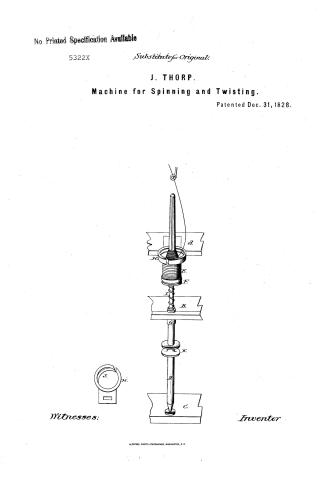
J. Thorp's Patent Drawing for a Machine for Spinning and Twisting

National Archives, Restored Patent Drawings (Record Group 241) · Full-size scan at the National Archives · Catalog record
Text on the drawing
Words on the drawing as machine-read by the National Archives; not checked. Useful mainly for searching.
118. SPINNING, / Div. 21. / Rings & Travelers. / Original Dwg Missing. / itas drawing was made/from an eng rowing in the "Franklin Journal, i. Mar:8.18%5. / Substitutefor Original. / # 5322x / J. THORP. / Machine for Spinning and Twisting. / Patented Dec. 31, 1828. / 5322X / NOTEL AIT / J'or somewhat smiled / condmction. See illustration on / page 220, vol. 12, Sicceres Senes / Franklin J. journal (18-1 / A. / also, page 431, Vot 10 / H. / of a me (1.830 / E. / Qlas jo, 130 vol 18am / F. / I. / B. / Describes oplit / G. / Ser Ing / K. / J. / D. / H. / Machine Spinning Twisting / C. / Witnesses: / Inventor
USPTO scan
The patent as scanned by the USPTO
-
 Page 1
-
 Page 2


U.S. Patent and Trademark Office · Google Patents
Published accounts: journal notice
Notice in the monthly list of patents, with remarks
Journal of the Franklin Institute, new ser., vol. 3 (1829), p. 202 · View the page
33. For a Ring Groove Spinner; John Thorp, Providence, Rhode Island, December 31.
Remarks. This gentleman has recently obtained several patents for improvements in spinning; we mean to embody, and publish them at a future day. INFORMATION TO PATENTEES, On the surrendering of a Patent for the purpose of amending the Specification, by the EDITOR. It is the practice of the patent office, under a decision to that effect, to admit of the surrender of a patent, by the patentee, should he discover that, through inadvertence, he had not described his invention, or discovery, in those clear and exact terms which the law requires. It is to be understood, however, that the new specification must not include any improvement not intended to have been included in the former; it must only describe it more exactly, and make known more explicitly what the patentee claims as new. The patent of Paulus Hedl, No. 21, in the foregoing list, was thus surrendered. The new patent bears the same date with the former, and the legal fee, thirty dollars, must be paid. The justice of this procedure is manifest, and we think it a great hardship that the practice under the patent law, does not admit of the same justice, when any defect in the claim is discovered in court; in this case, if the patentee enumerates half a dozen points upon which he rests his claim to invention, and one of these is found to be old, the patent is vacated, and the whole is lost to him, whatever may be the real extent of his merits. Had he made the discovery before the validity of his claims had been questioned in court, he might have corrected the procedure, by surrendering his patent; but when the same is discovered by a litigious adversary, and his acute counsel, he has no remedy. When a patent is surrendered, for the purpose of having it re-issued, it ought to be accompanied by a deed of surrender, to be recorded in the patent office. The subjoined is a good form.
Published accounts: journal notice
Notice in the monthly list of patents
Journal of the Franklin Institute, new ser., vol. 3 (1829), p. 431 · View the page
Pressing melted glass into moulds, 2. Ship windlass, 3. Extracting the gum from flax, 4. Manufacturing metallic salts, ib. 118 ib. Abiel Stevens, ib. Jedediah Richards, jr. 119 Henrietta Cooper, ib. William Nelson, ib. Thomas Symington, 120 John Deakyne. ib. J. M'Donald and R. M'Queen, 121 John Thorp, 122 ib. ib. William Howard, Esq. ib. Anthony Hermange, ib. Joshua Ayars, Aaron Carman, Hermange and Steenstrup Anthony Hermange, James Parker, M. D. ib. 123 ib. ib. 124 John F. King, ib. John Judge, ib. Deming Jarvis, 189 Samuel Nicholson, ib.. Sands Olcott, ib. Edward Clark, 190 5. Water wheels, 6. Manufacture of cloths, Orpheus Thompson, ib. I. P. and R. G. Hazard, 191 Index. PAGE 7. Machinery for making screws, Lemuel W. Wright, • 191 8. Snatch blocks, J. Evans, 192 9. Corn sheller, Thomas J. Dean, ib. 13. Pump boxes, 15. Sawing felloes for wheels, &c. 16. Washing machine, 17. Locomotive engines, 18. Repairing of fences, 19. Propelling boats, 21. Fences of iron, &c. 10. Increasing water power, 11. Machine for cutting dye woods, &c. Aaron Foster, 12. Pressing unburnt bricks, &c. 14. Preparing meat for sausages, &c. Samuel L. Holmes, 193 ib. Ephraim Mayo, ib. I. P. Williams and S. G. Rea, 194 Samuel Fahrney, 195 ib. Eber Blodget, ib. William Howard, ib. Edward Pitkin, 196 N. Bingham and Pliny Warner, ib. 20. Nostrums for the cure of gout, &c. Elisha Smith, 22. Hinged water wheels, 23. Rolling leather, 24. Cleaning smut, &c., from wheat, &c. 25. Washing machine, 26. Planing, tongueing, grooving, &c. 27. Extracting spiritous liquors from corn, 28. Polishing and graining Morocco leather, 29. Scythe sneath, &c. 30. Grooves for mule drums, 31. Apparatus to supersede the crank, 32. Machine for locking wagons, 33. Ring groove spinner, January. 1.
Published accounts: journal notice
Notice in the monthly list of patents, with remarks
Journal of the Franklin Institute, new ser., vol. 4 (1829), p. 66 · View the page
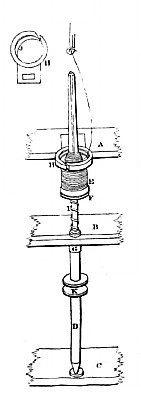
The whorl, C, sets on the bobbin, or vibrating rail, E, and turns on the spindle, moving up and down, obeying the motions of said rail, spreading the yarn over the whole length of the bobbin. The holes in the rail, E, through which the spindles pass, are of the same size with the spindles themselves; by which means they are kept steady. The rail, F, is a stationary plate of cast-iron, to which the spindles are confined. The bolts, H, through which the spindles pass, have a screw-nut on the backside of the rail, F, by which the spindles are drawn close to the rail, and held perfectly steady. When the spindles are placed close to each other, it may be necessary to surround each cup, or can, with a cylindrical, or semicylindrical tube, to prevent the yarns from interfering as they pass round their respective cans. Description of an improvement in spinning, called the "Ring Groove Spinner," for which apatent was granted to JOHN THORP, of Providence, Rhode Island, December 31, 1828.
Remarks. THE drawing and references which accompany this description, render it unnecessary to give the specification at length; we, therefore, will briefly state the nature of the invention. THORP'S Ring Groove Spinner. The common flyer is dispensed with in this improved mode of spinning, a ring being substituted for it, for the purpose of distributing the yarn upon the bobbin. The ring is sufficiently large to admit of the bobbin, with the yarn wound thereon, passing through it. Upon the surface of this ring the yarn revolves, being drawn by the bobbin as it twists, and receives it, and serving at the same time to keep the yarn at a proper distance from, and to distribute it upon, the bobbin. The ring is placed in a circular groove, in a circular plate, H, Fig. 4. This plate encompasses the bobbin, and may be made to vibrate over it by the motion of the rail to which it is attached, or the spindle and bobbin may be made to vibrate, as may be preferred. The lips that form the groove, are of a circle smaller in diameter than the ring, in order to retain it in its place. The depth of the groove is such as to allow the ring to yield to the pressure of the yarn. The ring thus fitting loosely, permits it to yield on either side, so as to allow a space for the revolving of the thread between it and the groove, whilst the friction which it sustains, causes it to wind sufficiently tight upon the bobbin.
DATAMP: illustration
Illustrations from DATAMP

DATAMP (Directory of American Tool and Machinery Patents), via the Internet Archive · Archived DATAMP page
About this record
- Patentee
- DATAMP
- Date
- the Name and Date index of patents, DATAMP, USPTO records
- Invention
- DATAMP
- Listed in
- the Name and Date index of patents, DATAMP, USPTO records, Jim Shaw's X-patent list, the Journal of the Franklin Institute, Burke's List of Patents (1847)
- in_burke