

Drawings and documents
National Archives restored drawings: drawing
Edward Pitkin's Patent Drawing for a Mode for Repairing Fences

National Archives, Restored Patent Drawings (Record Group 241) · Full-size scan at the National Archives · Catalog record
Text on the drawing
Words on the drawing as machine-read by the National Archives; not checked. Useful mainly for searching.
Agr Products / CLASS 53074 / Edw Pitkin's / Meode for repairing Fences. / Vol.y. p 283, / Patented: 13 Du: 1828. / ofig.4. / Fig.5. / Fig. /. / Fig 2 / Fig.3. / References. / Fig. 1 t quarter of a but of tree, 7 feet in length & about / foot in diameter. / b.b. shows when it us sawed to the centre and split a part. / Tig 2._et sawed timber or any that will not spirt. / c.c. shows the manner in which it may be sawed in two. / Fig.3.- One of the backing pieces sawed and split out as in Fig 1. / 4. One of the backing pieces fustened with spikes to a past rotter afat the bottom / 5.. Shows the manner wh ch a five holed past may be made a four-hole. / Patent Office. 28.Oct. 1839. / Meide under the direction of the Commifsioner of Patents, / in conformity with act: 3d March. 1837 / Menryh Sumoth / bomm. of Satents
USPTO scan
The patent as scanned by the USPTO
-
 Page 1
-
 Page 2
-
 Page 3


U.S. Patent and Trademark Office · Google Patents
Published accounts: journal notice
Notice in the monthly list of patents, with remarks
Journal of the Franklin Institute, new ser., vol. 3 (1829), p. 196 · View the page
18. For an improvement in the Repairing of Fences; Edward Pitkin, East Hartford, Hartford county, Connecticut, December 13.
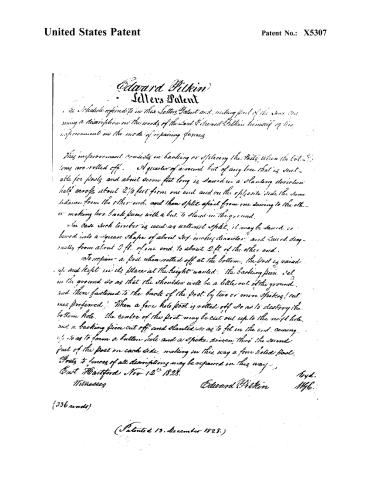
Remarks. There may be something novel in the subjoined plan of splicing posts, the bottoms of which have rotted off. We, however, have frequently seen the posts both of rail and board fences, spliced at the bottom in a manner so similar to that described and figured in the drawing in the office, that we are unable to tell the difference between the old and the patent mode. That our readers may discover it, we insert the following, which is the whole of the specification. "This improvement consists in backing or splicing the posts when the bottoms are rotted off. A quarter of a round butt of any tree that is suitable for posts, and about seven feet long, is sawed in a slanting direction, half way across, about 2 feet from one end, and on the opposite side, the same distance from the other end, and then split apart from one sawing to the other, making two backing pieces with a but to stand in the ground. In case such timber is used as will not split, it may be sawed or hewed into a square shape of about six inches diameter, and sawed diagonally, from about two feet of one end, to about two feet of the other end." "To repair a post when rotted off at the bottom, the post is raised up and kept in its place, at the height wanted the backing piece set into the ground so as that the shoulder will be a little out of the ground, and then fastened to the back of the post, by two or more spikes (cut ones preferred.)" " When a five holed post is rotted off, so as to destroy the bottom hole, the centre of the post may be cut up to the next hole, and a backing piece cut off and slanted so as to fit in, the end coming up so as to form a bottom to the fourth hole, and a spike driven through the sound part of the post on each side, making in this way a four holed post. Posts to fences of all descriptions may be repaired in this way."
About this record
- Patentee
- DATAMP
- Date
- the Name and Date index of patents, DATAMP, USPTO records
- Invention
- DATAMP
- Listed in
- the Name and Date index of patents, DATAMP, USPTO records, Jim Shaw's X-patent list, the Journal of the Franklin Institute, Burke's List of Patents (1847)
- in_burke