

Drawings and documents
National Archives restored drawings: drawing
Orpheus Thompson's Patent Drawing for an Inclined Water Wheel

National Archives, Restored Patent Drawings (Record Group 241) · Full-size scan at the National Archives · Catalog record
Text on the drawing
Words on the drawing as machine-read by the National Archives; not checked. Useful mainly for searching.
[168] / 5294-+ / Drpheus Thompsow / Inclined Water Wheel / Paienled Decr 6ᵗʰ 1828. / is / arm, / Fig.4 / Fig.3 / arm, / head of Vialer {er / Fig.2. / Figl / Piimax.
USPTO scan
The patent as scanned by the USPTO
-
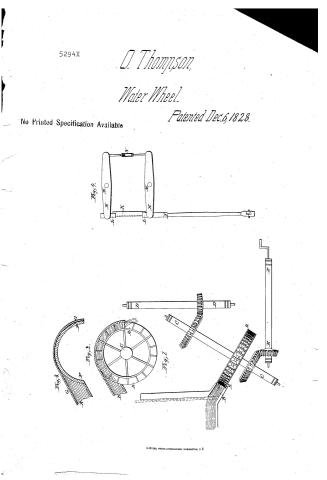 Page 1
-
 Page 2


U.S. Patent and Trademark Office · Google Patents
Published accounts: journal notice
Notice in the monthly list of patents, with remarks
Journal of the Franklin Institute, new ser., vol. 3 (1829), p. 190 · View the page
5. For an improved construction and position of Water Wheels, by placing the shaft in an oblique or leaning direction, called the "Inclined Wheel." And also in the mode or method of making a saw-gate to be applied thereto, or to any other moving power; which is called and denominated the "Centre Sawgate;" Orpheus Thompson, Jericho, Chittenden county, Vermont, December 4.
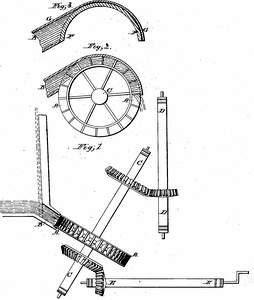
Remarks. The shaft of the water wheel is to be inclined so as to form an angle of about 30° with a vertical line. The water is to be shot upon the wheel from a penstock, under an adequate head. It is to strike the periphery of the wheel in a tangential direction, filling the buckets by which it is surrounded, being confined in them by a circular sheathing passing nearly half round the wheel. water acts upon the wheel, first by the momentum of its percussive stroke, and then by its gravity upon the inclined plane, having no way to escape until it leaves the wheel on the opposite side." "The A vertical or horizontal shaft may receive motion from the oblique, by means of bevel gear. The saw-gate, as the patentee calls it, is thus formed; there are two levers placed horizontally, with gudgeons in their centres, so as to make their arms equal like those of a scale beam; these are placed one above the other at such distance as is required for the length of a saw. These levers are connected at one end by the saw, working upon pins, and at the other by a screw rod, by which the saw may be tightened, which rod also works upon pins passing through the ends of the lever. A crank, on the end of a horizontal shaft, works a pitman, the upper end of which is attached to the lever. The patentee "claims as his invention and improvement, the manner of placing the water wheel in its inclined position, and of pitching the water thereon, as the same is herein before described; and also the saw-gate, as the same is made and constructed, and herein before described." American Patents for December, with Remarks. It We think that the inventor has proceeded upon the mistaken idea, that power will be gained by the mere lengthening of the levers upon which the water is to act, that is, upon the radii of the wheel. may be safely put down as a general rule in the construction of water wheels, that where the fall is sufficient to use any other than an undershot wheel, the height of the head ought not to exceed what is necessary for the filling of the buckets of the wheel, and this will rarely exceed one foot. The whole power of the water is derived from its gravity, and could the whole of this be made to act directly upon the wheel, the more would power be economized. This, however, is not the place to write a treatise on water wheels, and upon this subject, therefore, we will only add, that we are at a loss to perceive wherein the improvement in the proposed arrangement consists. Saws have been hung in a manner analogous to that described. A patent was obtained for an "Armed Saw-frame," by Mr. Samuel Sperry, on the 18th of June, 1828, which bears much resemblance to it. We apprehend that the wear and friction of so many joints, the difficulty of giving stability to the arms, so as to guide the saw correctly, and the curve in which the saw must work, will not only abstract much from the advantages expected, but prevent the "Centre Saw-gate" from becoming a formidable rival to the old fashioned saw-frame.
DATAMP: illustration
Illustrations from DATAMP

DATAMP (Directory of American Tool and Machinery Patents), via the Internet Archive · Archived DATAMP page
About this record
- Patentee
- DATAMP
- Date
- the Name and Date index of patents, DATAMP, USPTO records
- Invention
- DATAMP
- Listed in
- the Name and Date index of patents, DATAMP, USPTO records, Jim Shaw's X-patent list, the Journal of the Franklin Institute, Burke's List of Patents (1847)
- The Franklin Institute's journal gives a different date.
- in_burke