

Drawings and documents
National Archives restored drawings: drawing
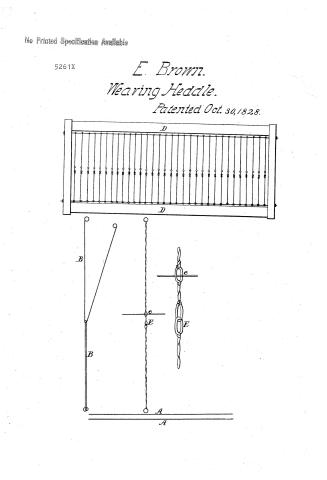
E. Brown's Patent Drawing for a Wire Harness for Weaving

National Archives, Restored Patent Drawings (Record Group 241) · Full-size scan at the National Archives · Catalog record
Text on the drawing
Words on the drawing as machine-read by the National Archives; not checked. Useful mainly for searching.
"Wene / 139. WEAVING. / [95] Heddles. / Tex / vol." page 135 / 3/1 / 5261-4 / E.BROWN / Hire-harneps for Weaving / Patented 30 "Oct"1828" / _A_A. Peices of wire to make the Headdle / B.B. do do" bent / C. Manner ofbending wire topasioyer Rod / D. Shaft / E. Eye forthe 100/6 to leaft through e Eye forthe thread / Patent Office april 30 1841- / Made under the direction of the commisioner gratuits / Strickland) Del') / in conformity with act of 3 "March 1537 / 12 Sumorth / Commipioner of Patents
USPTO scan
The patent as scanned by the USPTO
-
 Page 1
-
 Page 2


U.S. Patent and Trademark Office · Google Patents
Published accounts: journal notice
Notice in the monthly list of patents, with remarks
Journal of the Franklin Institute, new ser., vol. 3 (1829), p. 60 · View the page
41. Improvement in the patent granted to Matthew Chandler and Ezra Brown, for Wire Harness for Weaving; Ezra Brown, Cazenovia, Madison county, New York, October 30.
Remarks. (See the specification.)
Published accounts: journal notice
Notice in the monthly list of patents, with remarks
Journal of the Franklin Institute, new ser., vol. 3 (1829), p. 62 · View the page
An anvil with a face ten or twelve inches, by twelve or fourteen inches on the face, on which the size of the blade of the hoe is sunk, BROWN'S improved Wire Harness for Weaving. nearly as deep as the hoe blade is thick, with also the thickness of the eye of the hoe spread out flat, sunk in the same. From the centre of the blade to the middle of the eye as thus spread out, the anvil is still deeper sunk, so as to receive the ridge extending from the centre of the blade to the eye of the hoe when made. On this anvil a tilt or trip hammer works, with a face large enough to cover both blade and eye as extended or spread out. This hammer is put into motion in the usual way as now practised in forging iron. The hoe is made from a bar of iron about seven-sixteenths thick, and four, or four and a half, inches wide. The bar is heated and laid on the anvil, the end extending to the edge of the blade, or nearly so, and passing back over the centre of the eye. The action of the hammer forges the iron down into the sunk part of the anvil, until the iron begins to spread over the high part of the face of the anvil, and is made of the proper thickness for a hoe. In this part of the operation, the back part of the blade and the inside of the eye are up next the hammer; the upper side of the blade and outside of the eye next the anvil. The hoe is then trimmed by a pair of shears, such as are used by tin-plate workers, down to the impression made by the sink in the anvil. These shears are worked by a crank on the same shaft that gives motion to the tilt hammer. The hoe is then heated, and the blade part fastened in a vice made for the purpose; one jaw of the vice is flat; the other is formed so as to receive the ridge on the face of the hoe, and the upper part sunk or indented so as to fit the round of the eye. While the iron is at a proper heat, it is turned down to the front, and swedged in to the last described jaw of the vice, so that the eye is brought to form a square with the blade. Then the two wings which form the eye, are turned over so as to lap one over the other on the back, or pole, of the eye, at which place they are welded at a subsequent heat and operation. What is claimed as new and an improvement in the art of manufacturing weeding and other hoes, by this method, is, forging the blades and eye at the same operation, with a tilt hammer, at which time, one side of the hoe and eye is perfectly flat, the other only varied by the different thicknesses required. From this shape, the hoe is completed by squaring the eye to the front, and turning the wings so as to meet and lap over. There are many operations I use which have been, heretofore, practised. JAMES A. BLACK. Specification of an improvement on the patent granted to MATTHEW CHANDLER and EZRA BROWN, for Wire Harness for Weaving. Issued to EZRA BROWN, Cazenovia, Madison county, New York, October 30, 1828.
Remarks. WHEREAS, in the original harness, each heddle is formed of two pieces of wire, usually between Nos. 24 and 27, each about ten inches in length, and formed into a staple, by being bent in the centre, the prongs brought parallel at about one-sixteenth of an inch PETERSON'S Machine for Casting Printing Types. distant from each other, each end turned inward till it forms threefourths of a circle, and is brought against the wire, and at right angles with it, forming an eye nearly round, and of a size that would easily admit a rod of the size of No. 12 wire, which rod supports the heddles by being attached to the shaft. In one of these loops, an eye is formed, about three-eighths of an inch in length, and onesixteenth of an inch in breadth, by twisting the prongs together in a close manner, once and three-fourths round, which places the eye in the proper position to receive the thread by which it is occupied. This is called the eye part, and the other the loop part of the heddle. The loop is put through the eye, and each part extended to its respective rod and shaft.
About this record
- Patentee
- DATAMP
- Date
- the Name and Date index of patents, DATAMP, USPTO records
- Invention
- DATAMP
- Listed in
- the Name and Date index of patents, DATAMP, USPTO records, Jim Shaw's X-patent list, the Journal of the Franklin Institute, S. A. Elliot's printed list of patents, Burke's List of Patents (1847)
- S. A. Elliot's printed list of patents gives the same name and date.
- in_burke