

Drawings and documents
USPTO scan
The patent as scanned by the USPTO
-
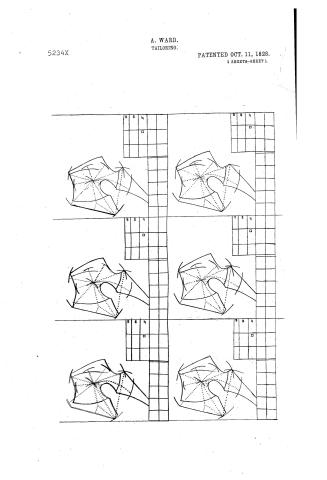 Page 1
-
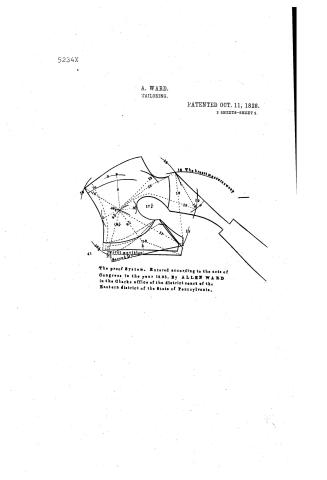 Page 2
-
 Page 3


U.S. Patent and Trademark Office · Google Patents
Published accounts: journal notice
Notice in the monthly list of patents, with remarks
Journal of the Franklin Institute, vol. 6 (1828), p. 396 · View the page
10. A triangular measure Ruler for delineating Garments; Allen Ward, Philadelphia, October 11.
Remarks. (See the specification.)
Published accounts: journal notice
Notice in the monthly list of patents, with remarks
Journal of the Franklin Institute, vol. 6 (1828), p. 406 · View the page
My improvement upon the machine for carding wool, consists in raising the main cylinder of the carding machine, about fourteen inches above the frame, so that a larger portion of its surface may be made to act upon the small cylinders. In the ordinary machine, there are three or four workers, and two strippers: by my improvement, I usually employ seven workers, and three strippers. The seven workers are operated upon by two separate bands or cords, from the same whorl, on the doffer shaft. By this arrangement, three or four of them may, at any time, be stopped, when it is intended to run the wool twice through; or by running the whole number, the work may be completed at one operation. What I claim as my invention is the employment of the additional workers and strippers. DON M. BACON. Specification of a Triangular Measure-case Ruler, for delineating garments with, or by. Patented by ALLEN WARD, Philadelphia, October 11, 1828.
Remarks. To make a triangular measure-case ruler, for delineating garments, I first procure three strips of tin or other metal plates, with which I form a triangular tube, having the edges of the metal strips turned outside, forming a trough or groove of each strip. I next proceed to solder the three troughs, or grooves, together, which, of course, forms a triangular tube, with the troughs or grooves outwards. I next prepare each side of the triangle for receiving the scales which are to be used therein, by regulating the depth of the groove or trough to the thickness of the scales, and by marking on each side of the triangular tube, some peculiar mark, such as is used in music to denote tunes, flats, sharps, &c. -any character will do to know the scales apart by. I have used a sharp to designate the scale of lengths, or heights, of each customer, and have marked the character on the side where the length scale belongs; and on the second side, I have marked the character of a la, or, in other words, a hollow square, which denotes the waist scale; lastly, I have marked the third side of the triangular tube with the character of a natural, which denotes the breast scale; and into these three grooves I slide each respective scale, according to the height and thickness of each customer. I also make some triangular measure-case rulers for delineating garments by, of wood, which answer the same purpose, but are not so durable. To make a wooden triangular measure-case ruler for delineating garments with, I take a piece of wood, about two feet long and two inches square, of which I form a triangular ruler; in each side of which I plough a dove-tail groove for the scales to slide in. I then put a band of wood or metal round each end, for the twofold or double purpose of holding the marks or characters of each scale, and for a supporter of a wedge with which the scales must be secured, to keep them from sliding back and forth. ALLEN WARD. FRANKLIN INSTITUTE. Report to the Board of Managers on the Fifth Annual Exhibition. To the Board of Managers of the Franklin Institute of the State of Pennsylvania, for the promotion of the Mechanic Arts, the Committee on Premiums and Exhibitions beg leave respectfully to report:THE fifth annual exhibition of the Franklin Institute, was held in pursuance of notice, at the Masonic Hall, on the 8th, 9th, 10th, and 11th days of October, at which time the committee were much gratified to find a rich and varied collection of the products of American skill and ingenuity. The articles presented were not so numerous as at the exhibition in 1826, but displayed, generally, an improvement in style and workmanship, highly creditable to our workmen, and afforded a reasonable hope, that in a few years the advanced state of knowledge, will place the mechanical productions of America, not only beyond the competition of foreigners in our own market, but enable us to enter into a fair competition with them in other countries. Of the 45 premiums offered by the Institute, 20 were claimed by one or more competitors, of which three remain under advisement, and 9 were awarded by the committee to successful competitors. Of the remainder, several were withheld, because the condition of the proposal was not adhered to. Premium No. 4-For the best specimen of Annealed Cast Iron, is awarded to Seth Boyden, of Newark, New Jersey, for specimen No. 163, being an assortment of buckles, bits, and other castings, remarkable for their smoothness and malleability. This is the first attempt in this country to anneal cast iron for general purposes, that has come under the knowledge of the committee, and the success attending it, fully entitles the maker to the silver medal. Premium No. 12-To the inventor of the best constructed Furnace and Boiler, superior to any now in use, for consuming anthracite in generating steam. This premium has been claimed, but the award is still under advisement. Premium No. 13-To the maker of the best Fire Bricks. The award of this premium is left open, in accordance with the terms of the proposal, until the samples shall be sufficiently tested. Premium No. 14-To the maker of the best Currying Knives, equal to the best now in use. This premium was claimed by two competitors, each furnished with very satisfactory certificates, as to the quality of their knives. John Shugart & Co. of Chambersburg, and Jacob Barrick, of the same place. As curriers' knives are implements which require a peculiar temper, very difficult to attain, and which can only be judged of by experiment, your committee accept the suggestion of the judges, and suspend the award of the premium until the knives can be fairly tested and compared, by a special committee, appointed for that purpose. As soon as their report is received, it shall be made known. Premium No. 16-For the best specimen of Japanned Waiters or Trays, made and japanned in Pennsylvania, is awarded to John V. Blackmore, of Philadelphia, for specimens Nos. 71 and 72, being two dozen of waiters made by him, of a quality not inferior to the imported. The committee regret that the specimens presented by William Nash, of Philadelphia, were deposited too late to be referred to the judges; they could not, therefore, enter into competition with the above. Premium No. 17-To the maker of the best Surveyor's Instrument, is awarded to Stancliff & Draper, of Philadelphia, for specimen No. 316, being an engineer's level, provided with Mr. William Strickland's divided horizontal circle. This instrument is remarkable for the beauty of its workmanship, and the accuracy with which it is divided, and fully entitles its ingenious makers to the silver medal. Premium No. 20-For the best Porcelain made in the United States, gilt, painted, and plain-" one hundred pieces must be exhibited;" is awarded to William E. Tucker, of Philadelphia, for specimen No. 253, being an assortment of porcelain, of first and second choice. In awarding this premium, the committee feel pleasure in noticing the great improvement which has taken place in the manufacture of this beautiful and interesting product. The judges report that they have compared the sample, called technically "first choice," with the best specimens of French China, and found it superior in whiteness, and the gilding well done. The same remark applies to the painting, with some exceptions; this part of the process being still susceptible of some improvement. The committee recommend this "first choice" to the public as of a quality not easily to be surpassed; and award to the maker the silver medal. Premium No. 27-For the best specimen of Stair Carpeting, in imitation of Venetian, is awarded to James B. M'Fee, of Philadelphia, for specimens No. 96 and 97, two pieces stair and entry carpet, which reflect great credit on the maker. Premium No. 29-To the maker of the best specimen of Calicoes or Prints, for ladies' dresses, made in the United States, is awarded to the Merrimac Manufacturing Company, for specimen No. 149. Prints were deposited, also, by the Taunton Manufac1 turing Company, and from the Warren Factory, near Baltimore; the latter low priced goods. It is but justice to all parties, to state, that the judges remarked the great improvement that had taken place in printed goods since the last exhibition. They had great difficulty in deciding whether the Merrimac or Taunton goods, should have the preference, both being well executed, and of brilliant colours. After some hesitation, they awarded to the Merrimac Company the silver medal. Premium No. 35-To the maker of the best Sofa, is awarded to Anthony G. Quervelle, for specimen No. 55, being the most complete and best finished of any exhibited. Premium No. 37-To the maker of the best Chairs, one dozen to be exhibited; is awarded to William Hancock, of Boston, for specimen No. 35, being one dozen mahogany chairs, well framed and finished; remarkable for the excellence of the carving, which was clean, bold, and in good taste. Premium No. 45-To the pupil of the High School who shall execute and exhibit the best specimen of perspective drawing from machinery; is awarded to Robert P. Warner, for specimen 282; being a drawing of an air-pump, the best exhibited. In addition to the premiums awarded to those competitors who claimed, under the proposal issued by the Institute, your committee, in pursuance of authority to grant premiums and special notices to such specimens exhibited, as may be worthy of most compliment, either for excellence of workmanship, or ingenuity, or other peculiar circumstances, have awarded: To James Devoe, of Kensington, a silver medal for two models of steam engines, made by him. The maker of these models is a lad, apprentice to John Walcham of Globe Mill Factory, and they were made at his leisure hours. The committee have not awarded this premium with any view to the intrinsic merit of the work; but they deem it within the province of the Franklin Institute, to encourage and reward examples of industry, perseverance, or ingenuity, among our rising mechanics. These models evinced a talent uncommon in so young a lad. To S. P. Wetherill & Co. Philadelphia, for two pigs of lead; being a part of 1000 pigs, the product of their Perkiomen mines, snelted by them. The quality of this lead has been fairly tested by being manufactured into white lead. After a series of years of expensive and fruitless attempts to smelt this ore, these gentlemen have at last succeeded in rendering available, another product from the inexhaustible mineral resources of Pennsylvania. A silver medal is awarded. The committee also award the silver medal to Wm. & T. H. Day, of Philadelphia, for specimens 14, being an assortment of door locks. These locks, of which the makers are, also, the inventors, were good and well finished, displaying much ingenuity in their construction; all of them were safety locks, presenting almost insurmountable obstacles to the pick-locks: a particular description will be given in the detailed report of the exhibition. VOL. VI. No. 6. - DECEMBER, 1828. 52 Ten pieces of Flannel were presented from the Yantic Factory, Connecticut. The judges reported them to be of a very superior quality, and the committee adopt their suggestion, and award to the maker, a silver medal. To Lloyd Mifflin, for No. 201, hearth rugs wove by him. These rugs were the first produce of machinery, invented by him, entirely upon new principles. The rugs were well made and substantial, and bid fair to rival the best imported article. The silver medal is awarded. To Messrs. Terhooven, for a sample of pins, made and presented by them; the pins were, in most part, of excellent quality, and reflect much credit on the makers. For the introduction of this useful and important branch of manufacture, the committee award the silver medal. Marble mantels from the manufactories of Tennant & Highlands, P. Fritz, J. Struthers, and S. & J. Jardin, fully sustaining the high reputation of Philadelphia workmanship, were presented. Those from Tennant & Highlands, were much admired for the taste of the design, and pleasing appearance. Those of American and foreign, and American marble, made by P. Fritz, were adjudged to be the best in point of workmanship. The next best, a pair of American and foreign, by J. Struthers. Honorary mention was awarded. The Franklin Institute has never been favoured with a more splendid display of pianos, than at this exhibition. Thirteen were presented from E. Pommer, C. F. L. Albright, J.J. Meckley, Loud & Brothers, S. Sweitzer, and Myers, of Philadelphia, Curtis & Gilbert, and A. Babcock, of Boston. As no premium was offered for pianos, presented at this exhibition, the committee forbear, at present, making any distinction; but in their detailed report, to be presented in a few days, a description of each, with their merits, may be expected. To Stanley & Co. of Baltimore, an honorary mention is awarded, for 3 pieces mixed sattinets; these goods were of very superior quality, and would have received the premium, had the conditions of the proposal been complied with. To James B. M'Fee and Groves & Fleming, of Philadelphia, an honorary mention is awarded, for their excellent samples of ticking; both very superior articles. Honorary mention is also awarded to - Clapp, Leicester, Mass. for 4 pieces mixed cloths, of excellent quality for the price, and to James M. Robbins, of Watertown, and Sheppard's woollen manufactory, Northampton, for 4 pieces blue, and 4 pieces black broadcloth, being the best exhibited. These cloths were not entitled to the premium, by the terms offered, there being a standing rule of the Institute, that no premium will be awarded, unless they are superior to any that have been heretofore presented. These cloths are represented by the judges, to be well made and substantial, of good fast colour, and handsomely dressed. It is but justice to remark, that the cloths heretofore exhibited, were sold at 10 and 11 dollars, while the above 8 pieces were offered at 7 dollars. Honorary mention is also awarded to Magee & Tabor, for a set of gig harness, made by them, of splendid workmanship, unequalled by any the judges had ever seen. These gentlemen obtained a premium last year. Also, to Leadbeater & Sons, for a splendid hanging astral lamp, with four burners; a specimen of work highly creditable to them. The committee regret these gentlemen did not make it of a size to claim the premium, which the quality of the work would have entitled them to do. The committee further award honorary mention, to William Rowland, of Philadelphia, for his very superior mill, pit, and cross cut saws, of excellent quality, well ground and finished. The committee further beg leave, especially, to notice the Pharmaceutical preparations of G. W. Carpenter, whose improvements in the science of pharmacy, reflect great credit on him, and have proved highly useful to the public. Also, the chemical preparations and colours from the Maryland Chemical Company, to whom our manufacturers are much indebted, for relieving them from a dependence on the importers, for articles which are indispensable. The bleaching salts was remarked as being of excellent quality, and preferred, by many, to the celebrated bleaching salt of Tennant, of Glasgow. Also, carbonate of magnesia, and calcined magnesia, made from the purest sulphate of magnesia, washed by steam, appeared nearly chemically pure; and many other specimens of equal quality. Cast Iron Medals, from Jones, Keim & Co. Windsor Furnace, near Hamburg, Penn.; the most perfect specimens of castings known of this country's production, and rivalling the most splendid Berlin medals. Fancy articles, from William Tait, Philadelphia, and Water Colours, from George C. Osborne, of Philadelphia, evinced much improvement in both branches of manufacture, and were highly creditable. Of the Sole Leather, from Ashburner & Son, and W. & I. Pritchett, the committee take much pleasure in stating, that they were judged to be of the best of the kind, and fully sustain the character so long held by the Philadelphia tanners. The committee would further particularly notice, Grates, from Lloyd & Son, - Jackson, and Mifflin, all of which were well made and of good workmanship. The design of No. 132, from Lloyd's, was particularly pleasing. Brass Hinges, &c. from William Garret, were adjudged well finished, and creditable articles. The committee cannot close this report without tendering their thanks to the gentlemen who so ably fulfilled the arduous duties of the committee of arrangement. To them the Institute and public are indebted, for the splendid exhibition they have just witnessed; and to them much praise is due for the neat and careful manner in which the articles were displayed. In closing the report of the Fifth Exhibition, the committee must again throw themselves on the indulgence of the public, to pardon any errors into which they may have fallen. If any injustice hás On the comparative power of Steam. A been done, they feel confident it will be attributed to causes without their control. The constant aim of the committee has been, equal justice and impartiality to all. They are aware that many articles, deserving special notice, have been omitted in this preliminary report. Respecting such they give the assurance, that in a few days, they will present a detailed report of all which were exhibited, with their respective merits. SAUMEL V. MERRICK, JAMES RONALDSON, THOS. FLETCHER, ADAM RAMAGE, M. W. BALDWIN, M. D. LEWIS, ISAIAH LUKENS, CHRISTIAN Gobrecht, Committee on Premiums and Exhibitions. Observations on the comparative difference in the effective power of Steam, as applied to the Rotary, and Reciprocating Engine. TO THE EDITOR OF THE FRANKLIN JOURNAL. SIR,-Having often enquired the difference in effect between a reciprocating engine and a rotary one, without being satisfactorily answered, I lately endeavoured to solve the problem myself. I have sent you the result of my labour: should my method of calculation be obscure, and the conclusion erroneous, I need only put you in mind, that you have promised to destroy, to correct, or to expunge, with tenderness, the communications of those who are less accustomed to handle a pen, than a HAMMER. 5 C 0 の 5. B A reciprocating steam engine, whose cylinder is 2 feet long and one foot in diameter, will describe, by its crank, a circle 2 feet in diameter, which will require a double stroke of the piston, and so consume a column of steam 4 feet long and one foot in diameter; but the whole power of the steam will only be exerted at two points in the circle, viz. at A and B, and as the crank recedes from these, the power decreases till it reaches C, C, the dead points, where the steam is altogether of no avail; and on the contrary, as it approaches A, B, the power increases till it arrives at its maximum, at those places. Now let us suppose the circle divided as in On the comparative power of Steam. the diagram, then each figure will express the power of the engine at the time the crank is opposite to it: so, also, would the gross amount of all the figures united, express the power of the engine, during one revolution of the crank, or a double stroke of the piston: may we not state it thus? Power 200 (the amount of figures) produced by a column of steam 4 feet by 1 foot. Now suppose a rotative engine of the same diameter as the circle which the crank above, describes, (viz. 2 feet) and the area of whose piston is the same as the one above-mentioned; then, (leaving friction, &c. &c. out of the question) the force of such an engine would be the same in all points of the circle, as the reciprocating one at A and B; consequently, each figure would represent 10, and the whole united, 400, or just double the power produced by the reciprocating engine. But then the quantity of steam consumed by the latter, will be considerably more than the former, viz. a column of steam 6.2832, the circumference by 1 foot: the account will then stand thus, the Reciprocating engine, power 200, steam 4.
About this record
- Patentee
- DATAMP
- Date
- the Name and Date index of patents, DATAMP, USPTO records
- Invention
- DATAMP
- Listed in
- the Name and Date index of patents, DATAMP, USPTO records, the Journal of the Franklin Institute, Burke's List of Patents (1847)
- in_burke