

Drawings and documents
National Archives restored drawings: drawing
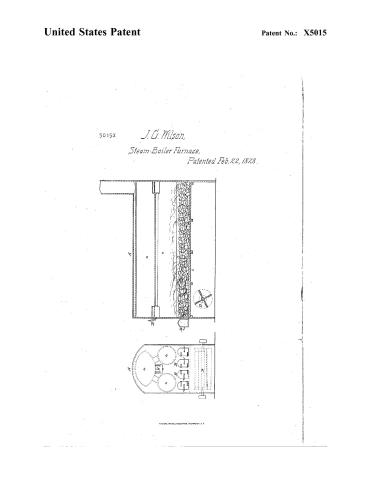
J.G. Wilson's Patent Drawing for a Steam Boiler for Stone Coal

National Archives, Restored Patent Drawings (Record Group 241) · Full-size scan at the National Archives · Catalog record
Show the text on the drawing Hide (68 words)
Words on the drawing as machine-read by the National Archives; not checked. Useful mainly for searching.
110. BOILER FURNACEB / : Teeding Ain / Class 4- Steam Eng in Frences / Feeding air / Not / $2 - / 5015+ / A Boiler a Sections / ET. Cr O WIIS SON / B. DOOT'S / Feb22-1925 / C. Cerate / Slean Boilers for slone coal / D. Shaft with / Ingitudinal Section / Fronty Boiler / A. / Paleul June 30"18 / Made under the clirection of the
USPTO scan
The patent as scanned by the USPTO
-
 Page 1
-
 Page 2
-
 Page 3


U.S. Patent and Trademark Office · Google Patents
Show the transcription Hide (400 words)
Machine transcription (LightOnOCR) of the pages as scanned by the USPTO, most of them the handwritten copies made when the records were restored after the 1836 fire. Not checked; it can misread handwriting, so compare it with the scan.
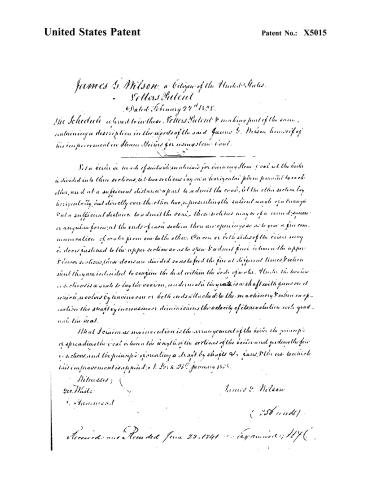
Page 2.
United States Patent
Patent No.: X5015
James S. Wilson, a Citizen of the United States.
Letters Patent
Dated: February 22, 1825.
The Schedule referred to in these Letters Patent & making part of the same, containing a description in the words of the said James S. Wilson himself of his improvement in Steam Boilers for raising steam & coal.
Set a boiler or number of suitable materials for burning any Steam & coal, the boiler is divided into three sections, & two sections lay on a horizontal plane parallel to each other, and at a sufficient distance apart to admit the coal, & the other section lay horizontally, but directly over the other two, presenting the salient angle of a triangle at a sufficient distance to admit the coal. These sections may be of a round, square or angular form; at the ends of each section there are openings so as to give a free communication of water from one to the other. On one or both sides of the boiler may be doors fastened to the upper section so as to open & admit fuel between the upper & lower sections; these doors are divided so as to feed the fire at different times, & when shut they are intended to confine the heat within the body of water. Under the lower section is a grate to lay the coal on, underneath the grate is a shaft with gears on it which revolves by having one or both ends attached to the machinery & when in operation the shaft by increasing or diminishing the velocity of its revolution will gradually heat.
That I claim as my invention is the arrangement of the boiler, the principle of spreading the coal between the lengths of the sections of the boiler and grading the fire in sections, and the principle of operating a draft by shafts & gears, & the use to which this improvement is applied.
Witnesses:
J. White
J. Hammond
James S. Wilson
(256 words)
Recorded and Recorded June 23, 1841 — (Examination) 1776.
Page 3.
United States Patent
Patent No.: X5015
5015X
J. G. Wilson,
Steam-Boiler Furnace,
Patented Feb. 22, 1888.

M. PETER, PHOTO-LITHOGRAPHER, WASHINGTON, D. C.
Published accounts: journal notice
Notice in the monthly list of patents
Journal of the Franklin Institute, vol. 5 (1828), p. 359 · View the page
In steam boilers for using stone coal; James G. Wilson, of New York, February 22.
About this record
- Patentee
- DATAMP
- Date
- DATAMP, USPTO records, Burke's List of Patents (1847)
- Invention
- DATAMP
- Listed in
- the Name and Date index of patents, DATAMP, USPTO records, Jim Shaw's X-patent list, the Journal of the Franklin Institute, the Mirror of the Patent Office (1828), S. A. Elliot's printed list of patents, Burke's List of Patents (1847)
- The sources give different dates; the date shown is the one most of them agree on.
- The Franklin Institute's journal confirms the date shown.
- The Mirror of the Patent Office's supplementary list gives the same patent.
- S. A. Elliot's printed list of patents gives the same name and date.
- Burke's 1847 Patent Office list gives the same patent.