

Drawings and documents
Published accounts: specification
Specification printed in the Mirror of the Patent Office (1828) with its plate
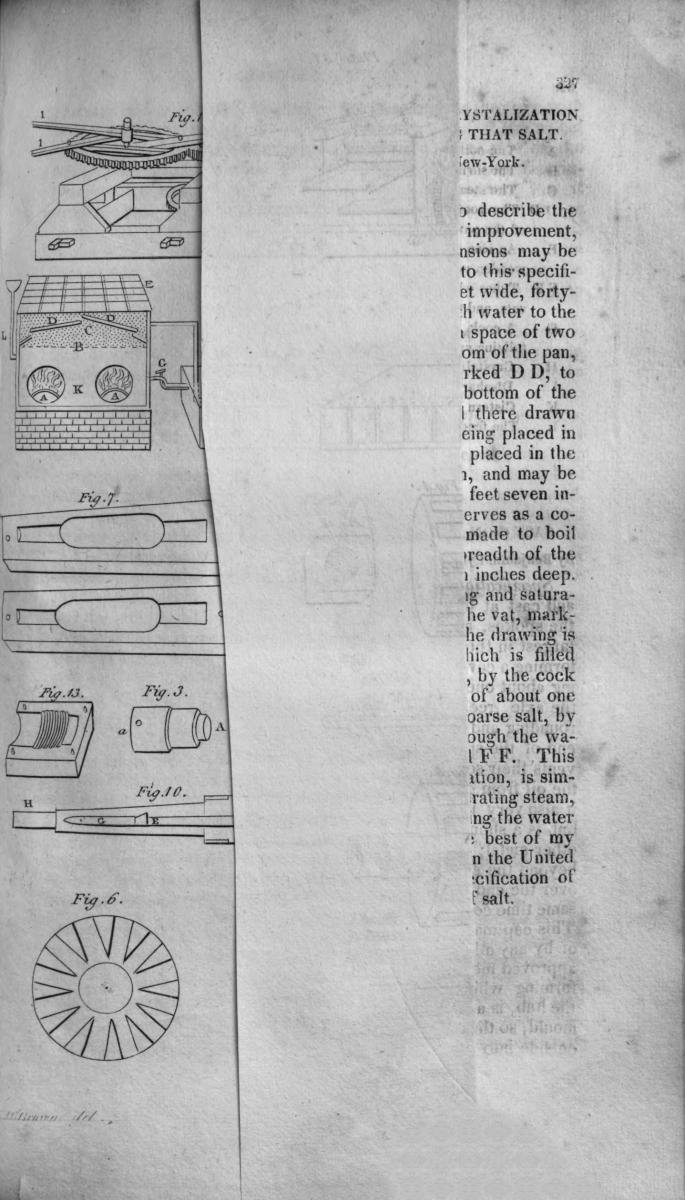
American Journal of Improvements in the Useful Arts, and Mirror of the Patent Office, vol. 1 (1828), printed p. 327 · View the page
Transcription
Machine-read text of the specification as printed in the Mirror; not proofread. Check the page scan for figures, reference letters and spelling.
AN INVENTION “IN THE CONCENTRATION. AND, CRYSTALIZATION ; OF MURIATE OF SODA, FROM BRINES CONTAINING THAT SALT. By Benajah Byington, of Salina, Onandago county, New-York. m ab Ct (4) . See Plate XXXI, fig. 2. AE HIN ee Specification. —t, the said Benajah Byington,*dovdestribe'the _ manner in which I perform my said invention and improvement, by the following “description thereof. The dimensions: maybe il varied, but in that shewn in the drawing aniexed to this*specifi- ial cation, the wooden Cistern, thar ed K, is twelve feet wide, fortytwo feet long, and six feet deep, whichis filled with water tothe | : depth of four feet, which covers the boilers, ‘and a‘space of two ‘ it feet, between the surface of the water, and the bottom‘of the pan, ta if occupied by steam, in which is placed roofs, marked DD, to bay Oy catch the condensed steam which drops from the bottom of the ce pan, and is carried into a trough on each side, and*there drawn off. The water in this cistern is heated by fire being placed in ) an iron boiler or boilers, marked A A, which are placed in the water and extended the whole length-of the cistern, and may be varied in size: those shewn in the drawing are two. feet seven in- 4 ches diameter. The iron pan, marked E, which serves as a co- _-ver for the’cistern, is filled withthe brine, and-is' made to’ boil {a by the-steamy below,: is: of the same. length and, breadth of the cistern, i.e, twelve by forty-two feet, and eighteen inches deep. iy This process, thus far, is intended for concentrating and Saturating the water: the crystalization. is performed in the vat, markai 8 ea HL, which may, be varied in size: that shewn in the drawing is ny fifty feet long, fifteen wide, and two feet deep, which is fill with the saturated water, drawn from the cistern K, by the cock marked G, which water_is kept at a temperature of about one hundred. of Fahrenheit, for the purpose of making coarse salt, by 2 bts heat of the steam from the cistern K, conducted through the wa- - 3 ter. in the crystalization vat in metal tubes marked FF. ‘This — ‘ a last application of the steam to effect the crystalization, is sim- Cs =, ilar to that in Barlow’s patent. But the mode of generating st am, the boiling of the pans with that steam, and saturating the water : in my specification, set forth as above, being, to the best of my "J knowledge and belief, new and never before used inthe United States. Ido hereby declare the above to be a specification of a my invention and improvement in the manufacture of salt. we Date’ of the patent, February 21st, 1827; ree ese sOAL sii} tesd ; ai gee 2S, T t a a ey ie talghoma REFERENCES.—PLATE XXXt. fig. 2. bie A The boilers, with fire in them.
The surface of the water.
C _ The steam.
DD The roofs which catch the condensed steam that drops fromthe bottou vot of the pan.
E .~ An iron pan, which serves as a cover, and is boiled by the steam of the weoden vat below, ' , FE, Tubes which conduct the steam from the cistern into the erystalizing vats, and throagh the same. 5 ae G ., Acock, fordrawing the saturated water from the cistern into the crys . otalizing yats. or .
“.Ty> Crystalizing vat. dial a Discharge of the steam.
K__.. Cistern into which the water is first conducted by the feed pipe L, L_. The feed pipe. as Me bots CAST IRON, OR OFHER METAL HUBS, FOR WHEEL CARRIAGES. By Benjamin Lymans, of Manchester, Connecticut—See plate XXXI, fig.-3tol4. Specification.—This hub is made of cast iron, or other metal, and cast at one casting, whole and entire, with the brite et the spokes, a bore or hollow through the hub for the axle tree, largest in the middle, for about one half of the length of the hub, forming a cavity or chamber for containing oil or grease, and leaving about on quarter of the length at each end to run close upon the axle tree, as a substitute for boxes; and a rim of iron suarrounding and forming this cavity for oil, and between that and the end of the spokes, and on which they firmly rest; which prevents their settling or working loose in the mortises, and prevents the oil from getting to the spokes, to cause them to work loose; it also very materially strengthens the hub. On each end of the hub is a shoulder cast, for receiving a band of wrought iron, or other metal; these strengthen and ornament the hub; they project beyond the end of the hub, and the outer one is formed mtoa cap over the end of the axle tree, keeping out the dirt, and at the A same time confining the oil or grease within the cavity and boxes. This cap may be secured to the hub by driving it on-when hot, or by any other means, as may be thought best. But the most Soproved method is, to put it on with a screw; the method of e - forming which is hereinafter described. Through the body of _ the hub, is a hole formed by placing a tube of tin or metal in the mould, so that when the hub is cast, the tube will pass fromthe ontside into the cavity; through this the oil or grease is conveylig ae AR tcl ROM RRNS OR n eRRe Pichi et eee " "NAY ak ; . AI S a wy, us 4 oy) AMERIOAN JOURNAL. p29 ‘ya ed to the axle tree, and confined there by stopping the tube with acork or screw. This saves the trouble of taking off the wheel . to grease it.. This tube may be placed on either side of the pe spokes. ‘This hub may be made of any size to suit any deserip- pie tion of carriages; for a one horse wagon, it is sufficient. that it be cast eight and a half inches in length, witha bore to receive an . iron axle-tree of one inch diameter at the small end, one anda half inches’at the other end of the hub; leaving the thickness of the hub at the small end about half an inch, with an almost square rise . eet in the middle, to a diameter of about six inches, sufficient to give : the length and depth of the mortise. :
The pattern which forms the mould for casting this hub is made in three separate parts, so that when put together they form 2S the shape of the hub. The back part of the body of the pattern is separate from the middle part at the commencement of the rise containing the mortises for the spokes. ‘The outer part separates from the middle part at the front end of the mortises for thespokes, so as to leave the strans or bars between the mortises and the rim in the centre attached to the rising part at the back of the mortises, that it may be moulded and drawn from the sand, Jeaving the sand whole which forms the mortises. On each end of the pattern is a centre turned of the size ofthe axle tree, forthe _, purpose of making a print in the mould for-setting in the core of oS oy sand which forms the bore of the hub. These three parts are . moulded in three separate flasks. The core of sand which forms _. the box for the axle and cavity, is formed in a mould consisting of ‘two pieces of wood or metal, one half the mould being cut in A “each and put together. To cast ascrew upon the small end: of : the hub for receiving the cap, an iron or other metal nut, with a female-screw cut in it, is so placed in the mould as to form that saa part of ‘the hub. When these three parts of the hub are mould- : the several flasks are’ put together, the core set in, and a fourth flask puton the back end, for the purpose of regulating and secur- a ing the core. The pattern for moulding the cap, containing : the female screw, is made of two pieces of wood, or metal, in Se the same-manner as the pattern for the core of the hub. The — . hollow of this pattern is the exact size of the inside of the cap, Another pattern, turned of the size of the outside of the cap, is moulded in the sand, and the core formed in the other pattern is : set in, which forms the mould for the cap.. When this kind of hub is designed for a wooden axle tree, the bore of course must bg larger, and they may either be capped or cast whole at the small end, and held on to the axle tree witliout the aid of a linch-~ ‘pin, by means of a skean or hook, let into the axle tree on the . R underside, extending back on the body of the axle tree, and fast- 3 ened by a bolt passing through the axle tree and skean, and secur- : ed by a nut at ae the other end of the skean extending sofar Se ng tat - 53 Se a \ ay ‘into the hub as to serve for a skean for the hub to-sten aunt and a hook or shoulder at the end, which turns ina groove or shoulder, cast in the hub for the purpose. The outer end of the axle is turned down to admit of a band, which answers for askeanat that end of the hub, and secures the axle tree from injury. ame band should be case-hardened, and the skean faced with tempered steel, or the skean itself may extend to the end of the axle tree, and turned over it without a band. : ras Date of the patent, November 6, 1827. Ra fianth
[References to the plate, as printed:]
REFERENCES—PLATE XXXI, fig. 3 to 14. :
ig. 3. The hind partof thepattern for the body of the hub, (a) the hole for A putting in oil. P relies! Be Fig. 4,. The middle part of ditto, forming mortises, &c. ; Fig. 5. The front partof do, AA Fig 1&3 the centres for making aprint in
Published accounts: journal notice
Notice in the monthly list of patents
Franklin Journal and American Mechanics' Magazine, vol. 4 (1827), p. 142 · View the page
In making salt; Benajah Byington, Salina, New York, Feb. 21.
Published accounts: journal notice
Notice in the monthly list of patents
Journal of the Franklin Institute, vol. 5 (1828), p. 62 · View the page
In the manufacture of salt; Benajah Byington, Salina, N. Y. Feb. 21. 1 In the construction of ships, and other vessels; Thomas W. Bakewell, Cincinnati, Ohio, Feb. 21.
About this record
- Patentee
- the Journal of the Franklin Institute, Journal
- Date
- the Name and Date index of patents, Jim Shaw's X-patent list
- Invention
- the Name and Date index of patents
- Listed in
- the Name and Date index of patents, Jim Shaw's X-patent list, the Journal of the Franklin Institute, the Mirror of the Patent Office (1828), S. A. Elliot's printed list of patents, Burke's List of Patents (1847)
- A drawing was printed in the Mirror of the Patent Office (1828).
- The patentee's full name comes from the Franklin Institute's journal.
- The residence comes from the Franklin Institute's journal.
- The specification was printed in the Mirror of the Patent Office (1828).
- S. A. Elliot's printed list of patents gives the same name and date.
- in_burke