

Drawings and documents
USPTO scan
The patent as scanned by the USPTO
-
 Page 1
-
 Page 2
-
 Page 3


U.S. Patent and Trademark Office · Google Patents
Transcription
Machine transcription (LightOnOCR) of the pages as scanned by the USPTO, most of them the handwritten copies made when the records were restored after the 1836 fire. Not checked; it can misread handwriting, so compare it with the scan.
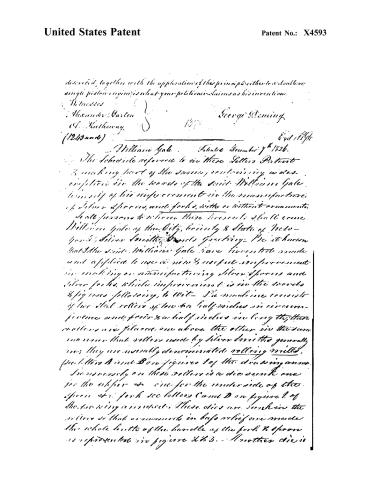
Page 2.
United States Patent
Patent No.: X4593
described, together with the application of this principle either to a double or single piston engine, is what your petitioner claims as his invention.
Witnesses
Alexander Barton
W. Hathaway
(1249 words)
George Deming
1377
Evd Hylt
William Gale. Patent December 7th 1826.
The Schedule referred to in these Letters Patent is making part of the same, containing a description in the words of the said William Gale himself of his improvement in the manufacture of silver spoons, and forks, with or without ornaments.
To all persons to whom these presents shall come, William Gale of the City, County & State of New-York, Silver Smith, &c. doth grant: Be it known that the said William Gale have invented and applied to use a new & useful improvement in making or manufacturing silver spoons and silver forks, which improvement is in the words & figures following, to wit— The machine consists of two steel rollers of ten to a half inches in circumference and from a half inches in long together, rollers are placed one above the other in the same manner that rollers used by Silver Smiths generally are; they are usually denominated rolling mills, (see letters A and B on figures 1 of the drawing annexed.) Impressively on these rollers is a die, one for the upper & one for the underside of the spoon & fork see letters C and D on figure 1 of the drawing annexed. These dies are such in the rollers so that ornaments in base relief are made the whole length of the handle of the fork & spoon as represented in figure 2 & 3. Another die is
Page 3.
United States Patent
Patent No.: X4593
such as shown by letter B. are one of the rollers only to make a spoon perfectly plain. These rollers are placed in wrought iron cast iron frames, and work in the same manner with common rollers as represented in figures 1. In the top of the frame screws are placed to regulate the rollers. These rollers may be turned by hand, horse, or steam power; the one now used by me is turned by hand with cranks. The silver must be prepared to the suitable size & thickness, and applied to the side of the rollers so as to come in contact with & be removed by the ends of the discs in their revolution & is received on the other side in the flat form of the spoon or fork.
The ornaments are perfectly formed in base relief. The spoon then requires only to be shaped, the bowl to be formed and fine polished. The silver for the forks must be prepared in the same way and applied in the same manner, and is in this way perfectly made, requiring only to be shaped & fine polished. I intend to apply this principle or improvement to the making of all kinds of silver spoons & forks, to any and every form and pattern.
Witnesses
William Gale
James R. Whiting
Thomas R. Landham
Expt. 1846.
Published accounts: journal notice
Notice in the monthly list of patents
Franklin Journal and American Mechanics' Magazine, vol. 4 (1827), p. 70 · View the page
In the manufacture of silver spoons, &c.; William Gale, New-York, Dec. 7.
About this record
- Patentee
- DATAMP
- Date
- DATAMP, USPTO records, Burke's List of Patents (1847)
- Invention
- DATAMP
- Listed in
- the Name and Date index of patents, DATAMP, USPTO records, Jim Shaw's X-patent list, the Journal of the Franklin Institute, S. A. Elliot's printed list of patents, Burke's List of Patents (1847)
- The sources give different dates; the date shown is the one most of them agree on.
- The Franklin Institute's journal confirms the date shown.
- S. A. Elliot's printed list of patents gives the same name and date.
- Burke's 1847 Patent Office list gives the same patent.