

Drawings and documents
USPTO scan
The patent as scanned by the USPTO
-
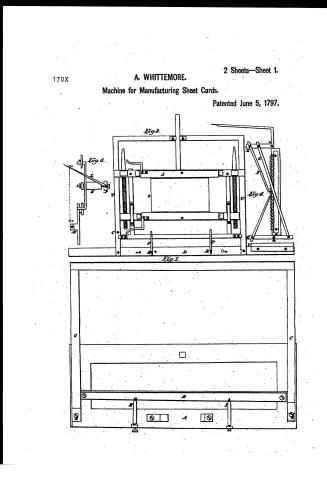 Page 1
-
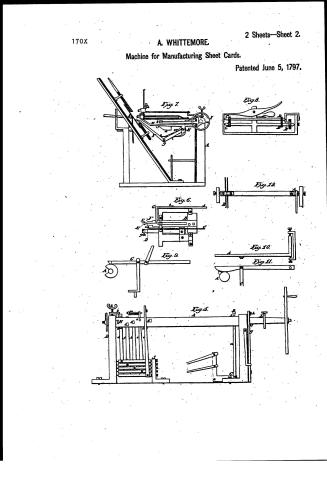 Page 2
-
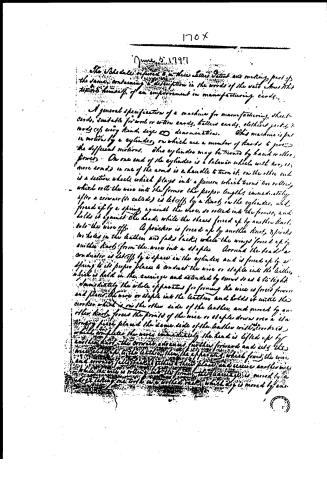 Page 3
-
 Page 4
-
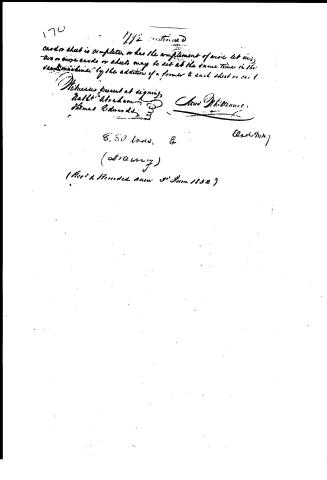 Page 5


U.S. Patent and Trademark Office · Google Patents
Published accounts: specification
Specification printed in the Mirror of the Patent Office (1828)
American Journal of Improvements in the Useful Arts, and Mirror of the Patent Office, vol. 1 (1828), printed p. 448 · View the page
Machine-read text of the specification as printed in the Mirror; not proofread. Check the page scan for figures, reference letters and spelling.
a By Amos Whittemore, of Boston. farts Bs. Specification —This machine is put in motion by a cylinder, on which are a number of knobs, to give the different motion. Pe . This cylinder may be turned by hand or other power. Onone 7? end of the cylinder is a balance wheel, with two or more arms; ee in ome of the arms is a handle to turn it; on the other end is a wee 2 sts eee rea eee ee ee emer eS et a Haters aH tii eer i ee . id ai oy Bi Ph BRR SMEE oe ee and iat net : aT lea oa section wheel, which plays into a pinion, which turns two rollers, which roll the wire into the former the proper length; immediately after, a crowner (so called) is let off by a knob on the cyl- Bb inder, and forced up by a spring against the wire, so rolled into P| the former, and holds it against the head, while the shears forced a up by another knob, cuts the wire off; a pricker is forced up by another knob, and pricks two holes in the leather, and eee falls back, while the wings, forced up by another knob, form the aa Wire into a staple around the head; a conductor is let off by 'a ee space in the cylinder, and is forced up by a spring to its ‘proper a place, to conduct the wire or the staple into the leather, which ~ a is held in the carriage, and extended by screws, so as to be tight. ie Immediately the whole apparatus for forming the wire is forced a forward, and places the wire or staple into the leather, and holds > ssa it until the crooker which is on the other side of the leather, and . a moved by another knob, forces the points of the wire or staple down over a stationary piece, placed the same side of the leath- a er with the crookers, which completes the wire; iramediately the head is lifted up by another knob; the crowner advances oc further forward, and sets the wire close up to the leather; then the apparatus, which forms the wire, and crowner, falls back ce together to their place and receive another wire: while the wire is rolling into the former, the carriage is moved bya dog, taking te one tooth in a tooth rack, which dog is moved by another knob a on the cylinder, and moves the carriage and leather to receive =. another wire or staple. It continues on until it goes once through ‘ag the cord or sheet, lengthwise, and is held up by a piece whichis governed by a spring, and a straight piece which gives the Bhs, length of the carder-sheet. The instant this dog is raised, an- a "a other dog at the opposite end of the machine, falls into another a ey tooth rack, and moves the carriage and sheet back, in the same’ ae manner it was carried forward. This dog is moved by the same es knob which moves the first mentioned dog by being connected . oe: with it, at the same time these dogs shift another dog, which is a moved by a small wheel on the end of the cylinder, being con- a nected with a piece which falls into a blank or space in the eS small wheel, by which means the dog takes one tooth inarage wheel, which is placed on an arbor above the small wheel,on which arbor are two small wheels, on which wind twochainsor straps, which are confined to the carriage or piece which the ‘Sa carriage slides on. The piece connected with the dog rises immediately as the small wheel on the first mentioned arbor rebe volves round and forces the dog to move the rag-wheel, andwinds the chains or straps, which raises the carriage and leather suffi- _ ciently for another row of wires to be Jet in; it holds the rag- ect a wheal. in the same place until the row of wires be full. This ae piece, which is connected with the dog which moves the rag- ee yuk a Neer YE ah cite is) Aa on RS Pe ' TEN Oa oo Tk wheel, is also connected with another piece un ler it, 1 hich rests and slides ona straight piece, the same len; ee the ay Oye straight piece that gives the length of the cord or sheet, and governs the other two dogs. This piece so connected with the dogs, slides on the straight piece, as the iariige! is moved on end (the straight piece being confined to, the. carriage) until it slips off the end of the straight piece, and lets the piece above connected with it, and the dog, fall into a blank or space in the small wheel on the first mentioned cyl inder, to let the dog take one tooth in the rag wheel, and rising Ey again by the small wheel revolving round, is caught on the a straight piece and held up until the row of wire is full, and then. slips off the other end, continues to operate in the same manner, until the card or sheet is complete, or has the compliment of wire let in. Two or more cards or sheets may beset at the same time in the same machine, by the addition of a for- Ee mer to each sheet or card. a testy ig ees Patented June 5th, 1797. ee aa Ce ci
[References to the plate, as printed:]
There is a hasty drawing accompanying this, without referenae ces; it is, therefore, not necessary to give a plate of it; noris _ there room for it inthis number. If, upon further consideration, _ a it is found to be expedient to give one, we shall do it ina future a number. prow Sales ely thee AES pi a . ARTIFICIAL EMMERY. (si
DATAMP: illustration
Illustrations from DATAMP
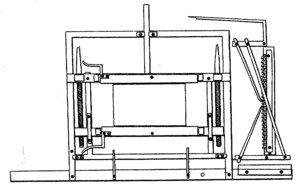
DATAMP (Directory of American Tool and Machinery Patents), via the Internet Archive · Archived DATAMP page
About this record
- Patentee
- DATAMP
- Date
- the Name and Date index of patents, DATAMP, USPTO records
- Invention
- DATAMP
- Listed in
- the Name and Date index of patents, DATAMP, USPTO records, Jim Shaw's X-patent list, the Mirror of the Patent Office (1828), S. A. Elliot's printed list of patents, Burke's List of Patents (1847)
- The specification was printed in the Mirror of the Patent Office (1828).
- S. A. Elliot's printed list of patents gives the same name and date.
- in_burke