

Drawings and documents
Published accounts: specification
Specification printed in the Mirror of the Patent Office (1828) with its plate
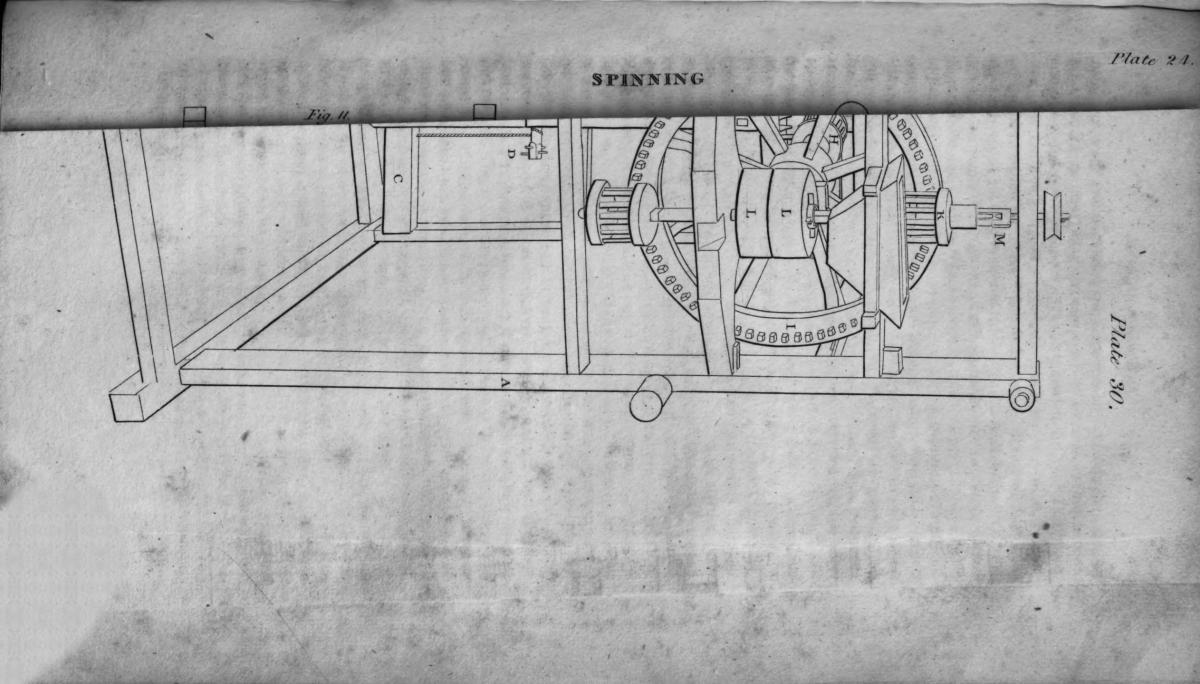
American Journal of Improvements in the Useful Arts, and Mirror of the Patent Office, vol. 1 (Washington, 1828) · View the page
Transcription
Machine-read text of the specification as printed in the Mirror; not proofread.
IMPROVEMENT IN THE GRIST MILL, 6) 4) sy.
By James and William Hindman, of Brown county, Ohio—See Plate XX by fF Be it known, that we, the said James and William Hindman of: the county and State aforesaid, have invented, constructed, ;and We: made, a new and useful improvement in the grist mill, not known or used heretofore, specified and described in the words follow~ ing: a frame is first constructed of suitable size and strength to support the machinery, hereinafter described. In this frame we: erect, in the first place, an upright shaft, to be turned by a water wheel. placed at the bottom of it, in such a manner as to be subject to elevation and depression as occasion may require. Thisiis ef fected by cutting mortises as near the lower end of the, shaft as convenient; the length of which is governed by circumstances. In these mortises the arms of the wheel are to cross at right angles, leaving in the mortises a vacancy to enable the miller, by the help ofa windlass or other suitable method, to raise or lower the wheel at pleasure. In the forebay is placed a spout, the end of which rests in a sliding gate, which may be raised or lowered in the same way as that of the wheel, and the water thrown ina di-. rection to suit it; the passage of the water being obstructed at the lower end of the forebay, to such a height as the nature of the case may require. gO ge means we avoid ali inconvenience from back-water. On the upper extremity of this upright shaft, is placed a master cog, or band wheel; if a cog wheel, a wallower is made to mash ty into it, which turns a counter shaft, with a counter cog wheel on its extremity of sufficient dish to mash in the trunnel heads, one placed above, the other below the stones. This gives the stones aes motion in contrary directions, by which means the business of a grinding is greatly facilitated. ‘The spindle for the upper stone must be square at the lower end, and in the form of a winged gudgeon. Two mortises are to be inserted in the spindle to receive two iron cross arms in the eye of the stone, which serve to confine the spindle in the stone. The spindle is to be, rounded near the centre, between the stone and trunnel head, and a follower fixed on it, with a box of oil fixed under the follower, to oil the spindle.
The stones may be separated or put together by means of a male or female screw on the top of the spindle, with aswivel in the female screw, and worked by means of two. band-wheels, as occasion may require. ‘The under spindle is to be fastened in the stone, oiled and supported in the same way as the upper one. The under stone is also supported by two arms, passing through the spindle, and extending beyond the extremity of the stone, for the purpose of actuating hopper boys to throw the meal into the spout. ;
een: oer ene Ee eT ee ee es ny ee Ge det a ee peg : gels hg We claim as new and original, the mode of raising the water and wheel, and turning the stones incontrary directions, the mode of closing and separating them, together with the method, of ae making and oiling the spindles; and these principles are intended, to apply to water wheels of every description, horse-mills,, &c. pi sil. REFERENCES—PLATE XXX.
A Supporting frame.
Upright shaft of the water wheel.
Four arm of a water wheel which cam be elevated or depressed, in the grooves of the upright shaft. ;
D. Windlass, with ropes to raise or lower the wheel. Sliding gate of the forebay.
Spout. :
Master cog-wheel.
Horizontal wallower. :
Counter cog-wheel. :
The two upright trunnel heads.
The two stones which move in contrary directions, M: Male and female screw, swivel and wheel, for separating and putting the stones together. * ;
PORTABLE THRASHING MACHINE, FOR WHEAT AND OTHER SMALL GRAIN. .
About this record
- Listed in
- the Mirror of the Patent Office (1828)
- This patent has no X number: it is not in the list of patents restored after the 1836 fire. It is known only from the printed lists named below. The reference number (U…) is the IP Mall’s own.
- Listed in the Journal of the Franklin Institute or the Mirror of the Patent Office at the time of issue.