

Drawings and documents
USPTO scan
The patent as scanned by the USPTO
-
 Page 1
-
 Page 2
-
 Page 3
-
 Page 4


U.S. Patent and Trademark Office · Google Patents
Show the transcription Hide (1,031 words)
Machine transcription (LightOnOCR) of the pages as scanned by the USPTO, most of them the handwritten copies made when the records were restored after the 1836 fire. Not checked; it can misread handwriting, so compare it with the scan.
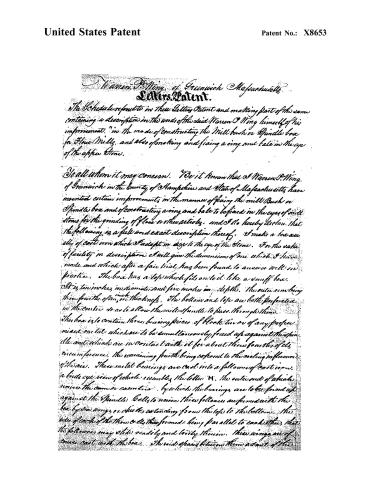
Page 2.
United States Patent
Patent No.: X8653
Warren P. Wing, of Greenwich, Massachusetts
Letters Patent.
The Schedule referred to in these Letters Patent and making part of the same containing a description in the words of the said Warren P. Wing himself of his improvement, "in the mode of constructing the Mill bush or Spindle box for Flour Mills, and also of making and fixing a ring and bale in the eye of the upper Stone."
To all whom it may concern. Ye it known that I Warren P. Wing of Greenwich in the County of Hampshire and State of Massachusetts have invented certain improvements in the manner of fixing the mill Bush or Spindle box and of constructing a ring and bale to be fixed in the eyes of mill stones for the grinding of flour or other articles, and I do hereby declare that the following is a full and exact description thereof. I make a box usually of cast iron which I adapt in size to the eye of the Stone. For the sake of facility in description I will give the dimensions of one which I have made and which after a fair trial has been found to answer well in practice. The box has a top which fits on to it like a snuff box. It is ten inches in diameter and five inches in depth. The outer rim being three fourths of an inch thick. The bottom and top are both perforated in the centre so as to allow the mill spindle to pass through them. This box is to contain three bearing pieces of block tin or of any proper mixed metal which are to be simultaneously forced up against the spindle and which are in contact with it for about three fourths of its circumference, the remaining fourth being exposed to the cooling influence of the air. These metal bearings are cast into a follower of cast iron, a bird’s eye view of which resembles the letter A. The outer end of which receives the cam or eccentric by which the bearings are to be forced up against the Spindle. Bells to receive these followers are formed with the box by two wings or sheets extending from the top to the bottom. The side flanks of the three cells thus formed being parallel to each other, the followers may slide readily and truly therein. These wings are of course cast with the box. The void space between them admits of the
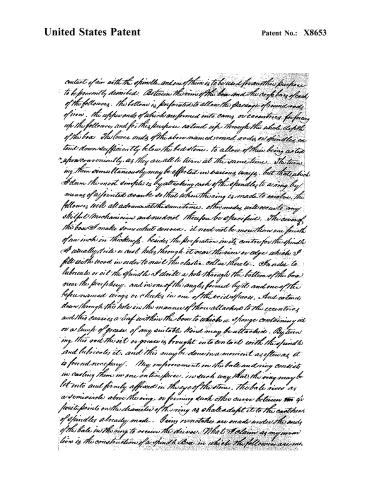
Page 3.
United States Patent
Patent No.: X8653
contact of air with the spindle, and one of them is to be used for another purpose to be presently described. Between the rim of the box and the ends bars of each of the followers, the bottom is perforated to allow the passage of round rods of iron, the upper ends of which are formed into cams or eccentrics for forcing up the followers, and for this purpose extend up through the whole depth of the box. The lower ends of the above named round rods or spindles extend down sufficiently below the bed stone, to allow of their being acted upon conveniently, as they are all to turn at the same time. The turning them simultaneously may be effected in various ways, but that which I deem the most simple is by attaching each of the spindles to a ring by means of a jointed crank so that when the ring is made to revolve, the followers will all advance at the same time. Other modes will occur to any skilful mechanic and need not therefore be specified. The cover of the box I make somewhat conical, it need not be more than one fourth of an inch in thickness, besides the perforation in its centre for the spindle I usually drill or cast holes through it near the rim or edge which I fill with wood in order to nail the elastic collar thereto. In order to lubricate or oil the spindle I drill a hole through the bottom of the box near the periphery, and in one of the angles formed by it and one of the before named wings or cheeks in one of the void spaces. And extend down through this hole in the manner of those attached to the eccentrics, and this carries a leaf within the box to which a sponge containing oil or a lump of grease, of any suitable kind may be attached. By turning this rod the oil or grease is brought into contact with the spindle and lubricates it, and this may be done in a moment as often as it is found necessary. My improvement on the bale and ring consists in casting them in one entire piece, in such way that the ring may be let into and firmly affixed in the eye of the stone. The bale rises as a semicircle above the ring, or forming such other curve between two opposite points on the diameter of the ring as shall adapt it to the center of spindles already made. Gains or notches are made under the ends of the bale in the ring to receive the drive. What I claim as my invention is the construction of a spindle box in which the followers are arranged
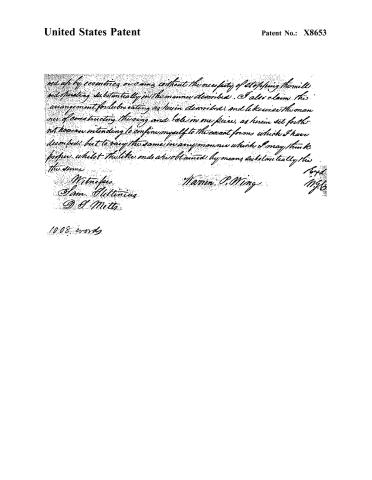
Page 4.
United States Patent
Patent No.: X8653
and up by eccentrics or cams without the necessity of stopping the mill and operating substantially in the manner described. I also claim this arrangement for lubricating as herein described, and likewise the manner of constructing the ring and lobe in one piece, as herein set forth, not however intending to confine myself to the exact forms which I have described, but to vary the same in any manner which I may think proper, whilst the like ends are obtained by means substantially the same.
Witnesses:
Sam. Hiltinius
D. J. Metts
Warren. P. Wing
1008 words
Published accounts: journal notice
Notice in the monthly list of patents, with remarks
Journal of the Franklin Institute, new ser., vol. 16 (1835), p. 167 · View the page
28. For an improved mode of constructing a Mill Bush, or Spindle Box, and a Ring and Ball for the Stones of Flour Mills; Warren P. Wing, Greenwich, Hampstead county, Massachusetts, February 20.
Remarks. (See the specification.)
Published accounts: journal notice
Notice in the monthly list of patents
Journal of the Franklin Institute, new ser., vol. 16 (1835), p. 179 · View the page
Specification of a Patent for a new and improved mode of constructing a Mill Bush, or Spindle Box, for Flour Mills; and also of making and fixing a Ring and Bale in the Eye of the upper Stone. Granted to WARREN P. WING, of Greenwich, Hempstead county, Massachusetts, February 20th, 1835.
Published accounts: specification
Specification printed in the Journal of the Franklin Institute
Journal of the Franklin Institute, new ser., vol. 16 (1835), p. 179 · View the page
Text of the specification as printed in the Journal, from OCR; not proofread.
Specification of a Patent for a new and improved mode of constructing a Mill Bush, or Spindle Box, for Flour Mills; and also of making and fixing a Ring and Bale in the Eye of the upper Stone. Granted to WARREN P. WING, of Greenwich, Hempstead county, Massachusetts, February 20th, 1835. To all whom it may concern, be it known, that I, Warren P. Wing, of Greenwich, in the county of Hampshire, and State of Massachusetts, have invented certain improvements in the manner of fixing the mill bush, or spindle box, and of constructing a ring and bale to be fixed in the eyes of millstones for the grinding of flour, or other articles; and I do hereby declare that the following is a full and exact description thereof. I make a box, usually of cast-iron, which I adapt in size to the eye of the stone. For the sake of facility of description, I will give the dimensions of one which I have made, and which, after a fair trial, has been found to answer well in practice. The box has a top, which top fits on to it, like a snuff-box. It is ten inches in diameter, and five inches in depth, the outer rim being three-fourths of an inch in thickness. The bottom and top are both perforated in the centre, so as to allow the mill spindle to pass through them. This box is to contain three bearing pieces, of block tin, or of any proper mixed metal, which are to be simultaneously forced up against the spindle, and which are in contact with it for WING'S Mill Bush, or Spindle Box. about three-fourths of its circumference, the remaining fourth being exposed to the cooling influence of the air. These metal bearings are cast into a follower of cast-iron, a birds-eye view of which resembles the letter H, the outer end of which receives the cam, or eccentric, by which the bearings are to be forced up against the spindle. Cells to receive these followers are formed within the box, by six wings, or cheeks, extending from the top to the bottom, the sides of each of the three cells thus formed being parallel to each other, that the followers may slide readily and truly therein; these wings are, of course, cast with the box. The void spaces between them admit of the contact of air with the spindle, and one of them is to be used for another purpose, to be presently described. Between the rim of the box, and the crossbars of each of the followers, the bottom is perforated to allow the passage of round rods of iron, the upper ends of which are formed into cams, or eccentrics, for forcing up the followers, and, for this purpose, extend up through the whole depth of the box. The lower ends of the above named round rods, or spindles, extend down sufficiently below the bed stone to allow of their being acted upon conveniently, as they are all to turn at the same time. The turning them simultaneously may be effected in various ways, but that which I deem the most simple is by attaching each of the spindles to a ring, by means of a jointed crank, so that, when the ring is made to revolve, the followers will all advance at the same time; other modes will occur to any skilful mechanician, and need not, therefore, be specified. The cover of the box I make somewhat convex; it need not be more than one-fourth of an inch in thickness; besides the perforation in its centre for the spindle, I usually drill, or cast, holes through it, near the inner edge, which I fill with wood, in order to nail the elastic collar thereto. In order to lubricate, or oil, the spindle, I drill a hole through the bottom of the box, near the periphery, and in one of the angles formed by it, and one of the before named wings, or cheeks, in one of the void spaces. A rod extends down through this hole, in the manner of those attached to the eccentrics, and this carries a leaf within the box, to which a sponge containing oil, or a lump of grease of any suitable kind, may be attached. By turning this rod, the oil, or grease, is brought into contact with the spindle, and lubricates it; and this may be done in a moment, as often as it is found necessary. My improvement in the bale and ring consists in casting them in one entire piece, in such way that the ring may be let into, and firmly affixed in, the eye of the stone. The bale rises as a semicircle above the ring, or forming such other curve between two opposite points on the diameter of the ring, as shall adapt it to the cock heads of spindles already made. Gains, or notches, are made under the ends of the bale, in the ring, to receive the driver. What I claim as my invention, is the construction of a spindle box, in which the followers are moved up by eccentrics, or cams, without the necessity of stopping the mill, and operating substantially in the manner described. On the Purification of Gold. I also claim the arrangement for lubricating, as herein described, and likewise the manner of constructing the ring and bale in one piece, as herein set forth; not, however, intending to confine myself to the exact form which I have described, but to vary the same in any manner which I may think proper, whilst the like ends are attained by means substantially the same. WARREN P. WING. TRANSLATIONS FROM Foreign JourNALS. On the Action of Hydro-chlorate Muriatic Acid Gas on Silver, at a high temperature. Theory of the Method of Parting in the Dry Way. By M. BOUSSINGAULT. (Translated for this Journal, by Jos. Wharton.) By the phrase parting in the dry way, the old chemists designated an operation by which they were able, by a long continued cementation, to remove, almost entirely, silver, and the other metals that are found alloyed with gold. This process has its origin in the highest antiquity, and it was not till near the year 1350, that the method of parting by aquafortis began to be at all known throughout Europe; while, owing to the high price of the acids, the use of this process was, for a long time, confined to the laboratories of experimenters, and the operations by the dry way, such as sulphuration by crude antimony, (sulphuret of antimony,) treatment with corrosive sublimate, and cementation with white clay and salt, continued to be employed for the purification of gold. Since that time, however, among the various results effected by the great progress of the arts dependent upon chemistry, the great diminution in the price of the acids, that followed as a consequence, soon rendered the method of parting in the wet way practicable on a large scale; and it is generally known to what a high degree of perfection the refining of gold and silver is now carried, by the French in particular, so that, at the present day, the ancient processes have been entirely abandoned throughout Europe. But the European arts, which were established in the new world at the period of its discovery, have remained there so nearly stationary, that I found, not long since, in various workshops, the processes of the middle age. Thus, in establishments as important as the mints of New Granada, the separation of the silver contained in the gold of the mines, is still effected in the dry way. I could hardly have been placed in circumstances of a more interesting nature than thus to find myself, as I did, among the instruments of the period of the chemistry of the furnace, and even to meet, scientifically speaking, with the men of that epoch. It was as if I had met with chemists, who had just waked up, after a sleep of three centuries. * At the request of the Committee on Publications. On the Purification of Gold. In the mint of Santa-Fé, cementation, or parting in the dry way, is always employed, when it is desired to free the gold of the mines from the silver that is combined with it, oftentimes in large proportions, so as to bring it to the state of purity required by the law for the regulation of the gold coinage. The argentiferous gold being first reduced to the granular state, is subjected to the process of cementation in kettles of porous earth. The cement is composed of two parts of brickdust, and one of powdered sea salt, mixed together. A layer of this cement is first spread out on the bottom of the vessel, and is then covered with the granulated ore; this last is then covered with a fresh layer of cement, and so on. The layers of cement should be about an inch in thickness. A cementing pot contains, generally, from ten to fifteen pounds (French) of gold. The furnace in which the cementation is effected, is a hollow cylinder, four and a half feet in diameter, by nine feet in height; at about three feet from the ground, is placed a grate, on which the cementing pots stand. At the bottom of the furnace, on the very level of the ground, an opening is made, through which the fuel is introduced. This furnace has neither fire grate nor chimney, and the cementing pots are put in and taken out from above. The operation requires from twenty-four to thirty-six hours, varying with the quantity of silver to be extracted; the cementing pots are kept at a cherry red heat. The operation being finished, the cement is washed in water, which causes the gold to separate in grains, of about twenty-one to twenty-two carats. These are melted together into bars of a suitable size, for lamination. The cement, after being pounded into a fine paste, is mixed with one-tenth its weight of sea salt, and then amalgamated with mercury. The mercury added is nearly ten times the amount of silver present in the cement. The process of amalgamation is carried on in large wooden troughs, at a temperature varying from 14° to 18º of the Centigrade scale, (57.2° to 64.4° Fahrenheit;) the operation requires from four to five days. The chloride of silver enclosed in the cement is reduced by the mercury, during the process of amalgamation; chloride of mercury is formed, and carried off in the washings; while the metallic silver amalgamates with mercury. This amalgam is always very dry, on account of the large quantity of chloride of mercury diffused through its mass. The silver obtained after driving off the mercury, is nearly pure, containing only a few thousandths of gold. In the process of cementation, the silver is converted into a chloride by the action of the dry clay, and the equally dry marine salt, a reaction which does not receive a satisfactory rationale from the facts hitherto determined on the subject. But, however this may be, since the process was attended with success, in the case of argentiferous gold in large sized grains, I determined to apply it to the extraction of silver contained in powdered gold, extracted by washing from pyrites. This gold ordinarily contains 0.26 of silver; but before operating on large quantities, I wished On the Purification of Gold. to attempt certain modifications, by erecting a furnace more economical in point of fact, but particularly by the substitution of Cornwall crucibles, for holding the mixed powders, instead of the fragile vessels above referred to, so that the chances of fracture might be diminished as far as possible. With this view, the mixture of powdered gold and cement was placed in a crucible, and exposed for thirty hours to the heat of a furnace, wood charcoal being used for fuel. At the end of this time, the standard of the gold was not sensibly altered; a result which, it will be admitted, was calculated to surprise. I had the patience to keep the powdered gold under the heat for seventy-two hours; but, notwithstanding, the gold was found, after the operation, to contain almost as much silver as before it was subjected to the fire. In a word, all my efforts with good crucibles uniformly failed, and I was forced, to the great satisfaction of the workmen, to return to the ancient method of operation. It seemed extremely probable that the access of air was indispensably necessary to ensure the success of the cementation; it was, at least, only in this way that I could account for the advantage presented by badly burnt and porous earthen vessels, over crucibles of a good quality, and, so to speak, impermeable. To satisfy myself on this point, I made the following experiment. I took two laminæ of silver, weighing each 24.6 grains; one of these I placed in the centre of a small porcelain vessel, filled with a cement of sea-salt and brickdust; the vessel was placed in the centre of a crucible, and covered over with charcoal powder, heaped up around it; so that all precautions were taken to keep the metal out of contact with the air. The other silver plate was, on the contrary, exposed on a cupel containing the cement, and the cupel was placed under the muffle of an assay furnace; so that, in this case, the access of air was facilitated as much as possible. Heat was applied for seven hours; the sheet enclosed in the crucible had not, at the end of that time, materially diminished in weight; it still weighed 24.3 grains; while, on the contrary, that placed under the muffle weighed only 9.5 grains; it had, consequently lost 15.1 grains. The surface of the second plate was much corroded, and the cement was impregnated with chloride of silver. The presence of air was thus shown to be indispensable to the success of the cementation; but its action, in the conversion of the silver into a chloride, still remained to be examined. I first endeavoured to determine whether sea salt alone could attack silver at a red heat; but a sheet of this metal, placed in a cupel, under the muffle, and covered over with sea salt, experienced no alteration, even after being subjected for three hours to the heat. During the progress of this experiment, I had occasion to observe the great increase in the volatility of chloride of sodium, produced by the passage of a current of very hot air. The salt, as soon as it was placed in the cupel, (under the muffle,) gave out fumes in abundance, and, in a short time, was entirely dissipated. It follows, then, from this experiment, that the presence of the clay, also, is essential to the conversion of the silver into a chloride, On the Purification of Gold. by the action of sea salt; and as it is composed of silica and alumina, it appeared worth while to study separately the action of these two substances. Two laminæ of silver, weighing each 6.5 grains, were accordingly placed in two different cupels; in one of these cupels was put a cement, composed of silica and sea salt; in the other, a cement composed of alumina, and the same. For four hours, the muffle of the furnace was kept at a heat above a cherry red; at the end of this time, the silver in the aluminous mixture had completely disappeared. On cooling, the cement belonging to this cupel was slightly agglutinated; it presented a crystalline structure, but was not sensibly saline to the taste. When first taken from the furnace, it was of a brilliant white appearance, but on exposure to the solar rays, it soon acquired a deep violet tint; the sheet enclosed in the silicious cement still weighed four grains; it presented a very striking crystalline appearance, over the whole extent of its surface; certain points were covered with a plaster, so to speak, of an olive green, which adhered strongly to the metal; the parts of the cement that had been in contact with the silver, were of a deep brown colour. The cement was not saline to the taste, and was almost wholly vitrified. It is doubtless to this last circumstance that the failure of the cementation with the silicious mixture must be attributed. It is known that, even at a high temperature, silica exerts positively no action upon sea salt, if the materials be perfectly dry; but the researches of MM. Thenard and Gay Lussac, have shown that the presence of watery vapour immediately determines an energetic action, attended by the disengagement of hydro-chloric acid gas, and the formation of silicate of soda. It is evident, then, that, in the above experiment with the silicious cement, vapour of water was present, since the chloride of sodium was vitrified by the silica. The air, in traversing the muffle of the cupel furnace, must, then, have carried with it a sufficient quantity of watery vapour to establish the reaction. In cementation on a large scale, such as is carried on at Santa-Fé, the cementing materials are constantly surrounded with watery vapours, produced during the combustion of the wood. To prove that it is really the vapour of water constantly present in the atmosphere, or that produced during the combustion of the fuel, which renders the presence of air necessary in the cementing process, I placed a sheet of silver, surrounded with cement, in a porcelain tube, and, after raising it to a red heat, caused a stream of well dried air to pass through it; as I expected, the silver suffered no change whatever. A difficulty, however, still remained. If, as seemed evident, the vapour of water be the agent that determines the action of the earths on the sea salt, hydro-chloric acid should, indubitably, be produced; and as we have found that the silver is transformed into a chloride, and no hydro-chloric acid is evolved, it follows, as a probable consequence, that the last named substance is decomposed by silver at a red heat, though this metal is generally supposed to exert no action whatever on hydro-chloric acid gas, even at high degrees of heat; this point remained, then, to be determined. On the Purification of Gold. A lamina of silver, twisted into a spiral, was introduced into a tube of porcelain, and placed in a furnace. By one end of the tube was introduced a current of hydro-chloric acid gas, previously dried by passing through chloride of calcium; at the other extremity was fitted a tube, entering under a bell glass filled with water. When the heat rose to a red, hydrogen gas began to be disengaged, but very quickly ceased coming over, the acid gas then continuing its passage, without decomposition, and the water of the bell glass became acid. On examination, the surface of the silver was found to be covered with a varnish of chloride of silver, and it was clear that the metal had been protected from further contact with the acid by the coating thus afforded it. To remedy this difficulty, in a measure, the silver lamina was surrounded with alumine, for the purpose of absorbing, as much as possible, the chloride produced. This second experiment succeeded much better than the former, and I was enabled to fill several test tubes with the hydrogen evolved; the exit of this gas under the receiver took place, however, in very small bubbles, and it was easy to perceive, from the strong acidity of the water, that the greater part of the acid still escaped decomposition. The evolution of hydrogen became slower and slower, and soon entirely ceased. The silver, when examined, was found to be much corroded, although the chloride produced had entered but very little into the body of the alumine, and the metal was still covered with a layer of chloride, which was a sufficient reason why the silver had escaped final destruction. In a second experiment, in which I added sea salt to the alumine, the operation continued without interruption, although, as in the preceding experiments, the hydrogen was evolved in very small bubbles, and the greater part of the acid passed over without decomposition. The addition, in this case, of the sea salt, was found to have greatly facilitated the diffusion of the chloride of silver through the alumine, and it is more than probable that the effect is due to the tendency of the two chlorides to combine together. The do
About this record
- Patentee
- DATAMP
- Date
- the Name and Date index of patents, DATAMP, USPTO records
- Invention
- DATAMP
- Listed in
- the Name and Date index of patents, DATAMP, USPTO records, Jim Shaw's X-patent list, the Journal of the Franklin Institute, Burke's List of Patents (1847), the Journal of the Franklin Institute, Journal
- Burke's 1847 Patent Office list gives the same patent.