

Drawings and documents
USPTO scan
The patent as scanned by the USPTO
-
 Page 1
-
 Page 2
-
 Page 3


U.S. Patent and Trademark Office · Google Patents
Show the transcription Hide (562 words)
Machine transcription (LightOnOCR) of the pages as scanned by the USPTO, most of them the handwritten copies made when the records were restored after the 1836 fire. Not checked; it can misread handwriting, so compare it with the scan.
Page 1.
7753X
No Printed Specification Available
T W Harvey,
Spike.
Patented Sep. 13, 1833.
Fig. 1
No. 1
No. 2
Fig. 2
No. 1
No. 2
Fig. 3
H
Page 2.
9/13/1833 7753x
Sept. 13 1833 7
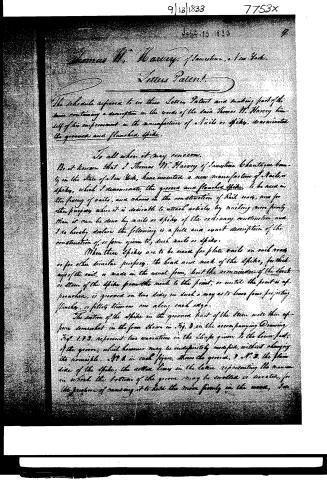
Thomas W. Harvey, of Jamestown, a New York.
Letters Patent.
The schedule referred to in these Letters Patent and making part of the same containing a description in the words of the said Thomas W. Harvey himself of his improvement in the manufacture of a Nail or Spike, denominated the grooved and flancher spike.
To all whom it may concern.
Be it known that I Thomas W. Harvey of Jamestown Chautauqua County in the State of New York, have invented a new manufacture of Nails, or Spikes, which I denominated the grooved and flancher spike, to be used in the fixing of rails, and chains in the construction of Rail roads, and for other purposes where it is desirable to attach articles by nailing more firmly than it can be done by nails or Spikes of the ordinary construction, and I do hereby declare the following is a full and exact description of the construction of, or form given to, such nails or Spikes.
When these Spikes are to be used for plate rails or rail roads or for other similar purposes, the head and neck of the Spike, for the purpose of the nail, is made in the usual form, but the circumference of the head or stem of the Spike from the neck to the point, or until the point is approached, is grooved on two sides in such a way as to have four projecting flanches, or fillets, running one along each edge.
The section of the Spike in the grooved part of the stem will then appear somewhat in the form shown in Fig. 3 in the accompanying Drawing. Fig. 1 & 2. represent two variations in the shape given to the lower parts of the groove; which however may be indefinitely modified, without changing the principle. At A. in each figure, shows the groove, & N. B. the stem side of the Spike; the dotted lines in the latter representing the manner in which the bottom of the groove may be swollen or serrated, for the purpose of causing it to hold the more firmly in the wood.
Page 3.
7753x
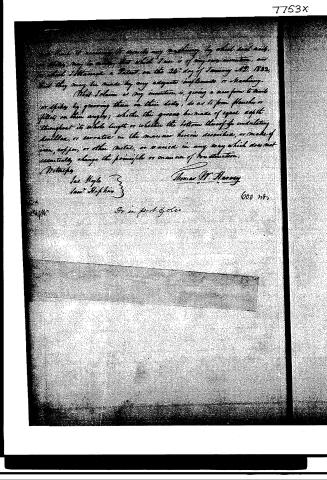
I do hereby declare that I have no machinery by which said nails, or spikes, may be made, that which I use is of my own invention, and for which I obtained a Patent on the 24th day of January A.D. 1832, that they may be made by any adequate implements or machinery.
What I claim as my invention, is, giving a cross form to nails or spikes by grooving them on their sides, so as to form flanches or fetters on their angles; whether the grooves be made of equal depth throughout its whole length or whether the bottom thereof be undulating, double, or serrated in the manner herein described, or made of iron, copper, or other metal, or varied in any way which does not essentially change the principle or manner of construction.
Witnesses
Jos. Nyle
Sam'l Hopkins
Thomas W. Harvey
600 no.
In part of title
Published accounts: journal notice
Notice in the monthly list of patents, with remarks
Journal of the Franklin Institute, new ser., vol. 13 (1834), p. 177 · View the page
18. For an improvement in Nails and Spikes, denominated the Grooved and Flanched Spike; Thos. W. Harvey, Jamestown, Chataque county, New York, September 14.
Remarks. (See the specification.)
Published accounts: journal notice
Notice in the monthly list of patents
Journal of the Franklin Institute, new ser., vol. 13 (1834), p. 184 · View the page
Fig.. S. What I claim as my invention is, the giving a new form to nails, or spikes, by grooving them on their sides, so as to form flanches, or fillets, on their angles; whether this groove be made of equal depth LESTER'S Improved Water Wheel. throughout its whole length, or whether the bottom thereof be undulating, swelled, or serrated, in the manner herein described, or made of iron, copper, or other metal, or varied in any way which does not essentially change the principle, or manner of construction. THOMAS W. HARVEY. Specification of a patent for an improved Water Wheel. Granted to EBENEZER A. LESTER, Boston, Massachusetts, September 13,1833.
Published accounts: specification
Specification printed in the Journal of the Franklin Institute
Journal of the Franklin Institute, new ser., vol. 13 (1834), p. 183 · View the page
Text of the specification as printed in the Journal, from OCR; not proofread.
Specification of a patent for an improvement in Nails and Spikes, denominated the Grooved and Flanched Spike. Granted to THOMAS W. HARVEY, Jamestown, Chataque county, New York, September 13, 1832. To all whom it may concern, be it known, that I, Thomas W. HARVEY'S Improved Nails, or Spikes. Harvey, of Jamestown, in the county of Chataque, and state of New York, have invented a new manufacture of nails, or spikes, which I denominate the grooved and flanched spike, to be used in the fixing of rails and chairs in the construction of rail-roads, and for other purposes, where it is desirable to attach articles by nailing, more firmly than it can be done by nails, or spikes, of the ordinary construction: and I do hereby declare that the following is a full and exact description of the construction of, or form given to, such nails or spikes. When these spikes are to be used for plate rails on rail-roads, or other similar purposes, the head and neck of the spike, for the thickness of the rail, is made in the usual form, but the remainder of the shank, or stem, of the spike, from the neck to the point, or until the point is approached, is grooved on two sides, in such a way as to leave four projecting flanches, or fillets, thereon, one along each edge. The section of the spike in the grooved part of the stem, will then appear somewhat in the form shown in fig. 3, in the accompanying drawing. Figs. 1 and 2, represent two varieties in the shape given to the lower part of the groove, which, however, may be indefinitely modified, without changing the principle. No. 1, in each figure, shows the grooved, and No. 2, the plain side of the spike, the dotted lines in the latter representing the manner in which the bottom of the groove may be swelled, or serrated, for the purpose of causing it to hold the more firmly in the wood. I do not think it necessary to describe any machinery by which such nails, or spikes, may be made; that which I use is of my own invention, and for which I obtained a patent on the 24th day of January, 1832, but they may be made by any adequate implements or machinery. No. 1. No. 2. No. 1. No. 2. Fig. 1. Fig. 2. Fig.. S. What I claim as my invention is, the giving a new form to nails, or spikes, by grooving them on their sides, so as to form flanches, or fillets, on their angles; whether this groove be made of equal depth LESTER'S Improved Water Wheel. throughout its whole length, or whether the bottom thereof be undulating, swelled, or serrated, in the manner herein described, or made of iron, copper, or other metal, or varied in any way which does not essentially change the principle, or manner of construction. THOMAS W. HARVEY.
About this record
- Patentee
- DATAMP
- Date
- the Name and Date index of patents, DATAMP, USPTO records
- Invention
- DATAMP
- Listed in
- the Name and Date index of patents, DATAMP, USPTO records, Jim Shaw's X-patent list, the Journal of the Franklin Institute, Burke's List of Patents (1847), the Journal of the Franklin Institute, Journal
- The Franklin Institute's journal gives a different date.
- Burke's 1847 Patent Office list gives the same patent.