

Drawings and documents
USPTO scan
The patent as scanned by the USPTO
-
 Page 1
-
 Page 2
-
 Page 3
-
 Page 4


U.S. Patent and Trademark Office · Google Patents
Show the transcription Hide (813 words)
Machine transcription (LightOnOCR) of the pages as scanned by the USPTO, most of them the handwritten copies made when the records were restored after the 1836 fire. Not checked; it can misread handwriting, so compare it with the scan.
Page 2.
United States Patent
Patent No.: X6513
Calvin W. Cook of Lowell, Massachusetts,
Letter Patent
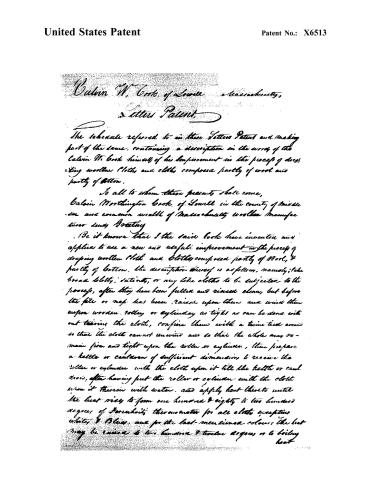
The schedule referred to in these Letters Patent and making part of the same, containing a description in the words of the Calvin W. Cook himself of his improvement in the process of dyeing woollen cloth and cloths composed partly of wool and partly of cotton.
To all to whom these presents shall come,
Calvin Worthington Cook of Lowell in the county of Middlesex and common wealth of Massachusetts woollen manufacturer
Greeting
Be it known that I the said Cook have invented and applied to use a new and useful improvement in the process of dyeing woollen cloth and cloths composed partly of wool, & partly of cotton, the description whereof is as follows, namely; take broad cloth, satinety, or any like cloths to be subjected to the process, after they have been fullered and rinsed clean, but before the felt or nap has been raised upon them and wind them upon wooden roller or cylinder as tight as can be done with out tearing the cloth, confine them with a twine tied around so that the cloth cannot unwind and so that the whole may remain firm and tight upon the roller or cylinder, then prepare a kettle or cauldron of sufficient dimensions to receive the roller or cylinder with the cloth upon it till the kettle or cauldron, after having put the roller or cylinder with the cloth upon it therein with water, and apply heat thereto until the heat rises to from one hundred & eighty to two hundred degrees of Fahrenheit thermometer for all cloths excepting whites & blues, and for the last-mentioned colours the heat may be raised to two hundred & twelve degrees or to boiling heat
Page 3.
United States Patent
Patent No.: X6513
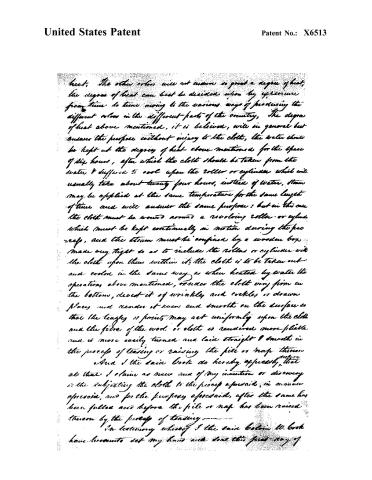
heat. The other colors will not answer so great a degree of heat, the degree of heat can best be decided upon by experience from time to time, owing to the various ways of producing the different colors in the different parts of the country. The degree of heat above mentioned, it is believed, will in general best answer the purpose without injury to the cloth, the water should be kept at the degree of heat above mentioned for the space of six hours, after which the cloth should be taken from the water & suffered to cool upon the roller or cylinder which will usually take about twenty four hours, instead of water, steam may be applied at the same temperature for the same length of time and will answer the same purpose: but in this case the cloth must be wound around a revolving roller or cylinder which must be kept continually in motion during the process, and the steam must be confined by a wooden box made very tight so as to include the rollers or cylinders with the cloth upon them within it; the cloth is to be taken out and cooled in the same way as when heated by water the operations above mentioned, render the cloth very firm in the bottom, devoid it of wrinkles and cockles, or drawn places and render it even and smooth on the surface so that the leaves or points may act uniformly upon the cloth and the fibre of the wool or cloth is rendered more pliable and is more easily turned and laid straight & smooth in the process of teasing or raising the pile or nap thereon.
And I the said look do hereby expressly, that as that I claim as new and of my invention or discovery is the subjecting the cloth to the process aforesaid, in manner aforesaid, and for the purposes aforesaid, after the same has been fulled and before the pile or nap has been raised thereon by the process of teasing.
In testimony whereof I the said below W. look have hereunto set my hand and seal this first day of
Page 4.
United States Patent
Patent No.: X6513
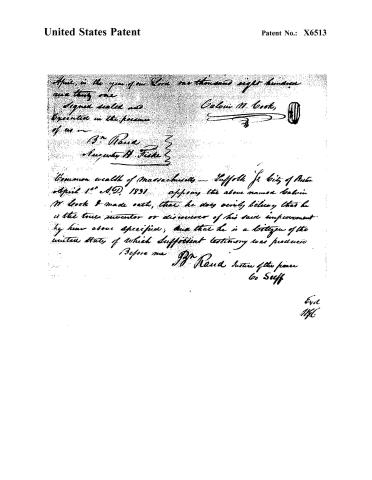
April, in the year of our Lord one thousand eight hundred and thirty one
Signed, sealed and executed in the presence of us —
Calvin M. Cook,
J. R. Rand
Henry A. Fisher
Commonwealth of Massachusetts — Suffolk Co. City of Boston
April 1st A.D. 1891 — appears the above named Calvin M. Cook & made oath, that he does verily believe, that he is the true inventor or discoverer of this said improvement by him above specified; and that he is a citizen of the United States, of which sufficient testimony was produced before me.
J. R. Rand
Justice of the Peace
Co. Suff
Evel
11/16
Published accounts: journal notice
Notice in the monthly list of patents, with remarks
Journal of the Franklin Institute, new ser., vol. 8 (1831), p. 169 · View the page
22 74. For an improvement in the process of Dressing Woollen Cloths, and cloths composed partly of wool, and partly of cotton; Calvin W. Cook, Lowell, Middlesex county, Massachusetts, April 23.
Remarks. (See the specification.)
Published accounts: journal notice
Notice in the monthly list of patents, with remarks
Journal of the Franklin Institute, new ser., vol. 8 (1831), p. 179 · View the page
From some remarks in the specification, it would appear that the operation of this apparatus has been tested; we, however, are not informed to what extent. The principal objection which presents itself Cook's improvement in Dressing Cloths. to us, from examining the plan upon paper only, is, that it will be difficult, if not impossible, to give to it the strength of the screw dock, so as by its aid to raise vessels of a large class.* SPECIFICATIONS OF AMERICAN PATENTS. Specification of a patent for an improvement in the process of Dressing Woollen Cloths, and Cloths composed partly of Wool and partly of Cotton. Granted to CALVIN W. Cook, Lowell, Middlesex county, Massachusetts, April 23, 1831.
Remarks. THE description of this process is as follows: Take broad cloths, sattinetts, or any like cloths to be subjected to the process, after they have been fulled and rinsed clean, but before the pile or nap has been raised upon them, and wind them upon wooden rollers, or cylinders, as tight as can be done without tearing the cloth. Confine them with a twine tied around so that the cloth cannot unwind, and so that the whole may remain firm and tight upon the roller, or cylinder; then prepare a kettle, or cauldron, of sufficient dimensions to receive the roller, or cylinder, with the cloth upon it. Fill the kettle, or cauldron, after having put the roller, or cylinder, with the cloth upon it, therein, with water, and apply heat thereto, until the heat rises from one hundred and eighty to two hundred degrees of Fahrenheit's thermometer, for all cloths excepting whites and blues; and for the last mentioned colours the heat may be raised to two hundred and twelve degrees, or to boiling heat. The other colours will not endure so great a degree of heat; the degree of heat can best be decided upon by experience from time to time, owing to the various ways of producing the different colours, in the different parts of the country. The degree of heat above mentioned, it is believed, will in general best answer the purpose without injury to the cloth. The water should be kept at the degrees of heat above mentioned, for the space of six hours; after which the cloth should be taken from the water and suffered to cool upon the roller, or cylinder, which will usually take about twenty-four hours.
Published accounts: specification
Specification printed in the Journal of the Franklin Institute
Journal of the Franklin Institute, new ser., vol. 8 (1831), p. 180 · View the page
Text of the specification as printed in the Journal, from OCR; not proofread.
Specification of a patent for an improvement in the process of Dressing Woollen Cloths, and Cloths composed partly of Wool and partly of Cotton. Granted to CALVIN W. Cook, Lowell, Middlesex county, Massachusetts, April 23, 1831. THE description of this process is as follows: Take broad cloths, sattinetts, or any like cloths to be subjected to the process, after they have been fulled and rinsed clean, but before the pile or nap has been raised upon them, and wind them upon wooden rollers, or cylinders, as tight as can be done without tearing the cloth. Confine them with a twine tied around so that the cloth cannot unwind, and so that the whole may remain firm and tight upon the roller, or cylinder; then prepare a kettle, or cauldron, of sufficient dimensions to receive the roller, or cylinder, with the cloth upon it. Fill the kettle, or cauldron, after having put the roller, or cylinder, with the cloth upon it, therein, with water, and apply heat thereto, until the heat rises from one hundred and eighty to two hundred degrees of Fahrenheit's thermometer, for all cloths excepting whites and blues; and for the last mentioned colours the heat may be raised to two hundred and twelve degrees, or to boiling heat. The other colours will not endure so great a degree of heat; the degree of heat can best be decided upon by experience from time to time, owing to the various ways of producing the different colours, in the different parts of the country. The degree of heat above mentioned, it is believed, will in general best answer the purpose without injury to the cloth. The water should be kept at the degrees of heat above mentioned, for the space of six hours; after which the cloth should be taken from the water and suffered to cool upon the roller, or cylinder, which will usually take about twenty-four hours. Instead of water, steam may be applied at the same temperatures, for the same length of time, and will answer the same purpose; but in this case the cloth must be wound around a revolving roller, or cylinder, which must be kept continually in motion during the process, and the steam must be confined by a wooden box, made very tight, so as to include the rollers, or cylinders, with the cloth upon them, within it. The cloth is to be taken out and cooled in the same way as when heated by water. The operations above mentioned render the cloth very firm in the bottom, divest it of wrinkles and cockles, or drawn places, and render it even and smooth on the sur* Some weeks will probably elapse between the date of this patent and that which will be next issued, as, in consequence of the absence of the Attorney General, the signature of that officer cannot be obtained, and without this a patent would not be valid. GIRAUD'S Spiral Lever for Propelling Vessels. face, so that the teazles, or points, may act uniformly upon the cloth, and the fibre of the wool, or cloth, is thus rendered more pliable, and is more easily turned and laid straight and smooth in the process of teasing, or raising the pile, or nap, thereon. And I, the said Cook, do hereby expressly declare, that all that I claim as new, and of my invention, or discovery, is the subjecting the cloth to the process aforesaid, in the manner aforesaid, and for the purposes aforesaid, after the same has been fulled, and before the pile, or nap, has been raised thereon by the process of teasing. CALVIN W. Соок.
DATAMP: illustration
Illustrations from DATAMP
DATAMP (Directory of American Tool and Machinery Patents), via the Internet Archive · Archived DATAMP page
About this record
- Patentee
- DATAMP
- Date
- the Name and Date index of patents, DATAMP, USPTO records
- Invention
- DATAMP
- Listed in
- the Name and Date index of patents, DATAMP, USPTO records, Jim Shaw's X-patent list, the Journal of the Franklin Institute, Burke's List of Patents (1847), the Journal of the Franklin Institute, Journal
- Burke's 1847 Patent Office list gives the same patent.