

Drawings and documents
USPTO scan
The patent as scanned by the USPTO
-
 Page 1
-
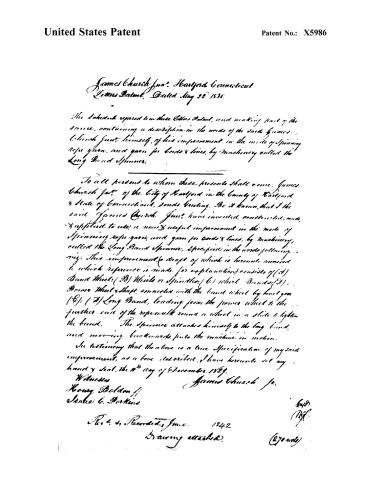 Page 2


U.S. Patent and Trademark Office · Google Patents
Show the transcription Hide (309 words)
Machine transcription (LightOnOCR) of the pages as scanned by the USPTO, most of them the handwritten copies made when the records were restored after the 1836 fire. Not checked; it can misread handwriting, so compare it with the scan.
Page 2.
United States Patent
Patent No.: X5986
*James Church junr. Hartford, Connecticut
Letters Patent, Dated May 22 1836.*
The Schedule referred to in these Letters Patent, and making part of the same, containing a description in the words of the said James Church junr. himself, of his improvement in the mode of spinning rope yarn, and yarn for cords & lines, by machinery called the Long Band Spinner.
To all persons to whom these presents shall come, James Church junr. of the City of Hartford in the County of Hartford & State of Connecticut, sends Greeting. Be it known, that I the said James Church junr. have invented, constructed, made, & applied to use, a new & useful improvement in the mode of spinning rope yarn, and yarn for cords & lines, by machinery, called the Long Band Spinner, specified in the words following, viz: This improvement (a draft of which is herewith annexed to which reference is made for explanation) consists of (A) Band Wheel; (B) Wheels or Spindles; (C) which Bands; (D) Power Wheel & Shaft, connected with the band wheel by belt gear (E); (F) Long Band, leading from the power wheel to the further end of the rope-walk round a wheel in a slide to lighten the band. The spinner attaches himself to the long band, and moving backwards, puts the machine in motion.
In testimony that the above is a true Specification of my said improvement, as aforesaid described, I have hereunto set my hand & seal, the 10th day of December 1829.
Witnesses
Henry Belden //
Senke C. Perkins
James Church junr.
*Filed & Recorded, June 1842
Drawing attached.*
(270 wds)
Published accounts: journal notice
Notice in the monthly list of patents, with remarks
Journal of the Franklin Institute, new ser., vol. 6 (1830), p. 149 · View the page
42. For an improved mode of Spinning Rope Yarn, and yarn for cords and lines; James Church, jr. Hartford, Hartford county, Connecticut, May 22.
Remarks. Nine lines contain the specification, which consists of references to a very indifferent drawing. The object appears to be to enable the spinner in a rope walk to turn the band wheel which drives the spindles. He is to attach himself to a long band, and walking backwards give motion to a whirl upon a shaft, and this, by bevil gear, is to turn the band wheel. We had much rather invent such a machine than work with it, as we do not admire that labour saving machinery which is to force a man to work harder than ever; we think the present contrivance well calculated to save one man by wearing out another.
Published accounts: specification
Specification printed in the Journal of the Franklin Institute
Journal of the Franklin Institute, new ser., vol. 6 (1830), p. 158 · View the page
Text of the specification as printed in the Journal, from OCR; not proofread.
Specification of a patent for an improvement in the mode of laying the foundation of Marine Rail-ways under water. Granted to JAMES RONALDSON and JOHN LINDSAY NEILL, of the City of Philadelphia, May 22, 1830. Our said invention is particularly intended for marine rail-ways in places where, from the nature of the bottom of a river, or other water, on which it is to be established, piles cannot be securely driven, or where the expense of driving them, and of erecting the required structure upon them, would form a serious objection thereto. It is also applicable in all situations where the bottom is of a hard substance, and is equally efficacious with a foundation of piles, and can be carried into operation in many instances with much greater facility, and less expense. A proper survey of the bottom upon which the rail-way is to be erected, must first be made, in order to ascertain the proper shape, or curvature, which should be given to the under part of the frame work, of which the foundation and rail-way, below the water, are to consist. This frame may be made and braced together in various ways, the sills being so formed as to adapt themselves to the bottom, and the upper part, or rails, having such an inclination as may be considered best for the intended purpose. In forming the Philadelphia Marine Rail-way, the work was put together over the place where it was to be used, but it may be formed or framed elsewhere, and transferred to its place of destination. The framing was commenced by fixing a number of beams strong enough to sustain the intended superstructure, and in such relative positions as that a line crossing them would have the same curvature with the bottom of the river, which is to be the foundation. Upon these beams were laid three sets of sills parallel to each other, the centre sill being situated under the keel rail, and the two side ones under the bilge rails. The sills were united together by logs forming cross-ties; and into the upper sides of the sills were inserted posts to support the rails. These posts were tenoned into the sills sufficiently deep to admit of a trenail. The whole of the sills, rails, and posts, being strongly braced by timber framed into them diagonally and otherwise, to give them the required strength, iron bolts, dovels, and trenails, were also driven when they were deemed useful. The scarps of the rails, or wooden ways, were all doveled and bolted, and made to rest on the posts: the ways were likewise doveled to each cross-tie, besides bolting. The upper sides of the rails, or wooden ways, were made perfectly even, and the iron rails then securely bolted upon them. The manner in in which this framing was effected, is represented in the drawing, and also in a model deposited in the patent office; they are deposited in compliance with the law, which requires that drawings, with written references, be furnished; and they serve to exhibit in a practical way, how the invention has been carried into effect. The frame when completed is to be sunk into its place. Before this is done, the bottom upon which it is to stand, must, if covered by any loose substance, be scraped, so as to remove whatever might interfere with its adapting itself thereto. The mode which we adopted for sinking the frame, was, first to lay a floor upon the cross logs, or ties, and fasten plank to the sides. These planks were to keep in the stones, or material used to sink the frame. The supporting beams were then removed, and the whole frame let down by tackles that held it suspended when the cross bearings were taken out. To save the trouble and expense of procuring large stones, small ones were put into barrels and headed up, in order to retain them in the situations where they were required. The frame was thus sunk into its place, and loose stones, earth, and sand, thrown into, and around the whole. We claim as our invention, the mode in which the above frame was put together; and we claim as new, and as our invention, this method of making the foundations, and the fixing of marine rail-ways under water, without the driving of piles, the making of coffer dams, the using of diving bells, or any similar structures, as usually employed for that purpose. If the rail-way is intended for large vessels, the having five railways, viz. one under the keel, one under each bilge, and one on each side for the support support of the upper works of the vessel with shores, are all considered modifications of the principle herein described, and we accordingly claim this method also as our invention. JAMES RONALDSON. JOHN L. NEILL.
About this record
- Patentee
- DATAMP
- Date
- the Name and Date index of patents, DATAMP, USPTO records
- Invention
- DATAMP
- Listed in
- the Name and Date index of patents, DATAMP, USPTO records, Jim Shaw's X-patent list, the Journal of the Franklin Institute, Burke's List of Patents (1847), the Journal of the Franklin Institute, Journal
- Burke's 1847 Patent Office list gives the same patent.