

Drawings and documents
USPTO scan
The patent as scanned by the USPTO
-
 Page 1
-
 Page 2
-
 Page 3


U.S. Patent and Trademark Office · Google Patents
Show the transcription Hide (805 words)
Machine transcription (LightOnOCR) of the pages as scanned by the USPTO, most of them the handwritten copies made when the records were restored after the 1836 fire. Not checked; it can misread handwriting, so compare it with the scan.
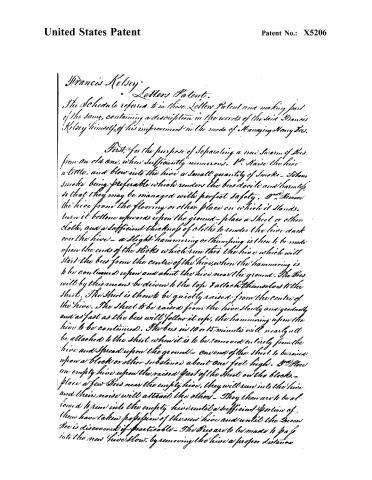
Page 2.
United States Patent
Patent No.: X5206
Francis Kelsey
Letters Patent.
The Schedule referred to in these Letters Patent and making part of the same, containing a description in the words of the said Francis Kelsey himself, of his improvement in the mode of Managing Honey Bees.
First, for the purpose of Separating a new Swarm of Bees from an old one, when sufficiently numerous. 1st. Raise the hive a little, and blow into the hive a small quantity of smoke. Tobacco smoke being preferable which renders the bees docile and harmless so that they may be managed with perfect safety. 2nd. Remove the hive from the flooring or other place on which it stands, turn it bottom upwards upon the ground—place a sheet or other cloth, and a sufficient thickness of cloths to render the hive dark over the hive—a slight hammering or thumping is then to be made upon the ends of the sticks which run thro’ the hive which will start the bees from the centre of the hive when the hammering is to be continued upon and about the hive near the ground. The Bees will by this means be driven to the top & attach themselves to the sheet. The sheet is then to be quietly raised from the centre of the hive. The sheet to be raised from the hive slowly and gradually and as fast as the bees will follow it up, the hammering upon the hive to be continued. The bees in 10 or 15 minutes will nearly all be attached to the sheet when it is to be removed entirely from the hive and spread upon the ground—one end of the sheet to be raised upon a block or other substance about one foot high. 3rd. Place an empty hive upon the raised part of the sheet on the blocks—place a few Bees near the empty hive, they will run into the hive and their noise will attract the others—They then are to be allowed to run into the empty hive until a sufficient portion of them have taken possession of the new hive and until the Bees are discovered if practicable—The Bees are to be made to pass into the new hive slow, by removing the hive a proper distance
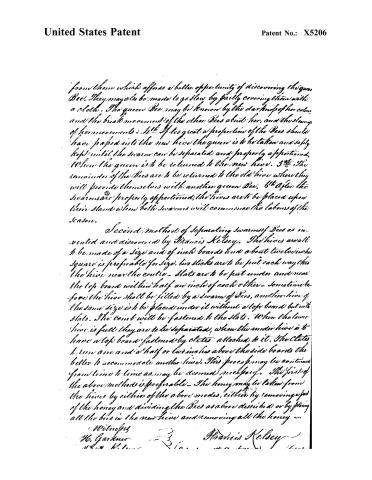
Page 3.
United States Patent
Patent No.: X5206
from them which affords a better opportunity of discovering the queen Bee. They may also be made to go slow by partly covering them with a cloth. The queen Bee may be known by the darkness of her color, and the brisk movement of the other Bees about her, and the slowness of her movements. 4th. If too great a proportion of the Bees should have passed into the new hive the queen is to be taken and safely kept until the swarm can be separated and properly apportioned. When the queen is to be returned to the new hive. 5th. The remainder of the Bees are to be returned to the old hive where they will provide themselves with another queen Bee. 6th. After the swarms are properly apportioned, the hives are to be placed upon their stand when both swarms will commence the labors of the season.
Second method of separating swarms of Bees as invented and discovered by Francis Kelsey. The hives are all to be made of a size and of inch boards and about twelve inches square is preferable for size. Two sticks are to be put each way thru the hive near the centre. Slats are to be put under and near the top board within half an inch of each other. Sometimes before the hive shall be filled by a swarm of Bees, another hive of the same size is to be placed under it without a top board but with slats. The cant will be fastened to the slats. When the lower hive is full they are to be separated, when the under hive is to have a top board fastened by clots attached to it. The clots to run one and a half or two inches above the side boards the better to accommodate another hive. This process may be continued from time to time as may be deemed necessary. The first of the above methods is preferable. The honey may be taken from the hives by either of the above modes, either by removing a part of the honey and dividing the Bees as above described or by placing all the bees in the new hive and removing all the honey.
Witness
W. Gardner
Francis Kelsey
Published accounts: journal notice
Notice in the monthly list of patents
Journal of the Franklin Institute, vol. 6 (1828), p. 262 · View the page
29. For an improvement in the mode of Managing honey bees; Francis Kelsey, Lockport, Niagara County, New York, August 26.
Published accounts: journal notice
Notice in the monthly list of patents, with remarks
Journal of the Franklin Institute, vol. 6 (1828), p. 266 · View the page
Specification of a patent obtained for a newly invented, or discovered mode or art, for the care and rearage of honey bees, being a mode by which the honey may be taken from the hive; and a new swarm separated from an old one, without injury to either. By FRANCIS KELSEY, Lockport, Niagara county, New York, August 26, 1828.
Remarks. FIRST METHOD OF SEPARATING. For the purpose of separating a new swarm of bees from an old one, when sufficiently numerous, 1st. Raise the hive a little, and blow into the hive a small quantity of smoke, (tobacco smoke being preferable,) which renders the bees docile and harmless, so that they may be managed with perfect safety. 2nd. Remove the hive from the flooring, or other place on which it stands-turn it bottom upwards upon the ground-place over the hive a sheet, or other cloth, and a sufficient thickness of cloths, to render the hive dark; a slight hammering or thumping is then to be made upon the ends of the sticks which run through the hive, which will start the bees from the centre of the hive; the hammering is then to be continued upon and about the hive, near the ground. The bees will, by this means, be driven to the top, and attach themselves to the sheet the sheet is then to be raised from the centre of the hive; the sheet must be raised from the hive slowly and gradually, and as fast only as the bees will follow it up, the hammering upon the hive to be continued. The bees in 10 or 15 minutes will nearly all be attached to the sheet, when it is to be removed entirely from the hive, and spread upon the ground; one end of the sheet is to be raised upon a block, or other substance, about one foot high. 3d. Place an empty hive upon the raised part of the sheet, on the block; place a few bees near the empty hive, they will run into the hive, and their noise will attract the others. They then are to be allowed to run into the empty hive, until a sufficient portion of them have taken possession of the new hive, and until the queen bee is discovered, if practicable. The bees are to be made to pass into the new hive slowly, by removing the hive a proper distance from them, which affords a better opportunity of discovering the queen bee; they may also be made to go slowly by partly covering them with a cloth. The queen bee may be known by the darkness of her colour, and the brisk movements of the other bees about her, and the slowness of her movements. 4th. If too great a proportion of the bees should have passed into the new hive, the queen is to be taken and safely kept, until the swarm can be separated, and properly apportioned, when the queen bee is to be returned to the new hive. 5th. The remainder of the bees are to be returned to the old hive, where they will provide themselves with another queen bee. 6th. After the swarms are properly apportioned, the hives are to be placed upon their stand, where both swarms will commence the labours of the season. SECOND METHOD OF SEPARATING. The hives are to be made of a size, and of wide boards, and about twelve inches square; two sticks are to be placed each way through the centre. Seats are to be put under and near the top board, within half an inch of each other. Some time before the hive shall be filled by a swarm of bees, another hive of the same size is to be placed under it, without a top board, but with seats. The comb will be fastened to the seats. When the lower hive is full, they are to be separated; when the under hive is to have a top board attached to it by cleats; the cleats to run one and a half inches above the side boards, the better to accommodate another hive. This process may be continued from time to time, as may be deemed necessary.
Published accounts: specification
Specification printed in the Journal of the Franklin Institute
Journal of the Franklin Institute, vol. 6 (1828), p. 266 · View the page
Text of the specification as printed in the Journal, from OCR; not proofread.
Specification of a patent obtained for a newly invented, or discovered mode or art, for the care and rearage of honey bees, being a mode by which the honey may be taken from the hive; and a new swarm separated from an old one, without injury to either. By FRANCIS KELSEY, Lockport, Niagara county, New York, August 26, 1828. FIRST METHOD OF SEPARATING. For the purpose of separating a new swarm of bees from an old one, when sufficiently numerous, 1st. Raise the hive a little, and blow into the hive a small quantity of smoke, (tobacco smoke being preferable,) which renders the bees docile and harmless, so that they may be managed with perfect safety. 2nd. Remove the hive from the flooring, or other place on which it stands-turn it bottom upwards upon the ground-place over the hive a sheet, or other cloth, and a sufficient thickness of cloths, to render the hive dark; a slight hammering or thumping is then to be made upon the ends of the sticks which run through the hive, which will start the bees from the centre of the hive; the hammering is then to be continued upon and about the hive, near the ground. The bees will, by this means, be driven to the top, and attach themselves to the sheet the sheet is then to be raised from the centre of the hive; the sheet must be raised from the hive slowly and gradually, and as fast only as the bees will follow it up, the hammering upon the hive to be continued. The bees in 10 or 15 minutes will nearly all be attached to the sheet, when it is to be removed entirely from the hive, and spread upon the ground; one end of the sheet is to be raised upon a block, or other substance, about one foot high. 3d. Place an empty hive upon the raised part of the sheet, on the block; place a few bees near the empty hive, they will run into the hive, and their noise will attract the others. They then are to be allowed to run into the empty hive, until a sufficient portion of them have taken possession of the new hive, and until the queen bee is discovered, if practicable. The bees are to be made to pass into the new hive slowly, by removing the hive a proper distance from them, which affords a better opportunity of discovering the queen bee; they may also be made to go slowly by partly covering them with a cloth. The queen bee may be known by the darkness of her colour, and the brisk movements of the other bees about her, and the slowness of her movements. 4th. If too great a proportion of the bees should have passed into the new hive, the queen is to be taken and safely kept, until the swarm can be separated, and properly apportioned, when the queen bee is to be returned to the new hive. 5th. The remainder of the bees are to be returned to the old hive, where they will provide themselves with another queen bee. 6th. After the swarms are properly apportioned, the hives are to be placed upon their stand, where both swarms will commence the labours of the season. SECOND METHOD OF SEPARATING. The hives are to be made of a size, and of wide boards, and about twelve inches square; two sticks are to be placed each way through the centre. Seats are to be put under and near the top board, within half an inch of each other. Some time before the hive shall be filled by a swarm of bees, another hive of the same size is to be placed under it, without a top board, but with seats. The comb will be fastened to the seats. When the lower hive is full, they are to be separated; when the under hive is to have a top board attached to it by cleats; the cleats to run one and a half inches above the side boards, the better to accommodate another hive. This process may be continued from time to time, as may be deemed necessary. The first of the above methods is preferable. The honey may be taken from the hives by either of the above modes; either by removing a part of the honey, and dividing the bees, as above described; or, by placing all the bees in the new hive, and removing all the honey. FRANCIS KELSEY.
About this record
- Patentee
- DATAMP
- Date
- the Name and Date index of patents, DATAMP, USPTO records
- Invention
- DATAMP
- Listed in
- the Name and Date index of patents, DATAMP, USPTO records, Jim Shaw's X-patent list, the Journal of the Franklin Institute, the Mirror of the Patent Office (1828), Burke's List of Patents (1847), the Journal of the Franklin Institute, Journal
- The Mirror of the Patent Office's supplementary list gives the same patent.
- Burke's 1847 Patent Office list gives the same patent.