

Drawings and documents
National Archives restored drawings: drawing
J. Putnam's Patent Drawing for a Machine for Making Slabs for Fire Backs, Stove Linings, Drains, etc.

National Archives, Restored Patent Drawings (Record Group 241) · Full-size scan at the National Archives · Catalog record
Show the text on the drawing Hide (74 words)
Words on the drawing as machine-read by the National Archives; not checked. Useful mainly for searching.
25.0LAY & POTTERY, / DIV. 15 / Brick Molds. / F1 / CLASSITICATION / Patented) 20thang 1835 / 9049- / DIVISION. / JPUTNAM / Maning slabs for Fire backs, Store linings, dTanis Ecu / a eleats / b. Moulds / C- - Blocks or whdges / OR / Patent office Oct 31 t' 1842 / Made under the direction of the commissions - of Pales / in couformity with act of 3 March 1537- / Streekland Del / Commerce of Patents)
USPTO scan
The patent as scanned by the USPTO
-
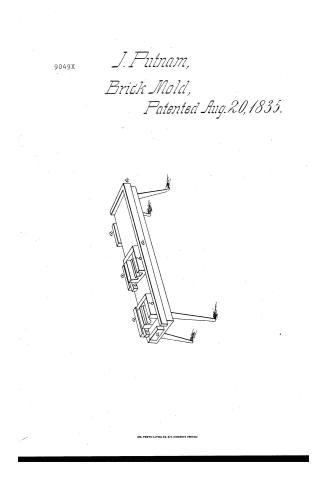 Page 1
-
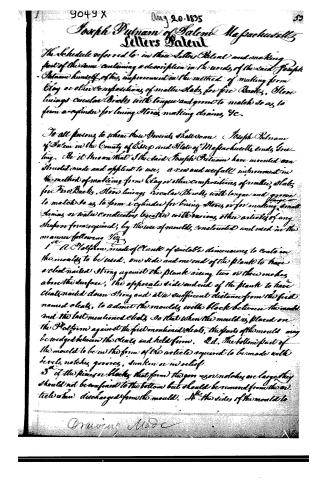 Page 2
-
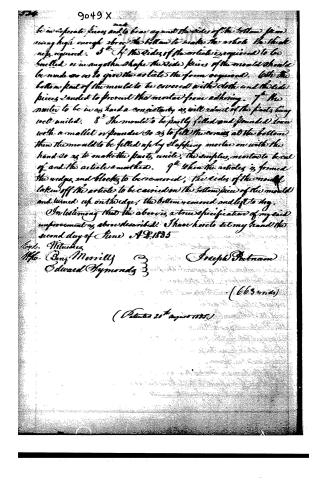 Page 3


U.S. Patent and Trademark Office · Google Patents
Show the transcription Hide (670 words)
Machine transcription (LightOnOCR) of the pages as scanned by the USPTO, most of them the handwritten copies made when the records were restored after the 1836 fire. Not checked; it can misread handwriting, so compare it with the scan.
Page 1.
9049X
J. Putnam,
Brick Mold,
Patented Aug. 20, 1835.

AM. PHOTO-LITHO. CO. N.Y. (OSBORNE'S PROCESS)
Page 2.
9049 X Aug 20-1875 53
Joseph Putnam of Salem, Massachusetts
Letters Patent
The Schedule referred to in these Letters Patent and making part of the same containing a description in the words of the said Joseph Putnam himself of his improvement in the method of making from clay or other compositions of malleable slabs for fire backs, stove linings, circular Bricks with tongue and groove to match so as to form a cylinder for lining Stoves, making drains, &c.
To all persons to whom these Presents shall come, Joseph Putnam of Salem in the County of Essex and State of Massachusetts, sends Greeting. Be it known that I the said Joseph Putnam have invented an invention made and applied to use, a new and useful improvement in the method of making from clay or other compositions of malleable slabs for Fire Backs, Stove linings, circular Bricks with tongue and groove to match so as to form a cylinder for lining Stoves, or for making small drains or water conductors together with various other articles of any shape or form required, by the use of moulds constructed and used in the manner following viz:
1st A Platform made of Plank of suitable dimensions to contain the moulds to be used, one side and one end of the plank to have a cleat nailed strong against the plank rising two or three inches above the surface, the opposite side and end of the plank to have cleats nailed down strong and at a sufficient distance from the first named cleats, to admit the moulds with block between them and the last mentioned cleats so that when the mould is placed on the Platform against the first mentioned cleats, the parts of the mould may be wedged between the cleats and held firm. 2d. The bottom part of the mould to be in the form of the article required to be made with several notches, grooves, sunken or in relief.
3d if the pieces or blocks that form the grooves or notches are large they should not be confined to the bottom but should be removed from the article when discharged from the mould. 4th the sides of the mould to
Drawing Made
Page 3.
9049 X
be in separate pieces, and to be set against the sides of the bottom piece rising high enough above the bottom to make the article the thickness required. 5th. If the sides of the article is required to be beveled or in any other shape the side pieces of the mould should be made so as to give the article the form required. 6th. The bottom part of the mould to be covered with cloth and the side pieces sand to prevent the mortar from adhering. 7th. The mortar to be in as hard a consistency as will admit of the parts being well united. 8th. The mould to be partly filled and pounded down with a mallet or pounder so as to fill the corners at the bottom then the mould to be filled up by slapping mortar on with the hand so as to make the parts unite, the surplus mortar to be cut off and the article smoothed. 9th. When the article is formed the wedge and blocks to be removed, the sides of the mould taken off the article to be carried on the bottom piece of the mould and turned up on the edge, the bottom removed and left to dry.
In witnessing that the above is a true specification of my said improvement as above described. I have hereto set my hand the second day of June A.D. 1835
Joseph Putnam
(663 under)
(Patented 20th August 1835)
Published accounts: journal notice
Notice in the monthly list of patents
Journal of the Franklin Institute, new ser., vol. 16 (1835), p. 287 · View the page
501. Stove backs and linings.-Joseph Putnam, Salem, Massachusetts,
Published accounts: journal notice
Notice in the monthly list of patents, with remarks
Journal of the Franklin Institute, new ser., vol. 17 (1836), p. 128 · View the page
39. For a machine for Manufacturing Corks; Jonathan Cutler, and Isaac Keyes, Putnam, Windham county, Vermont, July 21.
Remarks. This cork cutting machine has a mandrel which revolves like that of an ordinary lathe. The cutters consist of four or any other convenient numAmerican Patents for July, with Remarks. ber of pieces of steel formed at their ends like an ordinary gouge. They are capable of expanding and contracting, as otherwise, they would cut the cork into a cylinder instead of making it conical. Each of the cutters is hinged, by a handle at its opposite end, to the revolving shaft, and there is a collar so contrived as to cause the cutters to approach each other as the cork is cut. In front of the mandrel there is a horizontal wheel, called a feed wheel, around the periphery of which there are notches to receive the blocks of cork wood, which are ready for the machine. A cam causes this wheel to carry each block, in succession, up to the cutters, into the hollow between which it is finally received, and passes out at a proper opening behind the cutters. "What we claim as our own invention is the expansive, or cutting cylinder, as connected with the other machinery. Every other part of the machine may be constructed differently, and answer the same purposes." This machine is skilfully contrived, and described with sufficient clearness; the claim, also, we think well expressed and sufficiently guarded; still, we have doubts of the eventual success of the plan, from the intrinsic difficulties which present themselves in the cutting of cork by machinery. There have been several patented contrivances for the same purposes, but we believe that neither of them has stood the test of continued use. Those who are acquainted with the operation of cutting corks by hand know that a thin and sharp knife is employed for the purpose, and that the edge of this knife is preserved by passing it over a piece of wood between every two or three cuts, the workmen doing this dexterously with one hand whilst the other is employed in taking up a fresh block; without this fine edge the cutting cannot be effected, and we think that in a machine it can scarcely be preserved. Besides this, from the varying thickness of the cork wood, it is no easy matter to have the blocks all of one size. In cutting by hand this is of no consequence, while in cutting by machinery it is all important.
Published accounts: journal notice
Notice in the monthly list of patents (listed with a different spelling or date)
Journal of the Franklin Institute, new ser., vol. 16 (1835), p. 215 · View the page
Corks, cutting.-J. Cutler and I. Keyes, Putney, Vermont,
About this record
- Patentee
- the Journal of the Franklin Institute, Journal
- Date
- USPTO records, Jim Shaw's X-patent list
- Invention
- the Name and Date index of patents
- Listed in
- the Name and Date index of patents, USPTO records, Jim Shaw's X-patent list, the Journal of the Franklin Institute, the Journal of the Franklin Institute, Journal, Burke's List of Patents (1847)
- The sources give different dates; the date shown is the one most of them agree on.
- The patentee's full name comes from the Franklin Institute's journal.
- The residence comes from the Franklin Institute's journal.
- The Franklin Institute's journal gives a different date.
- Also listed in a contemporary journal or list under a different spelling or date; the record shown follows the standard lists.
- Burke's 1847 Patent Office list gives the same patent.