

Drawings and documents
National Archives restored drawings: drawing
S. Dickinson's Patent Drawing for a Cooking Stove

National Archives, Restored Patent Drawings (Record Group 241) · Full-size scan at the National Archives · Catalog record
Show the text on the drawing Hide (86 words)
Words on the drawing as machine-read by the National Archives; not checked. Useful mainly for searching.
$150 / 126. STOVES de FURNAO / [154] Cooking Stoves. / $1,50 / S. / 89914 / Cooking Hove / Paladed 15thang 1835 / DIVISION. / SECTION / Front / demicircalar Box / over / stricklaudicel / a Jonpiate- b. Bottomplate C. 2 sideplates d. houtplate / e. illiddle or division plate f square plates. g Transverse cuts-hibalve / i. Bottom of Box. K-value l. scraper m stiding grate / 72. slide plates / 11. / Patent office Nov 31" 1842 / Made under the decelor of the Commonent of Palents in Comformsty / with acto 3 March 1837- / Communications of Patents
USPTO scan
The patent as scanned by the USPTO
-
 Page 1
-
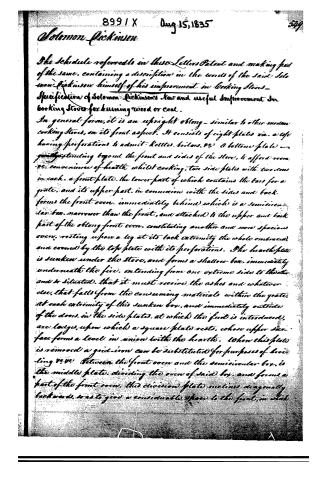 Page 2
-
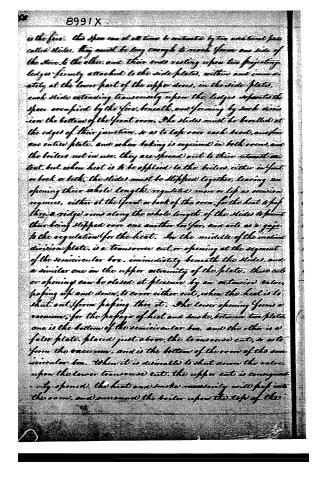 Page 3
-
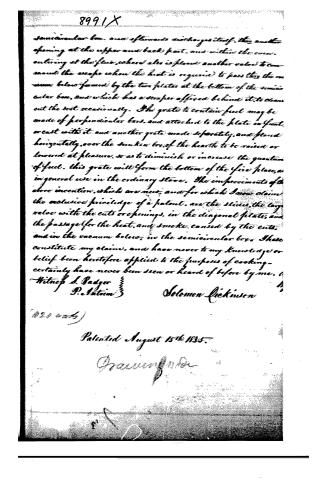 Page 4


U.S. Patent and Trademark Office · Google Patents
Show the transcription Hide (1,045 words)
Machine transcription (LightOnOCR) of the pages as scanned by the USPTO, most of them the handwritten copies made when the records were restored after the 1836 fire. Not checked; it can misread handwriting, so compare it with the scan.
Page 1.
BEST AVAILABLE COPY
S. Dickinson,
Cook Stove.
Patented Aug. 15, 1835.
No. 8,991 X
![Diagram of a cook stove with labeled parts including "Flue," "Semicircular Oven," and "Front Oven."]
H. PETERS, PHOTO-LITHOGRAPHER, WASHINGTON, D.C.
Page 2.
8991X Aug 15, 1835 519
Solomon Dickinson
The Schedule referred to in these Letters Patent and making part of the same, containing a description in the words of the said Solomon Dickinson himself of his improvement in cooking Stoves.
Specification of Solomon Dickinson’s New and useful Improvement in cooking Stoves for burning wood or coal.
In general form, it is an upright oblong—similar to other modern cooking Stoves, on its front aspect. It consists of eight plates viz. a top having perforations to admit Kettles, boilers, &c. A bottom plate—greatly extending beyond the front and sides of the Stove, to afford room &c. convenience of hearth whilst cooking. Two side plates with two doors in each, a front plate, the lower part of which contains the bars for a grate, and its upper part, in connexion with the sides and back, forms the front oven, immediately behind which is a semicircular box, narrower than the front, and attached to the upper and back part of the oblong front oven, constituting another and more spacious oven, resting upon a leg at its back extremity the whole embraced, and covered by the top plate with its perforations. The hearth plate is sunken under the stove, and forms a shallow box, immediately underneath the fire, extending from one extreme side to the other and is situated, that it must receive the ashes and whatever else, that falls from the consuming materials within the grate, at each extremity of this sunken box, and immediately outside of the doors, in the side plates, at which the fuel is introduced, are ledges, upon which a square plate rests, whose upper surface forms a level in union with the hearth. When this plate is removed a grid-iron can be substituted for purposes of boiling &c. Between the front oven and the semicircular box, is the middle plate, dividing the oven of said box, and forms a part of the front oven, this division plate inclines diagonally backwards, so as to give a considerable space to the front, in which
Page 3.
in the fire. This space can at all times be contracted by two additional plates called slides. They must be long enough to reach from one side of the stove to the other, and their ends resting upon two projecting ledges firmly attached to the side plates, within and immediately at the lower part of the upper doors, in the side plates. Each slide extending transversely upon the ledges separates the space occupied by the fire, beneath, and forming by such division the bottom of the front oven. The slides must be bevelled at the edges of their junction, so as to leave over each board, and form one entire plate, and when baking is required in both ovens, and the boilers not in use, they are spread out to their utmost extent, but when heat is to be applied to the boilers, either in front or back, or both, the slides must be slipped together, leaving an opening their whole length, regulated more or less as occasion requires, either at the front or back of the oven, for the heat to pass thru. A ridge runs along the whole length of the slides to prevent their being slipped over one another too far, and acts as a gage to the regulation for the heat. In the middle of the inclined division plate, is a transverse cut or opening at the segment of the semicircular box, immediately beneath the slides, and a similar one in the upper extremity of the plate. These cuts or openings can be closed at pleasure by an extensible valve, passing up and down, to cover either cut, when the heat is to shut out from passing thru it. The lower opening forms a vacuum, for the passage of heat and smoke, between two plates, one is the bottom of the semicircular box, and the other is a false plate, placed just above the transverse cut, so as to form the vacuum, and is the bottom of the oven of the semicircular box. When it is desirable to shut down the valve, upon the lower transverse cut, the upper cut is conveniently opened. The heat and smoke necessarily will pass into the oven, and surround the boiler upon the top of the
Page 4.
8991X
semicircular box, and afterwards discharges itself, there another opening at the upper and back part, and within this warm entering at the fire, where also is placed another valve to command the escape when the heat is required to pass through the vacuum below formed by the two plates at the bottom of the semicircular box, and which has a scraper affixed behind it, to clean out the soot occasionally. The grate to contain fuel may be made of perpendicular bars, and attached to the plate in front, or cast with it, and another grate made separately, and placed horizontally, over the sunken box of the hearth to be raised or lowered at pleasure, so as to diminish or increase the quantity of fuel. This grate will form the bottom of the fire place, as in general use in the ordinary stove. The improvements of the above invention, which are new, and for which I now claim the exclusive privilege of a patent, are the slides, the large valve with the cuts or openings, in the diagonal plate, and the passage for the heat, and smoke, caused by the cuts, and in the vacuum below, in the semicircular box. These constitute my claims, and have never to my knowledge or belief been heretofore applied to the purposes of cooking—certainly have never been seen or heard of before by me.
Witness S. Badger
P. S. S.
Solomon Dickinson
(120 words)
Patented August 15th 1835.
Gravure
Published accounts: journal notice
Notice in the monthly list of patents
Journal of the Franklin Institute, new ser., vol. 16 (1835), p. 286 · View the page
448. Cooking stoves.-Solomon Dickinson, Richmond, Indiana,
Published accounts: journal notice
Notice in the monthly list of patents (listed with a different spelling or date)
Journal of the Franklin Institute, new ser., vol. 17 (1836), p. 196 · View the page
For a Cooking Stove; Solomon Dixon, Richmond, Wayne county, Indiana, August 15.
About this record
- Patentee
- DATAMP
- Date
- the Name and Date index of patents, DATAMP, USPTO records
- Invention
- DATAMP
- Listed in
- the Name and Date index of patents, DATAMP, USPTO records, Jim Shaw's X-patent list, the Journal of the Franklin Institute, the Journal of the Franklin Institute, Journal, Burke's List of Patents (1847)
- Also listed in a contemporary journal or list under a different spelling or date; the record shown follows the standard lists.
- Burke's 1847 Patent Office list gives the same patent.