

Drawings and documents
USPTO scan
The patent as scanned by the USPTO
-
 Page 1
-
 Page 2
-
 Page 3
-
 Page 4


U.S. Patent and Trademark Office · Google Patents
Show the transcription Hide (970 words)
Machine transcription (LightOnOCR) of the pages as scanned by the USPTO, most of them the handwritten copies made when the records were restored after the 1836 fire. Not checked; it can misread handwriting, so compare it with the scan.
Page 1.
7816X
B. Lapham,
Force Pump,
Patented Nov. 19, 1833.
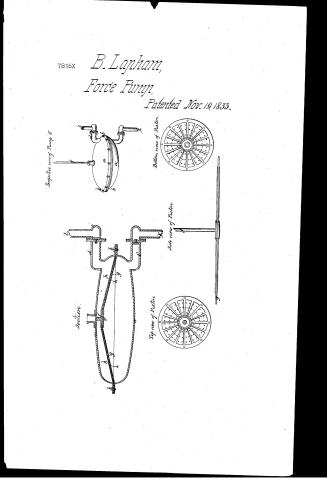
Perspective view of Pump C.
Bottom view of Piston.
Side view of Piston.
Section.
Top view of Piston.
Page 2.
7816X Nov. 19, 1853 353
Benjamin Lapham of Waterford, New York,
Letters Patent
The Schedule referred to in these Letters Patent and making part of the same containing a description in the words of the said Benjamin Lapham himself of his improvement in the forcing pump.
To all persons to whom these presents shall come, Benjamin Lapham of Waterford in the County of Saratoga and State of New York and knowing—Know ye that I the said Benjamin Lapham have invented, constructed, made and fit to use a new and useful improvement—to wit, an improved forcing pump calculated to lessen, or nearly dispense with the friction occasioned by the piston in the common pumps now in use; and also to prevent entirely or very nearly the loss of water escaping between the piston and the sides of the pump, which improved pump by varying its size and some other slight variations applies with equal fitness to all the purposes of raising water from the common house pump for domestic use, to the fire engine or forcing pump for extinguishing fire. The chief component parts of this pump like all other pumps, are the body or chamber which receives and discharges the water, and the piston.
The body or chamber of this Pump may be of block tin, of Pewter, or of cast iron or any other suitable metal or mixture of metals, and is cast or formed in two halves, each half being nearly in the form of the common basin. Each half has a flange round the edge, through which the two halves are secured together by screw bolts, so that when the two are screwed together the whole is somewhat in form of a watch. But the opposite edges of this chamber have each a cylindrical projection, each projection extending in length a little beyond the edge of the flanges, and on the end of each projection is a circular flange. One half of each projection and flange being attached
Page 3.
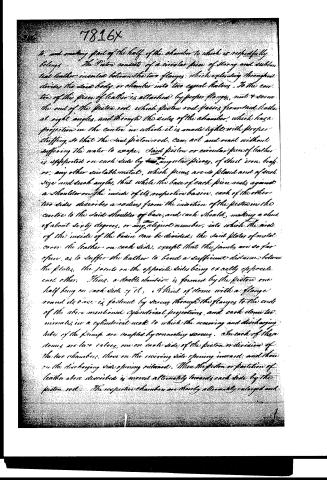
to, and making part of the half of the chamber to which it respectively belongs. The Piston consists of a circular piece of strong and substantial leather inserted between the two flanges, which extending throughout divides the said body or chamber into two equal halves. To the centre of this piece of leather is attached by proper flanges, one & seven the end of the piston rod, which piston rod passes from said leather at right angles, and through the sides of the chamber, which have a projection in the centre in which it is made tight with proper stuffing, so that the said piston rod can act and react without suffering the water to escape; said piston or circular piece of leather is supported on each side by two angular pieces, of steel iron, brass or any other suitable metal, which pieces are so placed and of such size and such angles, that while the base of each piece rests against a shoulder on the inside of its respective basin, each of the other two sides describes a radius from the insertion of the piston in the centre to the said shoulder of base, and each should, making an angle of about sixty degrees, or any aliquot number, into which the arcs of the inside of the basin can be divided; the said plates of metal cover the leather on each side, except that the joints are so far open, as to suffer the leather to bend a sufficient distance between the plates, the joints on the opposite sides being exactly opposite each other. Thus, a double chamber is formed by the piston one half being on each side of it. A vessel of dome with a flange round its base is fastened by screws through the flanges to the ends of the above mentioned cylindrical projections, and each dome terminates in a cylindrical neck to which the receiving and discharging tubes of the pump are coupled by connecting screws. In each of these domes are two valves, one on each side of the piston or division of the two chambers, those on the receiving side opening inward, and those on the discharging side opening outward. When the piston or portion of leather above described is moved alternately towards each side by the piston rod, the respective chambers are thereby alternately enlarged and
Page 4.
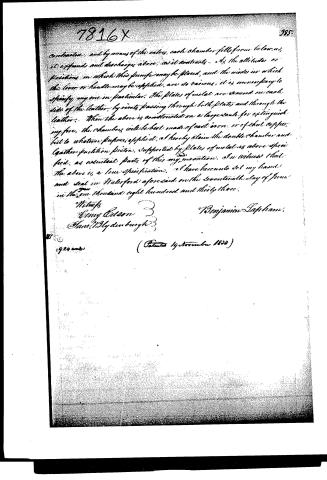
contracted, and by means of the valves, each chamber fills from below as it expands and discharges above, as it contracts. As the attitudes or positions in which this pump may be placed, and the modes in which the lever or handle may be applied, are so various, it is unnecessary to specify any one in particular. The plates of metal are secured on each side of the leather, by rivets passing through both plates and through the leather. When the above is constructed on a large scale for extinguishing fire, the chambers will be best made of cast iron, or of shot copper, but to whatever purpose applied, I hereby claim the double chamber and leather-furled piston, supported by plates of metal as above specified, as essential parts of this my invention. I do witness that the above is a true specification. I have hereunto set my hand and seal in Waterford aforesaid on the seventeenth day of June in the one thousand eight hundred and thirty three.
Witness,
Henry Carson
Sam'l Hydenburgh
Benjamin Lapham.
(Patented 19 November 1833)
Published accounts: journal notice
Notice in the monthly list of patents (listed with a different spelling or date)
Journal of the Franklin Institute, new ser., vol. 13 (1834), p. 316 · View the page
For a Forcing Pump; Benjamin Saphan, Waterford, Saratoga county, New York, November 19.
About this record
- Patentee
- DATAMP
- Date
- the Name and Date index of patents, DATAMP, USPTO records
- Invention
- DATAMP
- Listed in
- the Name and Date index of patents, DATAMP, USPTO records, Jim Shaw's X-patent list, the Journal of the Franklin Institute, Journal, Burke's List of Patents (1847)
- Also listed in a contemporary journal or list under a different spelling or date; the record shown follows the standard lists.
- Burke's 1847 Patent Office list gives the same patent.