

Drawings and documents
USPTO scan
The patent as scanned by the USPTO
-
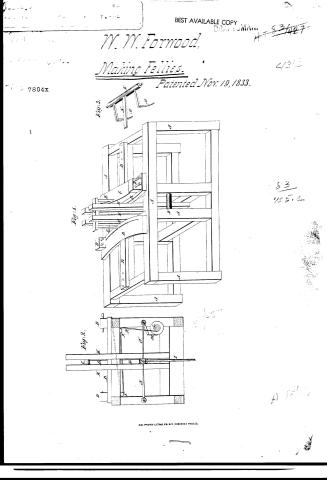 Page 1
-
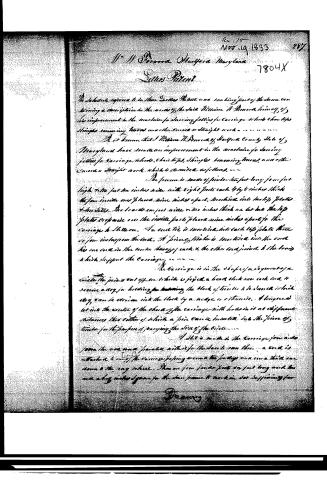 Page 2
-
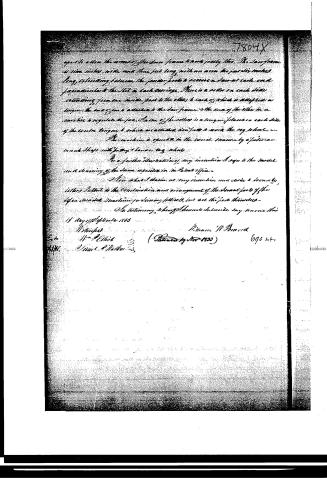 Page 3


U.S. Patent and Trademark Office · Google Patents
Show the transcription Hide (635 words)
Machine transcription (LightOnOCR) of the pages as scanned by the USPTO, most of them the handwritten copies made when the records were restored after the 1836 fire. Not checked; it can misread handwriting, so compare it with the scan.
Page 1.
BEST AVAILABLE COPY
W. W. Formood,
Making Felties.
Patented Nov. 19, 1833.
7804x
Fig. 3.
Fig. 1.
Fig. 2.
AM. PHOTO-LITHO. CO. N.Y. (OSBORNE'S PROCESS)
Page 2.
No. 15
Nov. 19, 1833
287
7804X
St. St. Ann's, Stafford, Maryland
Letters Patent
The Schedule referred to in these Letters Patent is as follows:
I, William H. Brown of Stafford County, State of Maryland, have made an improvement in the machine for shaving fells for carriages, chairs, stools, shingles, sawing boards, and other wood or straight work, which is described as follows:
The frame is made of timber two feet long, four feet high, and two feet six inches wide, with eight posts each 4 by 5 inches thick, the four inside ones placed nine inches apart, mortised into the top plates and the sill. The board is one foot wide and two inches thick and fastened to the top plates crosswise over the inside posts placed nine inches apart for the carriage to slide on. A cross tie is mortised into each top plate three or four inches from the end. A piece of timber is mortised into the ends two inches in the middle, through each of the other end joined to the board which supports the carriage.
The carriage is in the shape of a segment of a circle, the piece cut off on which is fixed a head block near each end to receive a dog for holding the block of timber to be shaved, which dog can be driven into the block by a wedge on either side. A tongue is let into the center of the chord of the carriage with holes in it at different distances from either of which a pin can be inserted into the piece of timber for the purpose of varying the size of the circle.
A slit is made in the carriage four inches from the end and parallel with it for the saw to run through, a cord is attached to one of the carriage passing around the pulleys and over a third one down to the saw wheel. There are four fence posts six feet long and two are a dog attached to them for the saw frame to work in, not supporting the
Drawing
Page 3.
7804X
apart to allow the arms of the door frame to work freely there. The door frame is nine inches wide and three feet long with an arm on each side, making long, extending between the former parts to receive a screw at each end perpendicular to the slit in each carriage. There is a roller on each side extending from one inside part to the other to each of which is attached a tongue, the end of one is attached to the door frame to the end of the other in a mortice to regulate the door. The one of the rollers is a tongue placed on each side of the centre tongue to which are attached iron rods to work the top to heat.
The machine is operated in the usual manner by a piston and crank shaft with gearing to balance the whole.
For a further illustration of my invention I refer to the model and drawing of the same deposited in the Patent office.
This what I claim as my invention new case is shown by letters Patent is the combination and arrangement of the several parts of the before described machine performing like functions not the parts themselves.
In testimony whereof I hereunto subscribe my name this 11 day of September 1833
William H. Amore
Witnesses
Wm. Elliot
Simon P. Walker
(Patented 19 Nov 1833) 690 n°
Published accounts: journal notice
Notice in the monthly list of patents (listed with a different spelling or date)
Journal of the Franklin Institute, new ser., vol. 13 (1834), p. 263 · View the page
For a machine for Sawing Felloes; William W. Forward, Hartford county, Maryland, November 19.
DATAMP: illustration
Illustrations from DATAMP
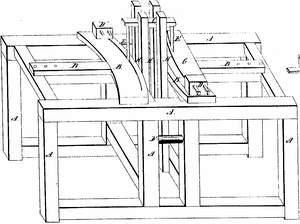
DATAMP (Directory of American Tool and Machinery Patents), via the Internet Archive · Archived DATAMP page
About this record
- Patentee
- DATAMP
- Date
- the Name and Date index of patents, DATAMP, USPTO records
- Invention
- DATAMP
- Listed in
- the Name and Date index of patents, DATAMP, USPTO records, Jim Shaw's X-patent list, the Journal of the Franklin Institute, Journal
- Also listed in a contemporary journal or list under a different spelling or date; the record shown follows the standard lists.