

Drawings and documents
National Archives restored drawings: drawing
Samuel Couillard, Jr.'s Patent Drawing for a Wool Cleaner

National Archives, Restored Patent Drawings (Record Group 241) · Full-size scan at the National Archives · Catalog record
Show the text on the drawing Hide (39 words)
Words on the drawing as machine-read by the National Archives; not checked. Useful mainly for searching.
1250 / SAM¹. COUILLARD.J / wool. / Fex / Milly / WOOL CLEANER. / Patented 30th Mar 1833. / Burring / Fig1 / TON / 750/- / O/A / IF"ig" 2 / LI / er
USPTO scan
The patent as scanned by the USPTO
-
 Page 1
-
 Page 2
-
 Page 3
-
 Page 4
-
 Page 5
-
 Page 6
-
 Page 7
-
 Page 8
-
 Page 9
-
 Page 10
-
 Page 11


U.S. Patent and Trademark Office · Google Patents
Show the transcription Hide (3,373 words)
Machine transcription (LightOnOCR) of the pages as scanned by the USPTO, most of them the handwritten copies made when the records were restored after the 1836 fire. Not checked; it can misread handwriting, so compare it with the scan.
Page 1.
7501X
S. Couillard, Jr.
Wool Cleaner
Patented Mar. 30, 1833.
Fig. 1.

Fig. 2.

H. PETERS, PHOTO-LITHOGRAPHER, WASHINGTON, D. C.
Page 2.
7501X
Samuel Cowillard, Senr. of Boston
Sen. of Massachusetts.
Letters Patent.
The schedule referred to in these Letters Patent and making part of the same containing a description in the words of the said Samuel Cowillard for himself of his improvement in the machine for cleaning wool and detaching or separating burrs &c. therefrom.
To all persons to whom these presents shall come: Be it known that I Samuel Cowillard Senr. of the City of Boston in the county of Suffolk and commonwealth of Massachusetts, Mechanician have invented and applied to use a new and useful improvement in the art of cleaning animal wool or such like substances, and detaching and separating therefrom the burrs and other foreign materials connected and mingled with said wool, or such like substance in the fleece or otherwise by extending & straightening the fibers of said wool or such like substance in such a manner as to bring the burrs and foreign materials wholly or principally unto the surface of said wool or such like substance there extending and straightened and then removing said burrs and foreign materials by scraping, cutting, pinching, blowing, or striking them off, also the mechanical contrivances and arrangement with the application and mode of operating the same, for the accomplishment of the purpose or purposes aforesaid not known before — where the principles of my said invention are the means whereby I accomplish the objects aforesaid & the machine by which I do the same.
Page 3.
7501X
with the mode of operating the same, may be denoted & set forth, in general terms as follows:
First, by causing the wool or such like substance to pass or be drawn from a feeding slot, suitable for the same, this and between two or more fixed or plain rollers, perfectly fixed & arranged, for the purpose in order that said wool or such like substance may be presented on the side opposite rollers so fixed & arranged opposite to that where it enters between them, to a lotho cylinder hereinafter described, in an uniform, regular, and gradual manner & thus be better prepared for subsequent operations.
Second, by causing said wool or such like substance to pass or be drawn over upon or against a revolving ribbon or lotho cylinder or cylinders, roller or rollers, band or bands between or against the same or any such like cylinder or cylinders, roller or rollers, band or bands, one or more armed with teeth or otherwise properly fixed & arranged for the purpose — so that said wool or such like substance while in the process of passing or being drawn as aforesaid is extended elongated, or drawn into a much thinner sheet or layer, and the fibers of said wool or such like substance in a degree straightened and laid parallel to each other while the loose and foreign materials connected and mingled with the said wool or such like substance are loosened and presented on the surface or surface of said wool or such like substance, which will be by this operation in a measure drawn, combed and cleaned out from said loose and other foreign materials, as well as from knots and snags.
Third, by causing said wool or such like substance to pass to be drawn from said cylinder or cylinders
Page 4.
7301X
roller, or rollers, band or bands, as above mentioned or to, there between or against two or more drawing rollers, ridged, fluted, or plain properly connected with a band belt or apron, & fixed and arranged for the purpose, so that said wool or such like substance while in the process of passing or being drawn as aforesaid by the comparative velocity in the rotation of said drawing rollers may receive a greater degree of elongation & be presented in a thinner sheet or layer and the fibres of said wool or such like substance be still more straightened, and laid more parallel with each other — at the same time the aforesaid sheet or layer of said wool or such like substance shall be during the process of passing or being drawn as aforesaid this & between the said drawing rollers so arranged as aforesaid, drawn, pinched or tightly held around one or more of said drawing rollers, and the ends of the fibres of the same confined in consequence of the comparative shortness of the distance between the nips, bites or pinches, of said drawing rollers — thus the burrs and other foreign materials connected and commingled with said wool or such like substance, are loosened and presented on the surface or surface of the same in such a manner as to be easily detached & taken wholly off by scraping, cutting, pinching, blowing or striking or otherwise operating on or against them while the wool or such like substance thus tightly held is in the process of passing or being drawn this among, over or upon the said drawing rollers or rollers & the belt or apron can be readily fixed & arranged as aforesaid
I further by running said wool or such like substance under, along, between or parallel to or the surface
Page 5.
7501X
if passing or being drawn as above described to be freed and cleared of burrs and other foreign materials by the means of any scraper, pressure, sucker, beater, or blower, one or more which shall revolve against or otherwise act upon or against said burrs or other foreign materials so that said wool or such like substances may pass or be drawn in a sheet or layer on to a receiving cylinder suitably fixed and arranged for the purpose or be otherwise taken away in a disentangled and cleaned state & in a good condition for the subsequent operations of the manufacturer.
And although I have herein declared that I have applied my said invention to use yet this declaration is not to be taken to mean further use, but merely that use which is necessary for experiment and trial without which my said invention could not have been produced and completed.
These may be considered to be the general principles of my invention aforesaid in the art of cleaning animal wool & such like substances and of detaching and separating therefrom burrs and other foreign materials connected and mingled with the same in the fleece or otherwise & of delivering said wool and such like substances in a clean and highly improved state. But the nature of my said invention & the manner in which the purposes aforesaid are accomplished with the mechanical conveniences used therefor, & the modes in which the machinery or the parts thereof are arranged applied & made to operate in order to clean and place the wool or such like substances in the condition above mentioned may perhaps be better understood by reference to the plan & drawing hereto annexed marked 1, 2, 3 which
Page 6.
7501X
which may be taken and considered as a part of this my specification.
A. In this plan represents a strong quadrangular frame made of wood or any other suitable material) of sufficient length and width to receive at the same time a whole floor of work of such dimensions as our circumstances may require, B. Is a feeding cloth on which the work or such like substance to be operated upon is placed; it is made of canvas or other suitable material for this purpose and passes around an end roller C. & around the lower of the two feeding rollers B.B. & B.B. also two feeding rollers of about one inch and half diameter, but may be varied in size according to the state of the work or the such substance — I make use of only two feeding rollers — but more may be used if thought necessary. The apparatus of these two rollers is ribbed or fluted, in order that burrs & foreign materials in the work may not be too much broken & flattened down by passing between them & also with a view the better to retain and hold back the work, and convey it more gradually to the toothed cylinder D.
D. Is a cylinder about six inches diameter armed with teeth which project from its surface from three to four eighths of an inch. These teeth are from one sixteenth to one eighth of an inch in diameter pointed and bent something in the manner of the letter S. & set in the cylinder about one fourth of an inch apart. But the form, size, and position of the cylinder as well as of the teeth with which it is armed may be varied according to the quality and condition of the work taken operation upon — This cylinder is placed on the side of the feeding rollers B.B. opposite to those where the work enters between them and so near them that the teeth of the same may take the work as near the finish or bite of the rollers B.B. as possible.
g. g. g. 1, 2, 3 are drawing rollers or a combination or a combination of drawing rollers (as seen in fig 3.) connected with a hand belt or apron E. extending the whole length of them — The rollers g. g. g. are of the same size or nearly so one of which is fluted and none of them may be so, if deemed expedient. — Where these drawing rollers g. g. g. are placed and
Page 7.
4801X
movements on their extremities as axes in their natural manner of rolling. That the drawing rollers 1, 2, are of a similar size and manufactured at their extremities except by the belt or apron E. By this belt or apron the rollers 1, 2, are alone kept in their proper position and made to revolve — while by the elasticity of the belt or apron E, they are allowed to recede more or less so as to admit the passage of burs or other materials of greater or less size.
The drawing rollers g, g, g, as seen in fig 3, are about one inch and a half in diameter & the small drawing rollers 1, 2, about one half inch in diameter & arranged as there represented, but the size of the same may be varied as well as the arrangement & number in same degree, and still effect the same purpose.
H is an intermediate shaft connected with suitable pinions pulleys and gearings for driving the machinery.
I, is an endless belt or apron made of canvas or some other suitable material, and passes around a large roller, etc. and around among the combination of drawing rollers g, g, g, 1, 2.
J, is called the preventer made of iron, steel or other material suitable for the purpose — It is in the form of a thin plate or knife & so placed that one edge of the same is parallel to the surface of the outward small drawing roller 2, & in contact with the belt or apron E, which passes over the roller 2 — The preventer is from one to two inches in width extending the length of the roller & from one sixteenth to one eighth of an inch in thickness but may be varied in its dimensions as may be convenient — One side of the preventer j, in contact with the belt or apron E, is filed or worn down to a blunt edge while the other edge or back is firmly fixed by screws or otherwise to a strong piece of iron steel or other suitable material which gives it firmness and stability.
This preventer j, may be placed stationary in the position in which it is intended to operate or it may be so fixed that it can be readily thrown back as seen in fig 4.
K is the bristle or clipper it may be made of wood iron or
Page 8.
any material suitable for the purpose. It is a cylinder with projections or wings the external edges of which are filed or lathed transversely with the axis of the cylinder and making alternately different angles with the same. This beater or clipper is so placed that the projections or wings as it rotates may come in contact with the burns and other foreign materials as near the blind edge of the focuser as possibly. It may be made square or in other forms or otherwise constructed to effect the same purpose.
Is a piece of iron or other suitable substance, near the bottom of which the belt or apron roller at, runs in its axis — at the upper end of Is there is a screw and nut suited for shortening or lengthening the same (the lower end being movable up and down,) and thus the belt or apron E, is loosened or strained.
M, represents the guides or regulators of the belt or apron, E.
at, is a large roller for the belt or apron E.
O, is a large cylinder for the purpose of receiving the wool, or such like substance from the belt or apron E, in a clean state in the form of a sheet, their layer or otherwise rolled around the same.
P is a pulley around which a band passes and connects it with another pulley q, on the shaft of the beater or clipper B, which it serves to drive.
K, is the pulley to the shaft of the beater or clipper B, and R, is the pulley around which the band S, passes connecting it with another pulley on the shaft H, which with suitable gearing is the main driver of the machinery.
The foregoing is a description of the mechanical contrivances and machinery which I make use of in my said invention & for accomplishing the purposes herein before mentioned all of which with the application and arrangement of the same may be further illustrated and better understood by a brief account of the mode of operation as follows to wit:
The wool or such like substance in the fleece or shorn with the burns & other foreign materials on same are brought with the same in place upon the focuser which, B, from the
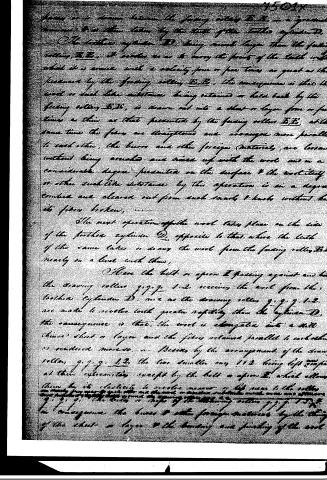
Page 9.
45014
being so in common between the feeding rollers $B_1B_2$ in a groove $D$ is then taken by the teeth of the toothed cylinder $D_1$
The toothed cylinder $D_1$ being much larger than the feeding rollers $B_1B_2$, it serves as a to carry the fibers of the tooth cylinder which it is wound with a velocity four or five times as great as the feed given by the feeding rollers $B_1B_2$. The consequence is that the wool or such like substance being retained or held back by the feeding rollers $B_1B_2$, is drawn out into a sheet or layer four or five times as thin as that presented by the feeding rollers $B_1B_2$, while at the same time the fibers are straightened and arranged more parallel to each other, the burs and other foreign materials, are loosened without being crushed and mixed up with the wool and in a considerable degree presented on the surface & the wool itself or other such like substance by this operation is in a degree combed and cleaned out from such snarls & knots without breaking its fibers broken,
The next operation of the wool takes place on the side of the toothed cylinder $D_1$ opposite to that where the teeth of the same takes or draws the wool from the feeding rollers $B_1B_2$ nearly on a level with them,
Here the belt or apron $I$ passing against and between the drawing rollers $g, g, g, 1, 2$ receiving the wool from the toothed cylinder $D_1$ and as the drawing rollers $g, g, g, 1, 2$ are made to revolve both greater rapidly than the cylinder $D_1$ the consequence is that the wool is elongated into a still thinner sheet or layer and the fibers obtained parallel to each other or rendered more so. Besides by the arrangement of the drawing rollers $g, g, g, 1, 2$ the two smaller ones $1, 2$ being left simply at their extremities except by the belt or apron $I$, which allows them by its elasticity to revolve nearer or be near to the rollers $g, g, g$ the teeth or edges of the withdrawing rollers $g, g, g, 1, 2$ in consequence the burs & other foreign matters by the taking of the sheet or layer & the drawing and feeding of the wool
Page 10.
7501X
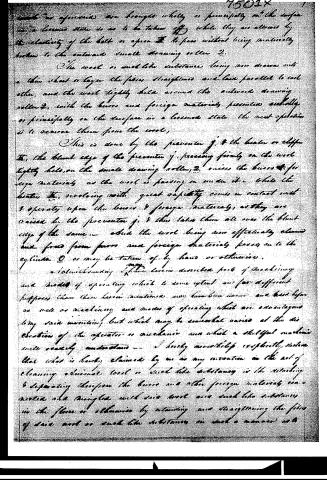
wool or afteraid are brought wholly or principally on the surface in a loose state so as to be taken off while they are allowed by the elasticity of the belt or apron I to pass without being materially broken to the outward small drawing roller 2.
The wool or wool-like substance being now drawn into a thin sheet or layer the fibres straightened and laid parallel to each other, and the wool tightly held around the outward drawing roller 2, with the burrs and foreign materials presented, wholly or principally on the surface in a loose state, the next operation is to remove them from the wool,
This is done by the preventer j, & the heater or clipper K, the blunt edge of the preventer j, pressing firmly on the wool tightly held on the small drawing roller, 2, raises the burrs & foreign materials as the wool is passing or under it—while the heater K, revolving with great rapidity, comes in contact with & operates upon the burrs & foreign materials, as they are raised by the preventer j, & thus takes them all over the blunt edge of the same—thus the wool being now effectively cleaned and free from burrs and foreign materials passes on to the cylinder O or may be taken up by hand or otherwise.
I have herein described parts of machinery and modes of operating which to some extent are far different purposes than those herein mentioned may have been known and used before as well as machinery and modes of operating which are analogous to my said invention, but which may be somewhat varied at the discretion of the operator or mechanic and which a skillful mechanic will readily understand. I hereby nevertheless, specifically declare that what is hereby claimed by me as my invention is the act of cleaning animal wool or wool-like substance is the raising & separating therefrom the burrs and other foreign materials connected and mingled with said wool and said like substance in the fibre or otherwise by extending and straightening the fibre of said wool or wool-like substance in such a manner as to
Page 11.
7501X
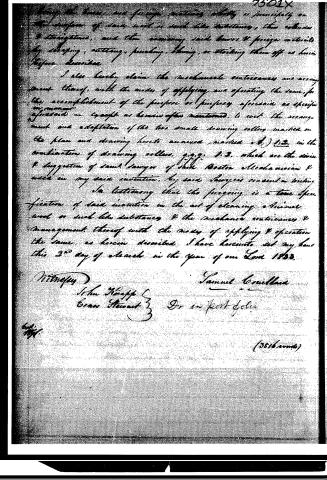
being the hair and foreign matters wholly or principally on the surface of such wool or such like substance, then extends & straightens, and then removing said hairs & foreign matters by scraping, nitting, pinching, shaving, or striking them off as herein before described.
I also hereby claim the mechanical contrivances and arrangement thereof, with the modes of applying and operating the same, for the accomplishment of the purpose or purposes aforesaid as specifically aforesaid — except as hereinbefore mentioned, to wit: the arrangement and adaptation of the two small drawing rollers marked on the plan and drawing hereto annexed marked a, b, c, d, in the combination of drawing rollers, p.g.g. 1.3, which are the same & suggestion of said Sawyer of said Boston Alcahamician & used in my said invention, by said Sawyer’s consent as herein before mentioned.
In testimony whereof the foregoing is a true specification of said invention in the art of cleaning animal wool or such like substance & the mechanical contrivances & management thereof with the modes of applying & operating the same, as herein described I have hereunto set my hand this 2nd day of March in the year of our Lord 1833.
Witnesses
John Knapp
Elias Stewart
Samuel Conklin
Dr. in post folio
(3516 words)
Published accounts: journal notice
Notice in the monthly list of patents (listed with a different spelling or date)
Journal of the Franklin Institute, new ser., vol. 12 (1833), p. 187 · View the page
For machinery for Cleaning Animal Wool, &c.; Samuel Couillon, jr., Boston, Massachusetts, March 30.
DATAMP: illustration
Illustrations from DATAMP


DATAMP (Directory of American Tool and Machinery Patents), via the Internet Archive · Archived DATAMP page
About this record
- Patentee
- DATAMP
- Date
- the Name and Date index of patents, DATAMP, USPTO records
- Invention
- DATAMP
- Listed in
- the Name and Date index of patents, DATAMP, USPTO records, Jim Shaw's X-patent list, the Journal of the Franklin Institute, Journal, Burke's List of Patents (1847)
- Also listed in a contemporary journal or list under a different spelling or date; the record shown follows the standard lists.
- Burke's 1847 Patent Office list gives the same patent.