

Drawings and documents
USPTO scan
The patent as scanned by the USPTO
-
 Page 1
-
 Page 2
-
 Page 3
-
 Page 4


U.S. Patent and Trademark Office · Google Patents
Show the transcription Hide (1,043 words)
Machine transcription (LightOnOCR) of the pages as scanned by the USPTO, most of them the handwritten copies made when the records were restored after the 1836 fire. Not checked; it can misread handwriting, so compare it with the scan.
Page 2.
United States Patent
Patent No.: X9509
Thomas Holland.
Letters Patent.
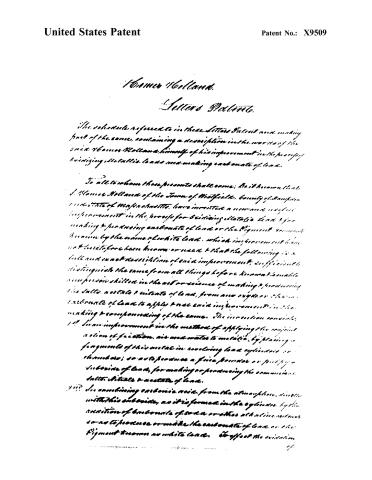
The schedule referred to in these Letters Patent now making part of the same, containing a description in the words of the said Thomas Holland himself of his improvement in the process of oxidizing metallic lead and making carbonate of lead.
To all to whom these presents shall come; Be it known that I, Thomas Holland of the Town of Westfield, county of Hampden and State of Massachusetts, have invented a new and useful improvement in the process for oxidizing metallic lead & for making & producing carbonate of lead or the Pigment known by the name of white lead, which improvement has not heretofore been known or used & that the following is a full and exact description of said improvement, sufficiently to distinguish the same from all things before known to enable any person skilled in the art or science of making & producing the salts, acetate & nitrate of lead, from any oxide or the carbonate of lead to apply & use said improvement in the making & compounding of the same. The invention consists:
1st In an improvement in the method of applying the conjoint action of fixation, air and water to metallic, by placing fragments of this metal in revolving lead cylinders or chambers; so as to produce a fine powder or purified suboxide of lead, for making or producing the common salts, nitrate & acetate of lead.
2nd In combining carbonic acid, from the atmosphere, directly with this suboxide, as it is formed in the cylinders, by the addition of carbonate of soda or other alkaline substances so as to produce or make the carbonate of lead or the Pigment known as white lead. To effect the oxidation of
Page 3.
United States Patent
Patent No.: X9509
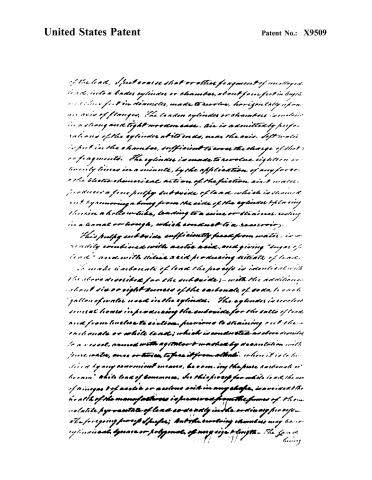
of the lead, a piece or a sheet or other fragment of metallized lead, into a leaden cylinder or chamber, about four feet in length and three feet in diameter, made to revolve, horizontally upon an axis of flanges. The leaden cylinder or chamber is enclosed in a strong and tight wooden case. Air is admitted by perforations of the cylinder at its ends, near the axis. Soft water is fed into the chamber, sufficient to cover the charge of sheet or fragments. The cylinder is made to revolve eight or ten times in a minute, by the application of any force or the electro-mechanical action of the friction air wheel, producing a fine pulpy suboxide of lead, which is drained out by removing a bung from the side of the cylinder & leaving therein a hollow side, leading to a sieve or strainer, resting in a basin or trough, which connect to a reservoir.
This pulpy suboxide sufficiently freed from water, is readily combined with acetic acid, and giving “sugar of lead” and with nitric acid producing nitrate of lead.
To make carbonate of lead the process is identical with the above described for the suboxide;—with the addition, about six or eight ounces of the carbonate of soda to each gallon of water used in the cylinder. The cylinder is worked somewhat more vigorously than the suboxide for the sake of lead and from lead to carbon, previous to straining out the carbonate or white lead; which is conducted as above described to a vessel, named with agitation & marked by a connection with pure water, once or twice, to free it from alkali. When it is to be dried by any convenient means, becoming the pure carbonate or “bourn” white lead of commerce. So this process for white lead, the use of nitrous or of acetic or acetic acid in any shape, is avoided. The heat of the manufacture is prevented from the fumes of the volatile pyro-mate of lead constantly in the ordinary process of the foregoing process of lead; but the revolving chamber may be cylindrical, square or polygonal, of any size & length. The fan is having
Page 4.
United States Patent
Patent No.: X9509
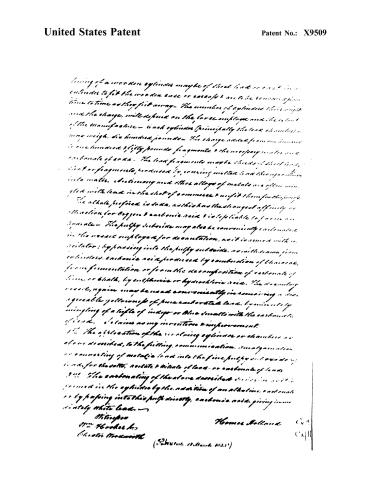
lining of a wooden cylinder maybe of sheet lead or cast iron cylinder to fit the wooden case or carcase & are to be removed from time to time as they get away. The number of cylinders their weight and the charge, will depend on the large employer and the extent of the manufacture — each cylinder (principally the lead chamber) may weigh six hundred pounds — The charge added from one cylinder is one hundred & fifty pounds fragments & the necessary water and carbonate of soda. The lead fragments maybe sheets of sheet lead, shot or fragments produced by, running molten lead through a die into water. Also many and other alloys of metals are often mixed with lead in the shot of commerce & unfit them for this purpose.
The alkali preferred is soda, as this has the strongest affinity or attraction for oxygen & carbonic acid & is capable to form an hydrate — The pulpy substance may also be conveniently carbonated in the vessel employed for decantation, as it is mixed with a agitator; by passing into the pulpy substance, as with a wire from cylinders, carbonic acid produced by combustion of charcoal, from fermentation or from the decomposition of carbonate of lime or chalk, by sulphuric or hydrochloric acid. The decanting vessel, again may be used conveniently in removing a considerable yellowness of pure carbonated lead, by minutely mingling of a little of indigo or blue smalt with the carbonate of lead. I claim as my invention & improvement.
1st. The application of the revolving cylinders or chambers as above described, to the fitting, communication, amalgamation or converting of metallic lead into the fine pulpy substance; in order, for the salts, acetate & nitrate of lead — or carbonate of lead.
2nd. The carbonating of the above described substance with a ferment in the cylinders by the addition of an alkaline carbonate or by passing into this pulpy directly, carbonic acid, giving immediately white lead.
Witnesses
Thomson Ballance
(Patented March 21, 1851)
Published accounts: journal notice
Notice in the monthly list of patents
Journal of the Franklin Institute, new ser., vol. 17 (1836), p. 438 · View the page
178. Mould candles. Jefferson Dunlap, New Holland, Penn.
Published accounts: journal notice
Notice in the monthly list of patents
Journal of the Franklin Institute, new ser., vol. 18 (1836), p. 388 · View the page
64. For an improvement in the process of Manufacturing White Lead; Horner Holland, Westfield, Hampden county, Massachusetts, March 18.
Published accounts: journal notice
Notice in the monthly list of patents (listed with a different spelling or date)
Journal of the Franklin Institute, new ser., vol. 17 (1836), p. 438 · View the page
White lead, making.--Homer Hollard, Westfield, Mass.
About this record
- Patentee
- DATAMP
- Date
- the Name and Date index of patents, DATAMP, USPTO records
- Invention
- DATAMP
- Listed in
- the Name and Date index of patents, DATAMP, USPTO records, Jim Shaw's X-patent list, the Journal of the Franklin Institute, the Journal of the Franklin Institute, Journal, Burke's List of Patents (1847)
- Also listed in a contemporary journal or list under a different spelling or date; the record shown follows the standard lists.
- Burke's 1847 Patent Office list gives the same patent.