

Drawings and documents
National Archives restored drawings: drawing
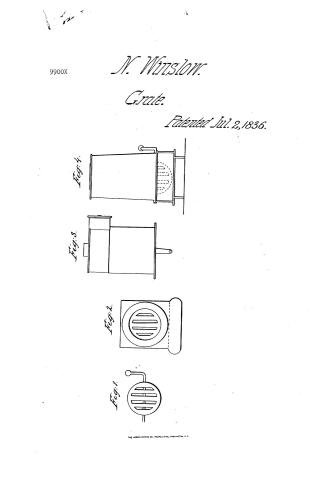
Nathaniel Winslow's Patent Drawing for a Pendulum Grate

National Archives, Restored Patent Drawings (Record Group 241) · Full-size scan at the National Archives · Catalog record
Show the text on the drawing Hide (40 words)
Words on the drawing as machine-read by the National Archives; not checked. Useful mainly for searching.
100 / 128. STOVES & FURNA / [154] Gras Rocking Bar. / p / classupication / Nath Winston Pendulune Grale / 9.900+ / Patented 2" July 1836 / DIVISION. / 9,900 X / cash / your / Fig.1. / Fig.3. / Fig. 2. / Hig.4. / ENC.
USPTO scan
The patent as scanned by the USPTO
-
 Page 1
-
 Page 2
-
 Page 3


U.S. Patent and Trademark Office · Google Patents
Show the transcription Hide (473 words)
Machine transcription (LightOnOCR) of the pages as scanned by the USPTO, most of them the handwritten copies made when the records were restored after the 1836 fire. Not checked; it can misread handwriting, so compare it with the scan.
Page 1.
9900X
J. Winslow.
Grate.
Patented Jul. 2, 1836.
Fig. 4.
Fig. 3.
Fig. 2.
Fig. 1.
THE MORRIS PETERS CO. PHOTOLITHING, WASHINGTON, D. C.
Page 2.
7/2/1836 9900X
Ash. 2402
Nathan Winslow
Letters Patent (Filed July 2, 1836)
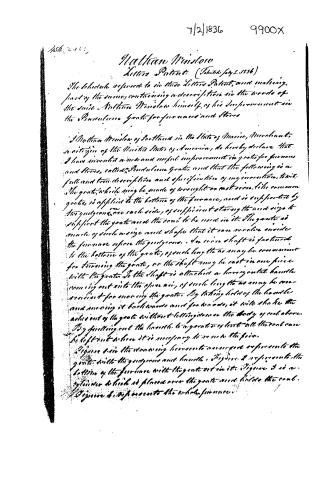
The schedule referred to in these Letters Patent, and making part of the same, containing a description in the words of the said Nathan Winslow himself, of his Improvement in the Pendulum Grate for furnaces and Stoves.
I, Nathan Winslow, of Portland in the State of Maine, Merchant, a citizen of the United States of America, do hereby declare that I have invented a new and useful improvement in grates for furnaces and stoves, called Pendulum Grates, and that the following is a full and true description and specification of my invention, to wit:
The grate, which may be made of wrought or cast iron, like common grates, is applied to the bottom of the furnace, and is supported by two guides on each side, of sufficient strength and size to support the grate and the coal to be used in it. The grate is made of such a size and shape that it can revolve inside the furnace upon the guides. An iron shaft is fastened to the bottom of the grate, of such length as may be convenient for turning the grate, or the shaft may be cast in one piece with the grate. To the shaft is attached a horizontal handle coming out into the open air, of such length as may be convenient for moving the grate. By taking hold of the handle and moving it backwards and forwards, it will shake the ashes out of the grate without letting down the body of coal above. By pulling out the handle to a greater extent all the coal can be left out when it is necessary to renew the fire.
Figure 1 in the drawing hereunto annexed represents the grate with the guides and handle. Figure 2 represents the bottom of the furnace with the grate set in it. Figure 3 is a cylinder which is placed over the grate and holds the coal. Figure 4 represents the whole furnace.
Page 3.
7/2/1836 9900x
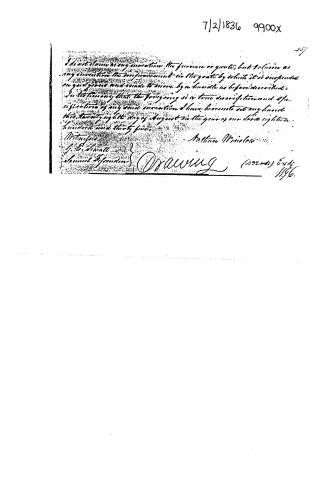
I do not claim as any innovation the furnace or grate, but I claim as an innovation the improvement in the grate by which it is suspended on guide-pins and made to move by a handle as before described.
In testimony that the foregoing is a true description and specification of my said invention I have hereunto set my hand this twenty-eighth day of August in the year of our Lord eighteen hundred and thirty-six.
Witnesses:
J. E. Small
Samuel Sprouden
Arthur Winchell
Drawing (102005) Engle 11/96.
Published accounts: journal notice
Notice in the monthly list of patents
Journal of the Franklin Institute, new ser., vol. 18 (1836), p. 359 · View the page
575. Grates, pendulum.-Nathan Winslow, Portland, Maine.
About this record
- Patentee
- the Journal of the Franklin Institute, Journal
- Date
- the Name and Date index of patents, USPTO records, Jim Shaw's X-patent list
- Invention
- the Name and Date index of patents
- Listed in
- the Name and Date index of patents, USPTO records, Jim Shaw's X-patent list, the Journal of the Franklin Institute, Burke's List of Patents (1847)
- The patentee's full name comes from the Franklin Institute's journal.
- Burke's 1847 Patent Office list gives the same patent.