

Drawings and documents
USPTO scan
The patent as scanned by the USPTO
-
 Page 1
-
 Page 2
-
 Page 3


U.S. Patent and Trademark Office · Google Patents
Show the transcription Hide (903 words)
Machine transcription (LightOnOCR) of the pages as scanned by the USPTO, most of them the handwritten copies made when the records were restored after the 1836 fire. Not checked; it can misread handwriting, so compare it with the scan.
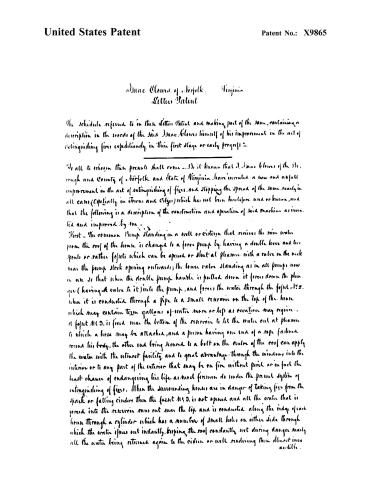
Page 2.
United States Patent
Patent No.: X9865
Jane Clowes of Norfolk, Virginia
Letter Patent
The Schedule referred to in this Letter Patent and making part of the same, containing a description in the words of the said Jane Clowes herself of his improvement in the art of extinguishing fires expeditiously, in their first stage or early progress:
We all to whom this patent shall come — Be it known that J. Jane Clowes of the Borough and County of Norfolk and State of Virginia have invented a new and useful improvement in the art of extinguishing of fires, and stopping the spread of the same, nearly in all cases (especially in Towns and Cities) which has not been heretofore used or known, and that the following is a description of the construction and operation of said machine as invented and improved by me.
First — The common Pump standing in a well or cistern that receives the rain water from the roof of the house, is changed to a force pump by having a double lever and two spouts or rather fojets which can be opened or shut at pleasure with a valve in the neck near the pump stock opening outwards; the lower valve standing as in all pumps now in use so that when the double pump handle is pulled down it forces down the plunger (having a valve to it) into the pump, and forces the water through the fojet. When it is conducted through a pipe to a small reservoir on the top of the house which may contain ten gallons of water more or less as occasion may require. A fojet No. 3 is fixed near the bottom of the reservoir to let the water out at pleasure to which a hose may be attached, and a person having one end of a rope fastened round his body, the other end being secured to a bolt on the centre of the roof can apply the water with the utmost facility, and to great advantage, through the windows into the interior or to any part of the exterior that may be on fire without peril or in fact the least chance of endangering his life as most firemen do under the present system of extinguishing of fires. When the surrounding houses are in danger of taking fire from the spark or falling cinders then the fojet No. 3 is not opened and all the water that is forced into the reservoir runs out near the top and is conducted along the ridge of each house through a cylinder which has a number of small holes on either side through which the water issues out instantly, keeping the roof constantly wet during danger, nearly all the water being returned again to the cistern or well rendering them almost inexhaustible.
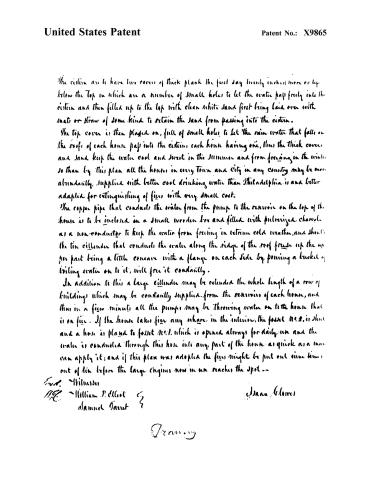
Page 3.
United States Patent
Patent No.: X9865
The cisterns are to have two covers of thick plank the first day twenty inches more or less below the top in which are a number of small holes to let the water pass freely into the cistern and then filled up to the top with clean white sand first being laid over with mats or straw of some kind to retain the sand from passing into the cistern.
The top cover is then placed on, full of small holes to let the rain water that falls on the roofs of each house pass into the cistern, each house having one, thus the thick cover and sand keep the water cool and sweet in the summer and from freezing in the winter so that by this plan all the houses in every town and city in any country may be more abundantly supplied with better cool drinking water than Philadelphia is and better adapted for extinguishing of fires with very small cost.
The copper pipe that conducts the water from the pumps to the reservoir on the top of the house is to be enclosed in a small wooden box and filled with pulverized charcoal as a non-conductor to keep the water from freezing in extreme cold weather, and should the tin cylinder that conducts the water along the ridge of the roof freeze up the upper part being a little concave with a flange on each side by pouring a bucket of boiling water on to it, will free it constantly.
In addition to this a large cylinder may be extended the whole length of a row of buildings which may be constantly supplied from the reservoirs of each house, and thus in a few minutes all the pumps may be throwing water on to the house that is on fire. If the house takes fire anywhere in the interior, the faucet No. 2 is shut and a hose is placed to faucet No. 1 which is opened always for daily use and the water is conducted through this hose into any part of the house as quick as a man can apply it; and if this plan was adopted the fires might be put out some time out of view before the large engines now in use reaches the spot.
End. Witness
William P. Elliot
Samuel Garret
Jane Glover
*Drawing
Published accounts: journal notice
Notice in the monthly list of patents
Journal of the Franklin Institute, new ser., vol. 18 (1836), p. 359 · View the page
568. Fires, extinguishing.-Isaac Clowes, Norfolk, Va.
About this record
- Patentee
- DATAMP
- Date
- the Name and Date index of patents, DATAMP, USPTO records
- Invention
- DATAMP
- Listed in
- the Name and Date index of patents, DATAMP, USPTO records, Jim Shaw's X-patent list, the Journal of the Franklin Institute, Burke's List of Patents (1847)
- Burke's 1847 Patent Office list gives the same patent.