

Drawings and documents
National Archives restored drawings: drawing
Johnson Marsh's Patent Drawing for a Double Shot Gun

National Archives, Restored Patent Drawings (Record Group 241) · Full-size scan at the National Archives · Catalog record
Show the text on the drawing Hide (23 words)
Words on the drawing as machine-read by the National Archives; not checked. Useful mainly for searching.
Geen Yocks / Fine-come - / of / (9 / Chocolate / 43 / 2Ad
USPTO scan
The patent as scanned by the USPTO
-
 Page 1
-
 Page 2
-
 Page 3
-
 Page 4


U.S. Patent and Trademark Office · Google Patents
Show the transcription Hide (546 words)
Machine transcription (LightOnOCR) of the pages as scanned by the USPTO, most of them the handwritten copies made when the records were restored after the 1836 fire. Not checked; it can misread handwriting, so compare it with the scan.
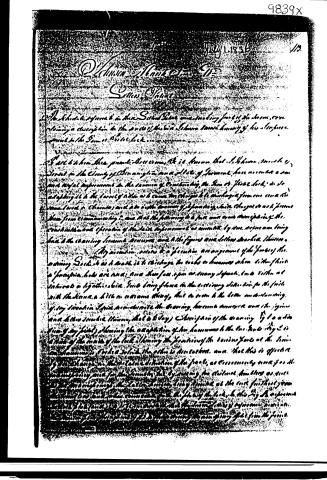
Page 1.
A6725 OR X 9,839
Locks.
J. MARSH.
Double Shot Gun.
Patented July 1, 1836.
9839x.
Fig. 2
Fig. 1
Fig. 3
R. PETERS, Photo-Lithographer, Washington, D.C.
Page 3.
9839X
115.
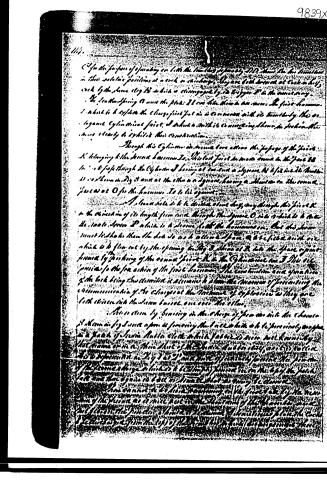
(For the purpose of speaking on both the lines they separately N.D. share the line lines in their relative positions at a rock or discharge, they are both driven at each a key, rock by the same key by which a discharge by its trigger is in the same way.
The following is over the plate: I can take them in one view. The first hammer which is to explode the charge first is in a connection with its trigger by the elongate cylindrical joint. I indicate with its connection shown, so as to be more clearly to exhibit their construction.
Through this Cylindrical bore above above the passage of the point N belonging to the second hammer I.D. This last joint is made round in the form of a tube to pass through the Cylindrical I having at one end a groove N to fit into the tube so as to be in a groove, having a shoulder on the round face as at O for the hammer I.D to lie against.
A small hole is to be drilled about half way through this joint N in the direction of its length from one through the groove O into which is to enter the small lever P which is to become locked the hammer on. But the lever must be shorter than the hole so as to allow a space Q to be filled with one which is to flow out by the opening in the key B above at R into the space or joint formed by joining of the round joint N in the Cylindrical and I. The air passes to the free action of the first hammer. The construction and operation of the lock being thus described, it remains to show the manner of operating the communication of the charges at the moment of explosion as they are both driven into the same bore, one over the other.
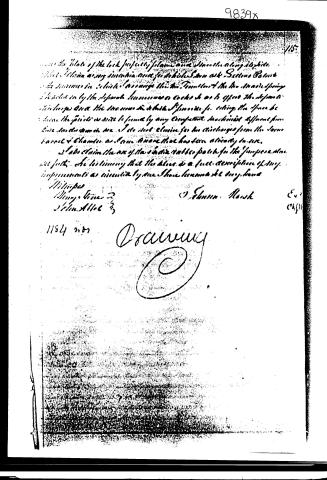
The action by bursting in the charge of powder into the chamber I. When a key is used upon a spring that locks which is to be previously wrapped in a patch of India Rubber cloth which fabric is now well known by that name or in a thin sheet of the same rubber cloth, and is called a rubber disc. In Fig 3 at 2, and more especially formed the portion of the rubber disc which is to be simply placed in on the top of the patch and then again to lock in a small that air may be drawn.
The hammer is to be held moving in the first tube by the movement of the piston as it will not in the direction of the hammer and not close the joint air. I have a diagram of the main plate of the lock I have here given the top of the lock by the lock discharge lever that
Published accounts: journal notice
Notice in the monthly list of patents
Journal of the Franklin Institute, new ser., vol. 18 (1836), p. 359 · View the page
566. Gun and pistol lock.-Johnson Marsh, East Dorset, Vt.
About this record
- Patentee
- DATAMP
- Date
- the Name and Date index of patents, DATAMP, USPTO records
- Invention
- DATAMP
- Listed in
- the Name and Date index of patents, DATAMP, USPTO records, Jim Shaw's X-patent list, the Journal of the Franklin Institute, Burke's List of Patents (1847)
- Burke's 1847 Patent Office list gives the same patent.