

Drawings and documents
National Archives restored drawings: drawing
Ebenezer Andrews and Steven Austin's Patent Drawing for a Cooking Stove

National Archives, Restored Patent Drawings (Record Group 241) · Full-size scan at the National Archives · Catalog record
Show the text on the drawing Hide (57 words)
Words on the drawing as machine-read by the National Archives; not checked. Useful mainly for searching.
128. STOVIS 8s FURNA OHS Cook Stores / [154] Cooking / Cal / # 40 / 9818. X / DIVISION. / origoneto / 9818.X / Ebenezer Andrews and Stephen Austin / Surrender of Patent of / Patented 30.May 1842 / June 8. 1542 / GF / Ei / le / to / X. / de / Figz / family / I'ig: 1 / B. / you / 01 / F' / II / I''' / Fig.3. / Fig.4
USPTO scan
The patent as scanned by the USPTO
-
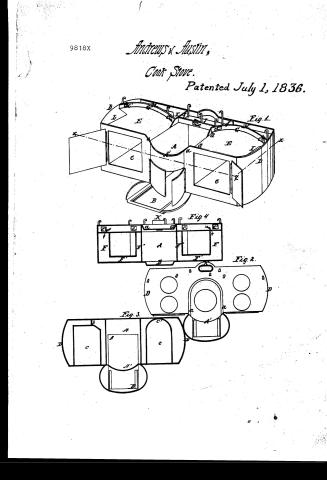 Page 1
-
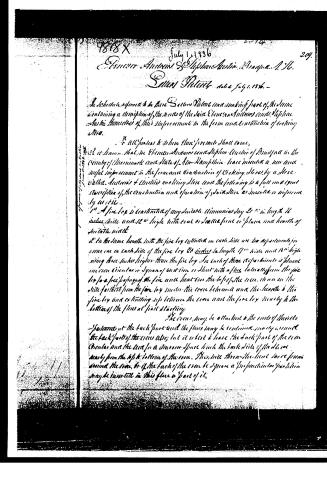 Page 2
-
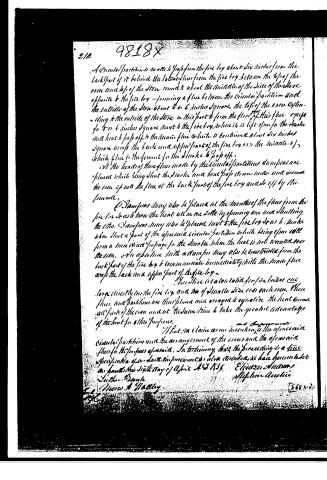 Page 3
-
 Page 4


U.S. Patent and Trademark Office · Google Patents
Show the transcription Hide (888 words)
Machine transcription (LightOnOCR) of the pages as scanned by the USPTO, most of them the handwritten copies made when the records were restored after the 1836 fire. Not checked; it can misread handwriting, so compare it with the scan.
Page 1.
9818X
Andrews & Austin,
Coal Stove.
Patented July 1, 1836.
Fig. 1.
Fig. 4.
Fig. 2.
Fig. 3.
Page 2.
July 1, 1836
Eleanor Andrews & Stephen Austin, Bradford, N.H.
Letters Patent, dated July 1, 1836.
A schedule referred to in these Letters Patent and making part of the same containing a description of the mode of the said Eleanor Andrews and Stephen Austin themselves of their improvement in the form and construction of cooking stoves.
To all persons to whom these presents shall come,
It is known that the Eleanor Andrews and Stephen Austin of Bradford in the County of Merrimack and State of New Hampshire have invented a new and useful improvement in the form and construction of cooking stoves by a stove called Andrews & Austin's cooking stove and the following is a full and exact description of the construction and operation of said stove as invented or improved by us the.
1st A fire box is constructed of any suitable dimensions say 20" in length, 16 inches wide, and 12" high with coal or shelled fire or place one hearth of suitable width.
2nd In the same hearth with the fire box inserted on each side are two departments for coals, one on each side of the fire box 20 inches in length, 17" wide and 16" high, rising three inches higher than the fire box. In each of these departments is placed one iron circular or square of cast iron or sheet iron with a flue laterally from the fire box for a free passage of the fire and heat into the top of the iron stove on the side farthest from the fire box under the iron between it and the hearth & the fire box and extending up between the iron and the fire box nearly to the bottom of the flues at first starting.
The iron may be attached to the ends of suitable supports at the back part and the flues may be continued nearly around the back parts of the stove also; but it is best to have the back part of the iron circular and the iron for a narrow space under the back side of the stove nearly from the top to bottom of the iron. This will throw the heat more firmly around the stove, or if the back of the stove be square a perpendicular partition may be inserted in this flue or part of it.
Page 3.
A Circular partition is made to pass from the fire box about six inches from the back part of it behind the lateral flue from the fire box between the top of the oven and top of the stove round to about the middle of the side of the stove opposite to the fire box—joining a flue between the circular partition and the inside of the stove about 5 or 6 inches square the top of the oven extending to the inside of the stove in this part to form the floor of this flue except for 5 or 6 inches square next to the fire box where it is left open for the smoke and heat to pass off to the main flue which is continued about six inches square across the back and upper part of the fire box to the middle of which flue is the funnel for the smoke to pass off.
At the heads of these flues made by the circular partitions dampers are placed which being shut the smoke and heat pass down under and around the oven up into the flue at the back part of the fire box and is off by the funnel.
Dampers may also be placed at the mouths of the flues from the fire box so as to turn the heat all on one side by opening one and shutting the other. Dampers may also be placed next to the fire box so as to make when shut a part of the aforesaid circular partition which being open will form a more direct passage for the smoke when the heat is not wanted over the oven. A door with a damper may also be constructed from the back part of the fire box to communicate immediately with the main flue across the back and upper part of the fire box.
This stove is calculated for fire bricks one large directly on the fire box and two of smaller size over each one. These flues and partitions are their plane and arranged to equalise the heat to some all parts of the oven and at the same time to take the greatest advantage of the heat for other purposes.
That we claim as our invention is the aforesaid circular partitions and the arrangement of the ovens and the aforesaid flues for the purposes aforesaid. In testimony that the preceding is a true specification of our said improvement, we have hereunto set our hands this 14th day of April A.D. 1836.
Elisha A. Hutton
Stephen A. Hutton
Stephen A. Hutton
Filed Nov 1 1836
Page 4.
9518x
Mar 18, 1836
receive them - Dated February 17th 1836
Witnesses
H. M. Wilbur
Jacob Fuller Jr.
Elam Wilbur
40 words
[Signature]
Published accounts: journal notice
Notice in the monthly list of patents
Journal of the Franklin Institute, new ser., vol. 18 (1836), p. 359 · View the page
552. Cooking stoves.-E. Andrews and S. Austin, Bradford, N. H.
About this record
- Patentee
- DATAMP
- Date
- the Name and Date index of patents, DATAMP, USPTO records
- Invention
- DATAMP
- Listed in
- the Name and Date index of patents, DATAMP, USPTO records, Jim Shaw's X-patent list, the Journal of the Franklin Institute, Burke's List of Patents (1847)
- Burke's 1847 Patent Office list gives the same patent.