

Drawings and documents
National Archives restored drawings: drawing
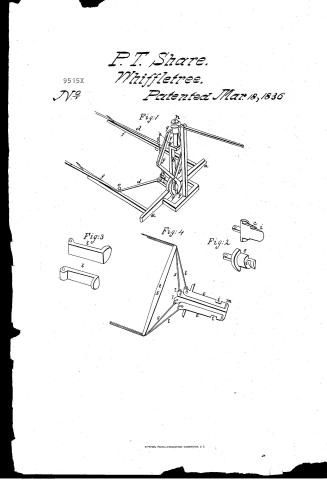
P.J. Share's Patent Drawing for a Detacher for Separating Horses for Harnesses

National Archives, Restored Patent Drawings (Record Group 241) · Full-size scan at the National Archives · Catalog record
Show the text on the drawing Hide (46 words)
Words on the drawing as machine-read by the National Archives; not checked. Useful mainly for searching.
#2 / curtaen / 21. CARRIAGES AND WAGONS. / Horse Detachers. / Separating Horses from Harrys) by T.Phare ets / Patented 18 Ma / CLASSLICATION / 9.515.x / DIVISION. / 9515-X / First / Eight / 51 / of / E.g. / Philip J. Ihave / pat- Mar. 18. 1836.
USPTO scan
The patent as scanned by the USPTO
-
 Page 1
-
 Page 2
-
 Page 3


U.S. Patent and Trademark Office · Google Patents
Show the transcription Hide (678 words)
Machine transcription (LightOnOCR) of the pages as scanned by the USPTO, most of them the handwritten copies made when the records were restored after the 1836 fire. Not checked; it can misread handwriting, so compare it with the scan.
Page 1.
P.T. Share.
Whiffletree.
Patented Mar. 18, 1836
9515X
No.
Fig. 1
Fig. 2
Fig. 3
Fig. 4
Page 2.
3/18/1836 9515x
Mar 18 1836
Philip A. Place
The above referred to the Letter of the 19th and making part of the same, containing a description of the use of the said July, I have hereof the improvement in the detachable for attaching lines from a carriage or for Mechanical purposes.
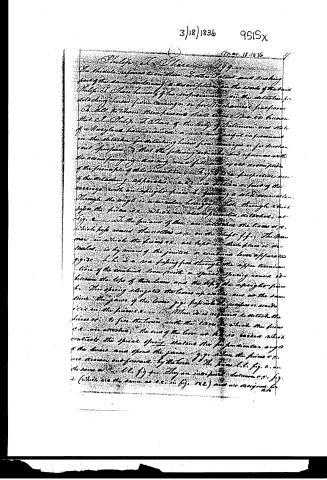
To all to whom these presents shall come, I do hereby declare that I, Philip A. Place of the City of Baltimore, and State of Maryland, have invented a new and useful improvement in the detachable for attaching lines from a carriage or for Mechanical purposes, and that the following remarks and references with the accompanying drawings are a full and exact description of the principle of this invention.
Fig. 1 is a perspective view of the detachable apparatus, and is a section in part of the carriage with an upright piece b, forming a solid connection through the angle to a circular horizontal hole through which passes the piece c.e., which are also represented, detached, at Fig. 2.
The pieces of the are attached the lines c.c., which pass round the rollers c.c., on the shaft f.f., the motion on which the pieces c.c. are kept in their place or attached, is by means of the jointed or combined lever apparatus Fig. 3c.
L.L. is a rod passing through the upper termination of the combined lever, with a spiral spring wound between the ends of the lever and the top of the upright piece b. This spring elongates the lever up and out at the same time the jaws of the lever g.g. separate the pieces or wires c.c. in the pieces c.c.
When it is required to attach the pieces c.c. to the lines with the lines to which the pieces c.c. are attached, the end of the lever at h.h. is raised which contracts the spiral spring, shutting the perpendicular angle of the lever and opens the jaws g.g. when the pieces c.c. are drawn out forward by the lines. The lines l.l. fig. 4. are the same as l.l. fig. 3. They are inserted between c.c. fig. 4. (which are the same as c.c. in fig. 1 & 2) and are designed for the
Page 3.
3/18/1836 9515x
two horses, one before the other. l.l. is for the hind horse & c.c. for the leader. The pins g.g. lock into the axles or wagons &c. &c. the same as in the single horse apparatus on fig. 1. but the inner has bushings which lap over the ends of c.c. or m.m. &c. so that l.l. & g.g. being detached before c.c. are free. If it is a single tire (which is not drawn in proportion & so is not the shaft p.f.) it being essential to represent the principle). The principle of this attachment is applicable to every kind of carriage or to sleighs, or to any kind of mechanical purpose where detaching apparatus are required. By the arrangement of combined levers instead of the single lever the aforesaid first move may be used, or by means of an upright projecting rod and hooked top a simple push downwards will effect the disengagement; or by means of a rod extending downwards from any convenient part of the combined levers the foot may effect the disengagement. I claim the principle of the plug c.c. as well as l.l. together with the combined lever apparatus for detaching or disengaging horses or other animals from all kinds of carriages or sleighs, for both road cars as well as mechanical purposes.
W.B.
6/18/37
Witnesses
Thomas M. Hill
Francis C. Elack
Filed at Patent
(Patented March 15, 1836)
Drawing
Published accounts: journal notice
Notice in the monthly list of patents, with remarks
Journal of the Franklin Institute, new ser., vol. 18 (1836), p. 328 · View the page
59. For a Detacher, for detaching horses from carriages, &c.; Philip T. Share, city of Baltimore, March 18.
Remarks. Numerous patents have been obtained, both here and in Europe, for detaching horses from carriages, in case of their running away; and many of them are sufficiently simple and efficient, but they have not been kept in use, nor are they likely to be so. We have no fault to find with the contrivance before us, nor any praise to bestow upon it, as it does no appear to be either better or worse than several of its predecessors. Sailors are proverbially averse to cork jackets, and other life-preservers, and other classes act, more or less, from the same kind of impulse; there is a feeling adverse to the constantly guarding against evils which are contingent, and are believed to be remote. Where by one act, like insuring against fire, the precaution is in its nature durable, prudent men will resort to it, but, otherwise, rarely. The contrivance which has become our text, will soon be forgotten, and be succeeded by analogous inventions, destined to share the same fate.
About this record
- Patentee
- DATAMP
- Date
- the Name and Date index of patents, DATAMP, USPTO records
- Invention
- DATAMP
- Listed in
- the Name and Date index of patents, DATAMP, USPTO records, Jim Shaw's X-patent list, the Journal of the Franklin Institute, Burke's List of Patents (1847)
- Burke's 1847 Patent Office list gives the same patent.