

Drawings and documents
National Archives restored drawings: drawing
Abel Conant's Patent Drawing for a Lock

National Archives, Restored Patent Drawings (Record Group 241) · Full-size scan at the National Archives · Catalog record
Show the text on the drawing Hide (33 words)
Words on the drawing as machine-read by the National Archives; not checked. Useful mainly for searching.
S. / 70. LOCKS & LATCHES. / Latches, Sliding. / CLASSLITATION / 9491X / DIVISION. / ABEL CONANT'S. / 9491) / LOCK. / Patented 12th March 1836. / my / 70
USPTO scan
The patent as scanned by the USPTO
-
 Page 1
-
 Page 2
-
 Page 3
-
 Page 4


U.S. Patent and Trademark Office · Google Patents
Show the transcription Hide (970 words)
Machine transcription (LightOnOCR) of the pages as scanned by the USPTO, most of them the handwritten copies made when the records were restored after the 1836 fire. Not checked; it can misread handwriting, so compare it with the scan.
Page 1.
9491X
A. Conant,
Latch.
Patented Mar. 12, 1836.

A.M. PHOTO-LITHO. CO. N.Y. (OSBORNE'S PROCESS)
Page 2.
3/12/1836 9491x
March 12, 1836 424
Abel Conant of Lowell, Massachusetts
Letters Patent
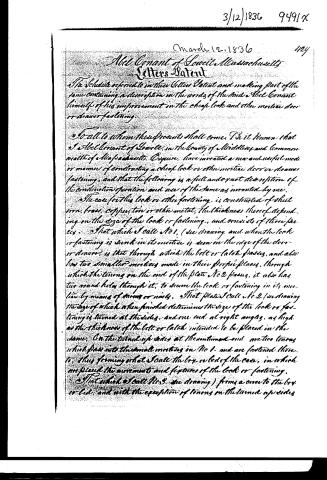
The Schedule referred to in these Letters Patent and making part of the same containing a description in the words of the said Abel Conant himself of his improvement in the cheap lock and other mortice door or drawer fastening.
To all to whom these presents shall come, Be it known that I, Abel Conant of Lowell, in the County of Middlesex and Commonwealth of Massachusetts, Cyprian, have invented a new and useful mode or manner of constructing a cheap lock or other mortice door or drawer fastening, and that the following is a full and exact description of the construction, operation, and use of the same as invented by me.
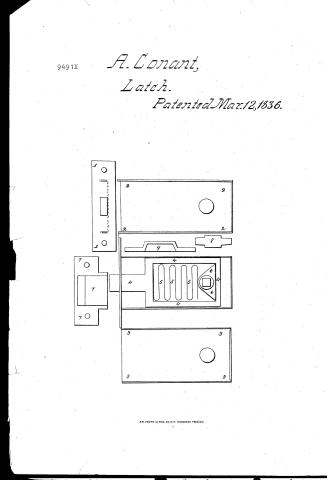
The case for this lock or other fastening is constructed of sheet iron, brass, copper, tin or other metal, the thickness thereof depending on the size of the lock or fastening, and consists of three pieces. That which I call No. 1, (see drawing and when the lock or fastening is seen in its mortice is seen on the edge of the door or drawer), is that through which the bolt or latch passes, and also has two smaller mortices made in their proper places, through which the tenons on the end of the plate No. 2 passes, it also has two round holes through it, to secure the lock or fastening in its mortice by means of screws or nails. That plate I call No. 2 (see drawing the edge of which when finished determines the size of the lock or fastening) is turned at the sides, and one end at right angles, as high as the thickness of the bolt or latch intended to be placed in the same. On the turned up sides at the continued end are two tenons which pass into the small mortices in No. 1, and are fastened there to, thus forming what I call the top or lid of the case, in which are placed the movement and fixtures of the lock or fastening. That which I call No. 3, (see drawing) forms a cover to the box or lid, and with the exception of tenons on the turned up sides
Page 3.
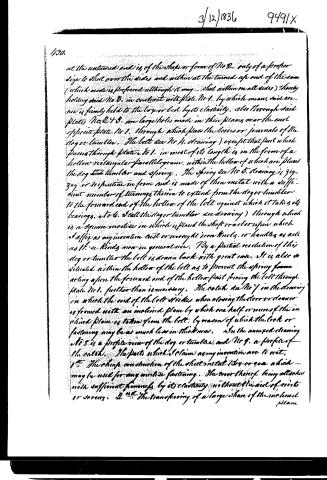
at the untuned end is of the shape or form of No 2, only of a proper size to shut over the sides and within at the turned up end of the same (which mode is preferred although it may... shut within on all sides) thereby holding said No 3, in contact with plate No 1, by which means, said cover is firmly held to the box or bed by its elasticity. Also through said plates Nos 2 & 3, are large holes made in their planes near the end opposite plate No 1, through which pass the bosses or journals of the dog or tumbler. The bolt see No 4, drawing, except that part which passes through plate No 1, in most of its length is in the form of a hollow rectangular parallelogram, within the hollow of which are placed the dog and tumbler and spring. The spring see No 5, drawing is zig-zag or serpentine in form and is made of thin metal with a sufficient number of turnings therein to extend from the dog or tumbler to the forward end of the hollow of the bolt against which it takes its bearings. (See No 6, all the dog or tumbler see drawing) through which is a square mortise in which is placed the shaft or arbor upon which is affixed my invention cast or wrought iron knobs, or handles as well as the like kinds now in general use. By a partial revolution of this dog or tumbler the bolt is drawn back with great ease. It is also so situated within the hollow of the bolt as to prevent the spring from acting upon the forward end of the hollow part forcing the bolt through plate No 1, further than is necessary. The catch see No 7 in the drawing in which the end of the bolt strikes when closing the door or drawer is formed with an inclined plane by which one half or more of the inclined plane is taken from the bolt, by reason of which the lock or fastening may be as much less in thickness. In the annexed drawing No 8 is a profile view of the dog or tumbler, and No 9, a profile of the catch. The parts which I claim as my invention are to wit, 1st, The cheap construction of the sheet metal box or case which may be used for any mortise fastening. The cover thereof being attached with sufficient firmness by its elasticity without the aid of nails or screws. 2nd, The transferring of a large share of the inclined plane
Page 4.
3/12/1836 9491x
431.
plane from the bell to the catch whereby the bell may be made but half, or less of the usual thickness, and thus reducing the thickness of the fastening and consequently diminishing the cutting of the door.
3d. The application of the zig zag or serpentine spring within the hollow of the bell, thereby giving a much greater length to the spring than could otherwise be had, by which its elasticity and usefulness are much increased. 4th. The use of cast or wrought iron bolts or handles from metal fastenings in place of glass, wood, brass, or other metal, in consequence of which the expense of fastening is greatly reduced.
Witness
Chas. C. Thompson
Sec. Woodward
Abel Cornant
(961 words) (Patented March 14, 1836.)
Drawing
Published accounts: journal notice
Notice in the monthly list of patents
Journal of the Franklin Institute, new ser., vol. 17 (1836), p. 438 · View the page
188. Door locks. Abel Corant, Lowell, Mass.
Published accounts: journal notice
Notice in the monthly list of patents, with remarks
Journal of the Franklin Institute, new ser., vol. 18 (1836), p. 325 · View the page
48. For a Cheap Lock; Abel Conant, Lowell, Middlesex county. Massachusetts, March 12.
Remarks. It so happens that this lock is not a lock, but merely a spring bolt, not a word being said about a key, or any contrivance for securing the bolt. The parts which are individually described, are, when put into their proper places, to form a mortise bolt, or fastening. The back part of the bolt, which occupies the interior of the box, is a quadrangular frame, which is forced back by means of a dog, or cam, in the usual way. A zigzag spring placed within the bolt, and bearing against the case of the tumbler and the front end of the hollow bolt, forces it forward. There are four individual claims, some of which, we apprehend, will not be sustainable. The first is to the cheap construction, which, as a result, may be very good, but as a claim is somewhat equivocal; the second, is to the transferring of a large portion of the champfer of the bolt to the catch, thus allowing the bolt to be reduced in thickness-which must certainly abridge the distance to which the bolt will throw out, and produce some inconvenience. The third is to the application of the zigzag spring within the hollow of the bolt, and the fourth, "to the use of cast, or wrought iron, knobs, or handles, in place of glass, wood, brass, or other metal." In this last particular, there is neither invention, nor discovery, but a mere change of materials; the validity of which, as a foundation of a claim, we must doubt. VOL. XVIII.-No. 5. -NOVEMBER, 1836.
About this record
- Patentee
- DATAMP
- Date
- the Name and Date index of patents, DATAMP, USPTO records
- Invention
- DATAMP
- Listed in
- the Name and Date index of patents, DATAMP, USPTO records, Jim Shaw's X-patent list, the Journal of the Franklin Institute, Burke's List of Patents (1847)
- Burke's 1847 Patent Office list gives the same patent.