

Drawings and documents
USPTO scan
The patent as scanned by the USPTO
-
 Page 1
-
 Page 2
-
 Page 3
-
 Page 4


U.S. Patent and Trademark Office · Google Patents
Show the transcription Hide (821 words)
Machine transcription (LightOnOCR) of the pages as scanned by the USPTO, most of them the handwritten copies made when the records were restored after the 1836 fire. Not checked; it can misread handwriting, so compare it with the scan.
Page 2.
United States Patent
Patent No.: X9503
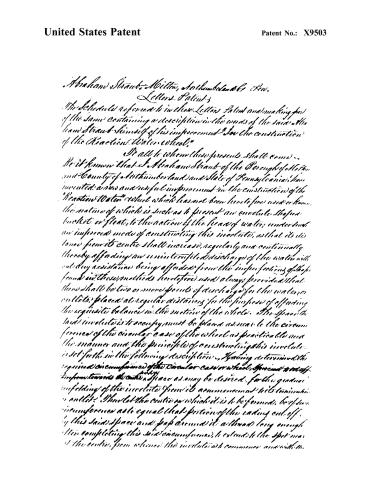
Abraham Straut, Milton, Northumberland Co. New.
Letters Patent
The Schedule referred to in these Letters Patent and making part of the same containing a description in the words of the said Abraham Straut himself of his improvement "For the construction of the Reaction Water Wheel."
To all to whom these presents shall come—
Be it known that I, Abraham Straut of the Borough of Milton, and County of Northumberland and State of Pennsylvania, have invented a new and useful improvement in the construction of the "Reaction Water Wheel" which has not been heretofore used or known, the nature of which is such as to present an envelope shaped bucket or float, to the action of the head of water, under such an improved mode of constructing this involute, as that its distance from its centre shall increase, regularly and continually, thereby affording an uninterrupted discharge of the water without any assistance being afforded from the imperfections of shape found in those methods heretofore used, always provided that there shall be two or more points of discharge for the water or outlets, placed at regular distances for the purpose of affording the requisite balance in the motion of the wheel. The space or said involute is to occupy must be placed as near to the circumference of the circular case of the wheel as practicable and the manner and the principle of constructing this involute is set forth in the following description. Having determined the required circumference of the circular case or wheel, spread a strip of paper towards the water space as may be desired, for the gradual unfolding of the involute from its commencement to its termination or outlet. Mark the centre on which it is to be formed, by drawing a circumference as to equal that portion of the radius cut off, by this said space and pass around it as broad long enough to complete this said circumference, to extend to the spot near the centre, from whence the involute is to commence and continue.
Page 3.
United States Patent
Patent No.: X9503
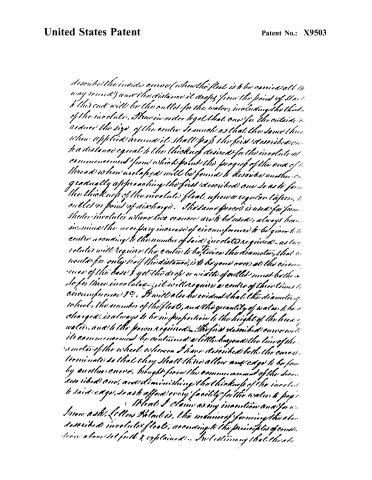
describe the inside curve (when the float is to be carried all the way round) and the distance it drops from the point of start. If this end will be the outlet for the water, including the thickness of the involute. There is order to get that one for the outside, reduce the size of the centre so much as that the same curve when applied around it, shall pass the first described one to a distance equal to the thickness desired for the involute at commencement from which point the proper of the end of the thread when wrapped will be found to describe another, gradually approaching the first described one so as to form the thickness of the involute float, upon a regular taper, to outlet or point of discharge. The same process is used for forming the involutes where two or more are to be used, always bearing in mind the necessary increase of circumference to be given to the centre according to the number of said involutes required—as two involutes will require the centre to be twice the diameter, that would for only half the distance, is to be gone over at the circumference of the base & yet the drop or width of outlet must be the same for three involutes; it will require a centre of three times the circumference &c. It will also be evident that the diameter of the wheel, the number of the floats, and the quantity of water to be charged, is always to be in proportion to the height of the head of water, and to the power required. The first described curve with its commencement be continued a little beyond the line of the radius of the wheel, wherein I have described both the curves, terminate so that they shall there allow one cage to be formed by another curve, brought from the commencement of the second described one, and diminishing the thickness of the involute to said cage, so as to afford every facility for the water to pass.
What I claim as my invention and for which I now ask the Letter Patent is, the manner of forming the above described involute float, according to the principles of construction above set forth & explained. In testimony that I have
Page 4.
United States Patent
Patent No.: X9503
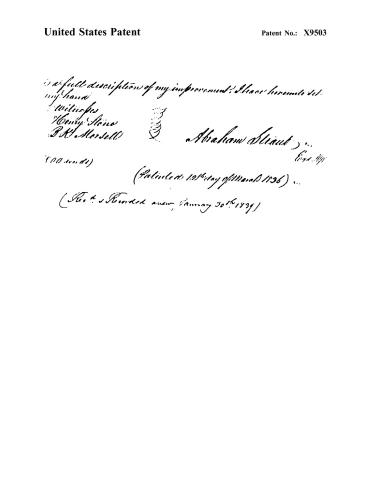
In a full description of my improvement, I have herewith set my hand:
Witnesses
Henry Stone
B.H. Marshall
Abraham Stuart
Ex. 1836
$500.00 (d.)
(Patented 19th day of March 1836)
(Rec’d & Recorded anew January 30th 1839)
Published accounts: journal notice
Notice in the monthly list of patents
Journal of the Franklin Institute, new ser., vol. 17 (1836), p. 438 · View the page
184. Water wheel. -Abraham Straub, Milton, Penn.
Published accounts: journal notice
Notice in the monthly list of patents, with remarks
Journal of the Franklin Institute, new ser., vol. 18 (1836), p. 324 · View the page
44. For a Reaction water wheel; Abraham Straub, Milton, Northumberland county, Pennsylvania, March 12.
Remarks. This reaction wheel is to be in the form of a drum, or cylinder, like Wing's, and many others; but it is to have only two buckets, or floats, and two points of discharge; each bucket is to exceed a half circle, to allow their lapping over at the discharge orifices. The great point upon which the patentee depends, is the peculiar kind of curves which he gives to his two buckets, "the nature of which is such an involute as that its distance from its centre shall increase regularly and continually, thereby affording an uninterrupted discharge to the water, without any resistance being offered from the imperfections of shape found in those methods heretofore used." These involutes, or buckets, differ but little from segments of circles, and notwithstanding the applied mathematics of the patentee, we are fully convinced that were he to make his own wheel, and another in all respects similar, but with the buckets segments of circles, he would never, from their effects, discover the difference between the two. Every practical man knows to what a short distance theory will conduct him as a sure guide in hydraulic undertakings. We do not think it necessary to give the patentee's mode of describing his curve. 45. For a Bed-bug destroyer; Brittain Garrard, Maysville, Blount county, Tennessee. Although three or four patents have been obtained for scalding bugs to death by steam, and although the kind of thing used for the purpose was well known prior to the obtaining of the first patent, it seems that there are yet some which have escaped destruction. The present patentee makes some change in the arrangement of his steam kettle, or boiler, rendering it somewhat more complex, but we do not think more convenient, than heretofore. We shall not describe, as the patentee has not claimed, the alterations, or improvements, made in "the family safety scalding pot and steam engine."
DATAMP: illustration
Illustrations from DATAMP
DATAMP (Directory of American Tool and Machinery Patents), via the Internet Archive · Archived DATAMP page
About this record
- Patentee
- DATAMP
- Date
- the Name and Date index of patents, DATAMP, USPTO records
- Invention
- DATAMP
- Listed in
- the Name and Date index of patents, DATAMP, USPTO records, Jim Shaw's X-patent list, the Journal of the Franklin Institute, Burke's List of Patents (1847)
- Burke's 1847 Patent Office list gives the same patent.