

Chapter 400
COPYRIGHTABLE MATTER: WORKS OF THE PERFORMING ARTS AND SOUND RECORDINGS
Outline of Topics
401 Musical works: in general.
- 404.01 No numerical standard.
- 404.02 Words and short phrases.
- 404.03 Transposition.
- 404.04 Works consisting entirely of information that is common property.
- 404.05 "Melodiousness" and harmony.
405 Physical embodiment of musical works.
- 405.01 Physical embodiment: copies.
- 405.02 Physical embodiment: sound tracks.
- 405.03 Physical embodiment: phonorecords.
406 Limitations on copyrightability.
- 406.01 Copyright term expired.
- 406.02 Certain musical arrangements.
- 406.03 Chord charts.
- 406.04 Musical works unlawfully employing other works under copyright protection.
407 Use of protected characters, names, and slogans.
- 408.01 Musical arrangements.
- 408.02 Adaptation.
- 408.03 Setting.
- 408.04 Variations.
- 408.05 Editing.
- 408.06 Additional music.
- 408.07 Abridgment.
- 408.08 "As a Whole" criterion.
[Numbers 410 through 416 are reserved.]
418 Claim in literary content.
420 Nondramatic literary works prepared for performance.
- 420.01 Song lyrics.
- 420.02 Comedy sketches.
- 420.03 Embodiment of nondramatic literary works prepared for oral delivery.
[Numbers 421 through 429 are reserved.]
432 Characteristic features of dramatic works.
- 432.01 Plot.
- 432.02 Characters.
- 432.03 Dialog.
- 432.04 Directions for action.
- 432.05 Drama without words.
433 Amount of dramatic content necessary.
434 Works not registrable as dramas.
435 Embodiment of dramatic works.
436 Dramatic derivative works.
438 Music accompanying dramas.
439 Components of dramatic musical works.
[Numbers 440 through 449 are reserved.]
- 450.01 Definition.
- 450.02 Presentation before an audience.
- 450.03 Characteristics of choreographic works.
- 450.04 Abstract choreography.
- 450.05 Requirement for registration.
- 450.06 Choreographic content: social dance steps and simple routines.
- 450.07 Embodiment of choreography.
- 450.08 Derivative choreographic works.
- 450.09 Status of improvisation.
[Numbers 451 through 459 are reserved.]
462 Distinction between pantomime and choreography.
[Numbers 464 through 469 are reserved.]
471 A motion picture is a kind of audiovisual work.
473 Sounds accompanying an audiovisual work.
475 Authorship in an audiovisual work.
476 Derivative audiovisual works.
[Numbers 478 and 479 are reserved.]
- 480.01 Requirement of fixation.
- 480.02 Forms of embodiment.
- 480.03 Copyrightable subject matter.
- 480.04 Motion pictures as derivative works and compilations.
[Numbers 481 through 484 are reserved.]
485 Motion pictures: special problems.
486 Deposit requirements for motion pictures.
- 486.01 Description required.
- 486.02 Unpublished motion pictures.
- 486.03 Published motion pictures.
- 486.04 Definition of "best edition."
- 486.05 Definition of "complete."
- 486.06 Motion picture Agreement.
- 486.07 Motion picture Agreement: Standard Modification.
- 486.08 Motion picture Agreement: Supplemental Property Agreement
487 Separately registrable work of authorship fixed in film, videotape, or the like.
[Numbers 488 and 489 are reserved.]
491 Sound recording distinct from underlying work.
492 Sound recording distinct from sounds accompanying audiovisual work.
- 493.01 Statutory definition of phonorecords.
- 493.02 Types of phonorecords.
- 493.03 Distinction between phonorecords and sound recordings.
- 493.04 Distinction between phonorecords and copies.
494 Date of fixation as it affects eligibility.
- 494.01 Definition of fixation.
- 494.02 State protection for sound recordings fixed before February 15, 1972.
495 Copyrightable subject matter.
- 495.01 Types of copyrightable authorship.
- 495.02 Authorship on the part of the performer.
- 495.03 Authorship on the part of the producer.
496 Sound recordings as derivative works.
- 496.01 Derivative sound recordings.
- 496.02 Types of derivative sound recordings.
- 496.03 Registrability of derivative authorship.
[Numbers 498.03 through 498.99 are reserved.]
Chapter 400
COPYRIGHTABLE MATTER: WORKS OF THE PERFORMING ARTS AND SOUND RECORDINGS
401 Musical works: in general. Musical works, including any accompanying words, are registrable without regard to aesthetic standards. The range of registrable works consists of music produced by traditional and electronic means, including works whose production involves the use of a computer. An electronic composition utilizing tones produced by synthesizer or altered by omitting characteristics of its timbre, such as omitting decay or attack, may be registered. A discussion of the elements of musical works, criteria for copyrightability, forms of embodiment, and derivative musical works follows.
402 Music defined. Music is a succession of pitches or rhythms, or both, usually in some definite pattern.
403 Elements of music. The elements of music are melody, rhythm, and harmony. They are defined below.
403.01 Definitions. Melody: a succession of single tones: rhythm: a grouping of pulses according to emphasis and length: harmony: the combination, simultaneously, or nearly so, of different pitches. These tones are spaced at certain prescribed distances from one another in related progressions. Although a musical work will be registered if any of these three elements can be considered to constitute a work of authorship, melody, the predominant element by which a work is perceived, usually determines whether a work is copyrightable. Even melody, however, may be too minimal for copyright protection, as it is in "Johnny One-Note," (excluding the "break"), while other elements, such as the rhythm and harmony in this composition, supply all or substantially all of the copyrightable content.
[Page 400-2]
404 Musical content. The criteria for copyrightability of music are: I) The work must contain at least a minimum amount of creative musical expression1 2) The work must not have been copied from another source. See Chapter 200: COPYRIGHTABLE MATTER - IN GENERAL.
404.01 No numerical standard. There is no predetermined number of notes or measures that will automatically qualify a work for copyright registration.
404.02 Words and short phrases. Words and short phrases, such as names, titles, and slogans, are not subject to copyright. 37 C.F.R. 202.1(a). Just as words and short phrases cannot be registered, phrases consisting of only a few musical notes, such as clock chimes, i.e., "mi do re sol, sol re mi do" cannot be registered.
404.03 Transposition. Transposition is the act of transferring music from one key to another, note for note. Compare "My Bonnie” in F:
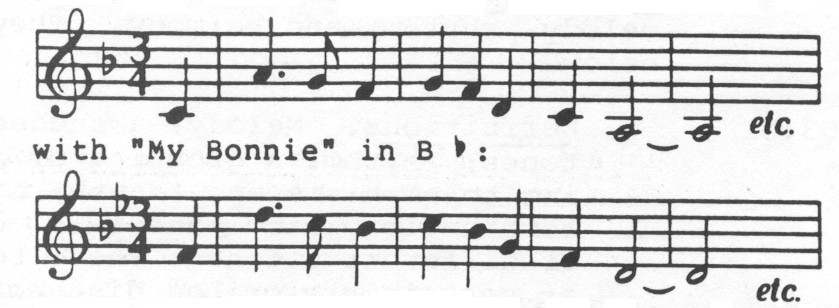
Since the relationship of all the notes to one another remains the same, and all that is required is the mere act of measuring intervals, transposition is a mechanical act and, as such, is not subject to copyright protection. There is no creative musical expression in a transposition. This turnabout four-note pattern repeated at a certain melodic interval from the preceding statement is essentially a transposition, and therefore is not registrable.

[Page 400-3]
404.04 Works consisting entirely of information that is common property. Works consisting entirely of information that is common property are not subject to copyright. 37 C.F.R. 202.01(d). Diatonic and chromatic scales, as such are considered works consisting entirely of information that is common property. Thus, works of this kind are excluded from copyright protection.

404.05 "Melodiousness" and harmony. "Melodiousness" and conventional (triadic) harmony are not criteria for registration. A musical composition based on a tone row, or a quarter-tone scale, for example, may be accepted for registration. Claims to copyright in composition with harmony based on intervals of seconds, fourths, or any other combination of tones may also be registered.
405 Physical embodiment of musical works. Music may be embodied in either copies or phonorecords. No basic registration is possible, however, without some kind of physical representation of the work --a copy, or phonorecord, or, where applicable, identifying material. See Chapter 800: DEPOSIT FOR REGISTRATION.
405.01 Physical embodiment: copies. The term copies includes every kind of embodiment of the work acceptable for registration, except phonorecords and certain identifying material.
405.01(a) Copies required before 1978. Until 1978, a copy was the only form in which a musical work could be accepted for registration. Various kinds of copies, however, were acceptable.
[Page 400-4]
405.01(b) Copies: musical notation. Standard I musical notation, using--the five-line, four-space staff is the form most frequently employed to embody musical works. Precision equal to that offered by conventional notation is not required, although the deposit should constitute as precise a representation of the work as possible. Any graphic representat1on of p1tch, rhythm, or both, suffices as long as the notation is capable of being performed. Examples: graphically drawn hand signals, fret notation, staves with more or fewer lines than the conventional staff, and "new music," combining graphic art with music notation.
405.01(c) Copies: literary description. A copy may be in the form of textual instructions for performance, e.g., a description of notes and rhythms. However, in order to be registrable as a musical composition, such instructions must be specific enough for the work to be performed.
405.02 Physical embodiment: sound tracks. Where music is embodied in a motion picture soundtrack, the motion picture is the copy. Although the deposit ordinarily required would be the motion picture, an exception to the deposit requirements permits the deposit of identifying material instead of a copy. See Chapter 800: DEPOSIT FOR REGISTRATION.
NOTE: Music published in a sound track before 1978 can be registered apart from the motion picture as a whole, only if the motion picture bore a separate copyright notice for the music. Music published in a sound track after 1977 may be registered apart from the motion picture, without a notice of copyright on the motion picture in the name of the music claimant.
[Page 400-5]
405.03 Physical embodiment: phonorecords. On January 1, 1978, phonorecords, including tapes, disks, sound sheets, soundwheels, and piano rolls, became acceptable deposits for registering claims to copyright in music recorded on them. Moreover, music embodied only in phonorecords before 1978 is now acceptable for registration in that form. If such phonorecords were available for sale or public distribution on January I, 1978, after having been sold or publicly distributed earlier, the musical work would be considered published and the date of such publication is January I, 1978. See section 909, Chapter 900: PUBLICATION.
406 Limitations on copyrightability. By reason of certain limitations in the copyright law, some works are not registrable though they might otherwise appear to be the subject matter of copyright.
406.01 Copyright term expired. A work whose copyright term has expired is not subject to copyright protection. Once a work has entered the public domain, its term cannot be extended or the protection revived. See section 103, Transitional and Supplementary Provisions of the current Act.
406.02 Certain musical arrangements. Musical arrangements embodied in a phonorecord and made pursuant to a compulsory license to make and distribute phonorecords of nondramatic music are not subject to copyright protection without the express consent of the copyright owner. See 17 U.S.C. 115(a) (2).
406.03 Chord charts. Chord charts ordinarily contain a significant number of public domain standard chords. To be registrable, works embodying chord charts must qualify as a compilation or as some other original work of authorship. See section 408.02 below.
[Page 400-6]
406.04 Musical works unlawfully employing other works under copyright protection. Musical works that unlawfully employ another work under copyright protection are not themselves subject to copyright protection if they are inseparably intertwined with the preexisting work. See 17 U.S.C. 103(a) and H.R. Rep. No.94-1476, 94th Cong., 2d Sess. 57-8 (1976) .For example, an unlawful four-part reharmonization of "All The Things You Are" that cannot be separated from the previous melody and harmony would not be registrable. However, the Copyright Office does not generally investigate the copyright status of preexisting material or whether it has been used lawfully. Where a work unlawfully employs preexisting copyrighted material that is separable from the new material, the new work is registrable.
407 Use of protected characters, names, and slogans. Occasionally musical works incorporate names, titles, or slogans whose utilization is subject to restrictions under other Federal laws, but the incorporation of such items does not prevent copyright registration. Where the Copyright Office is aware that a use of certain elements within a work may be in violation of existing law, it may inform the applicant of the possible restriction and direct the applicant to the Government agency that deals with the item in question. Some examples of restricted names and characters are: "Olympic," "Olympiad," (36 U.S.C. 380); "Woodsy Owl" (18 U.S.C. 711a); and "Smokey Bear" (18 U.S.C. 711).
408 Musical derivative works. A derivative work is a work based upon one or more preexisting works, such as. ..musical arrangements. 17 U.S.C. 101. In the case of derivative works, only certain kinds of preexisting material need be excluded from the claim on an application for
[Page 400-7]
copyright registration, namely, that which constitutes a significant amount of previously registered published, or public domain material.
1) Where the work does not incorporate any preexisting copyrightable material, but is merely based on a preexisting idea, the work is considered a new work, and not a derivative work.
Example:
A song about crossing a river inspired by the painting, "Washington Crossing the Delaware."
2) Where the work incorporates only a negligible amount of previously registered, published, or public domain material, the work is considered a new work: thus, the claim to copyright need not exclude the preexisting material.
Example:
A musical work incorporating only the first three notes of "Also sprach Zarathustra," by Richard Strauss.
3) Where a work incorporates preexisting material that was theretofore unregistered and unpublished, the work is considered a new work, for purposes of most registrations.
Examples:
a) An author writes song lyrics in 1978 and files them away in his home. In 1981, the author sets the lyrics to new music. Even though the lyrics were preexisting when the music was composed, the lyrics are not considered a preexisting work, for purposes of registration.
[Page 400-8]
b) A composer receives authority to set to music unpublished song lyrics that have never been registered, but is not, authorized to claim copyright in the lyrics. Since the lyrics have not been previously published or registered, they are not considered a preexisting work for purposes of registration, but they should nevertheless be excluded from the claim.
408.01 Musical arrangements. A musical arrangement is a work that results from the addition of new harmony to a preexisting work. The standard of originality for arrangements takes into consideration the fact that a melody carries with it a certain amount of implied harmony.
408.01(a) Harmonic chord symbols. Chord symbols represent the presence of three or more specific notes. However, the individual notes in the chords are not specifically distributed as are chord members in a written-out harmony or in harmony recorded on a phonorecord. To reach the "minimal amount" requirements, harmonic chord symbols must go beyond standard chords in common sequences.
Example:
Chord symbols C (major), a (minor), d (minor), and G (major) are submitted with original words. The harmony is not registrable because this chord sequence is both too short and standard. The words, if substantial enough, may be registered.
[Page 400-9]
408.0l(b) Instrumentation. Music may also be arranged by distributing or redistributing harmonic elements among different instruments.
Examples:
1) An orchestration of Debussy's "Reverie," a work originally composed for piano.
2) A marching band arrangement of Beethoven's String Quartet in G major, Opus 18, No.2.
Transpositions are not copyrightable. See section 404.03 above. Therefore, the Copyright Office will not make multiple registrations for the same work in different keys.
Example:
"Madame Evanti's Solfege songs" is submitted in a different key each for High, Medium, and Low voice. The applicant may select the version to be registered, but only one registration may be made.
Moreover, the notation of a musical work necessary to enable transposing instruments to play in the same key is not copyrightable.
Example:
The transposition of the standard four-part setting of the hymn "Abide with Me" for E-flat, A-flat, and B-flat saxophones and C clarinet, assigning a different part to each instrument, is not registrable.
[Page 400-10]
408.02 Adaptation. An adaptation results from reworking a preexisting melody, possibly including rhythmic variation as well. An example might be a jazz version of the "Battle Hymn of the Republic." This definition of adaptation is not as widely known as the definition of arrangement: thus, the Copyright Office will accept a claim on adaptation where the primary change is in the harmony. Where there is no registrable harmony, an application stating the claim as arrangement will not be accepted, but the Copyright Office will request that the basis of the claim be changed to adaptation, if appropriate.
408.03 Setting. A setting is a harmonization, or arrangement of a preexisting melody, or entirely new music set to preexisting words. Settings are similar to arrangements, except that they are more closely associated with preexisting words and chorale-type harmony.
408.04 Variations. Variations are adaptations and arrangements of one basic theme in various moods and styles. The basic theme is usually the preexisting work. Variations are treated as new works for purposes of registration, where the treatment results in substantial divergence from the preexisting material, or where the new material overwhelmingly predominates in comparison to the theme, such as where the theme or motive consists of only a few notes.
Example:
Because of substantial divergence from the theme, utilization of the Paganini motive in this phrase of Rachmaninoff's "Rhapsody on a Theme of Paganini," Opus 43,

[Page 400-11]
would not have prevented the Rachmaninoff work from being registered as a new work.
408.05 Editing. Music editing generally consists of markings for the performance of music, such as additional or altered fingering, accents, dynamics, and the like.
408.06 Additional music. Additions of music can be registered, such as the completion of an unfinished work or a reconstruction of missing music.
408.07 Abridgment. An abridgment of a musical work may be registrable provided that there is a substantial amount of selectivity, for example, more than merely omitting a section from the beginning or end.
408.08 "As a Whole" criterion. A derivative musical work may be registrable in the aggregate, even though the individual changes, examined separately, may not be.
Example:
A revision consisting of a change of fingering in two measures, added dynamics in four measures, and three measures of additional music could, in the aggregate, constitute a derivative musical work.
409 Compilations. A compilation is a work formed by the collection and assembling of preexisting materials or of data that are selected, coordinated, or arranged in such a way that the resulting work as a whole constitutes an original work of authorship. The term "compilation" includes collective works. 17 V.S.C. 101.
[Page 400-12]
409.01 Collective works. A collective work is a work. ..in which a number of contributions, constituting separate and independent works in themselves, are assembled into a collective whole. 17 U.S.C. 101.
Example:
A folio of selected Rodgers and Hammerstein songs.
However, a work will be rejected for registration if the claim is on compilation, unless it appears that enough basic material has been compiled.
Example:
A compilation claim on Sides 1 and 2 of a 45-r.p.m. phonorecord containing a musical selection on each side will be refused. A claim in the music, however, will be accepted if the music appears to meet the standards of originality. See section 404 above.
409.02 Method books. Method books that contain only previously published material, such as public domain chords, scales, exercises, and other information that is common property, may be registered as compilations if the works contain at least a certain minimum amount of compilation authorship. In view of the limited protection available, the Copyright Office will not suggest a compilation claim on its own initiative unless the contribution is obviously substantial.
[Numbers 410 through 416 are reserved.]
[Page 400-13]
417 Words accompanying music. Words accompanying music are considered an integral part of the musical work. There is no specific manner in which words shall accompany music. The words may be narrated to background music, sung to music on a phonorecord, set above the notes to which they are to be sung on a notated copy, or may be written on a separate sheet with no instructions as to how they are to be performed. The Copyright Office will question whether words accompany music only where it appears improbable that the words and music are meant to be performed or otherwise used together.
418 Claim in literary content. The words must be sufficiently substantial in themselves to support a claim on words. If the words are insufficient, the copyright Office will request that the claim on words be deleted from the application. The words may still be included as part of the deposit.
419 Literary content. In addition to ordinary words used in the conventional manner, nonsense syllables, nonsyntactica1 words, or coined words may be registered. The verbal expression, however, must have been originated by a human being and be of a sufficient amount.
420 Nondramatic literary works prepared for performance. Nondramatic literary works prepared for performance may be registered in Class PA. Nondramatic literary works not intended for performance should be registered in Class TX. See Chapter 300: COPYRIGHTABLE MATTER -- NONDRAMATIC LITERARY WORKS.
420.01 Song lyrics. Song lyrics, unaccompanied by mUS1C, may be registered in published or unpublished form in Class PA.
420.02 Comedy sketches. Jokes and other comedy routines may be registered if they contain at least a certain minimum amount of original expression in tangible form. Short quips and slang expressions consisting of no more than short phrases are not registrable.
[Page 400-14]
420.03 Embodiment of nondramatic literary works prepared for oral delivery. Nondramatic literary works intended for oral delivery may be embodied in copies or phonorecords. Human or mechanical agents, including computers, may be used to fix the words in tangible form.
[Numbers 421 through 429 are reserved.]
430 Dramatic works. The term "dramatic works" includes plays prepared for stage presentation, as well as those prepared for cinema, radio, and television. Applications for registration of claims to copyright in dramatic works should be submitted on Form PA.
431 Dramatic works fined. A dramatic composition is one that portrays a story by means of dialog or acting and is intended to be performed. It gives directions for performance or actually represents all or a substantial portion of the action as actually occurring, rather than merely being narrated or described. Examples of narration or description alone might be: the Bible story of Shadrach, Meshach, and Abednego, or a narration of the "Three Little Pigs." If the narrator is to devise or improvise his or her own action, the dramatic content is not fixed and thus the work is not a drama.
432 Characteristic features of dramatic works. Some of the features which are characteristic of dramas are the following:
432.01 Plot. A drama contains a thread of consecutively related events, either as a theme or in segments. A story delivered by narration alone, however, should be registered as a nondramatic work.
[Page 400-15]
432.02 Characters. A work may be considered a drama even though it contains only one character. The script of a soliloquy or monolog that tells a story may be registered as a drama, provided that it includes sufficiently explicit stage directions from which it can be performed.
Example: ,
A poem, such as "Invictus," with directions for acting out the story.
432.03 Dialog. Dialog alone will constitute a drama only if characters and a plot are inherent therein.
432.04 Directions for action. While directions for action by themselves do not constitute a drama, such instructions (or the actual representation of the action) are essential to drama.
432.05 Drama without words. A drama may be represented silently, provided there is visual dramatic action or pantomime, as for example, a new drama in the Noh style. However, a still tableau depicting a story incident does not meet this criterion.
433 Amount of dramatic content necessary. The work should have enough action to avoid the conclusion that the dramatic contribution is too minimal for copyright protection as a dramatic work. While a mere outline or narrative summary of the idea for a drama is not registrable as a dramatic work, every element of the drama need not be set out. A scenario may be registered as a dramatic work if it is adequate to serve as the basis for directing its action, even though the directions are brief and some details are
[Page 400-16]
left unspecified. Also, a recorded narration coupled with directions for the dramatic representation of some story incidents is registrable as a drama.
Example:
The script for a children's radio program narrating a visit to the zoo, containing detailed instructions to actors for characterizations of various animal antics.
434 Works not registrable as dramas. Simple directions for using scenery, stage settings, or ideas for sound effects do not in themselves constitute dramatic content. Where the version submitted is not an acting version, the work will not be registered as a drama. However, a work that does not meet the criteria for registration as a dramatic work may contain enough copyrightable content in another category to be registrable on some other basis.
435 Embodiment of dramatic works. A drama may be embodied in manuscript, typescript, or printed copy, on a video-recording, such as a videocassette, or another form of copy, or in a phonorecord. The fixation of a drama may be made simultaneously with its transmission or live performance.
436 Dramatic derivative works. Copyrightable additions or other changes to dramatic works may be made in one or more of several categories. Where a drama is translated, the work remains dramatic in nature and can be described as such on the application. Since the copyrightable addition is not dramatic, the new claim is on translation and not on drama. Where a drama is made into a novel, the addition is not dramatic and thus neither is the new work. Where a novel is made into a drama, the copyrightable new material is dramatic. Where a preexisting drama has been
[Page 400-17]
substantially revised or new dramatic material has been added, the result is a dramatic derivative work.
437 Compilations. A collection of dramas can be registered as a collective work. If the individual selections consist of dramatic works, the collection can be registered in Class PA, even though the dramas are not then under copyright protection.
438 Music accompanying dramas. To be a dramaticomus1cal compos1t1on, a sufficiently substantial part of the dramatic action or dialog should be combined with the music.
Examples:
Singspiel, musical comedy, operetta, and opera, including music drama.
A group of songs with instructions for expressive delivery, however, is not a dramatico-musical work. Where music is to accompany a dramatic work, such music must be fixed in the deposit and must be copyrightable on its own to support a claim in music~ it need not be interwoven with drama, however, as long as it is intended to form an integral part of the drama.
439 Components of dramatico-musical works. The music and book of a dramatico-musical work are registrable together as one unit, or they may be registered separately. Components that are not copyrightable cannot be registered separately.
[Numbers 440 through 449 are reserved.]
[Page 400-18]
450 Choreographic works. Under the current law, choreography is included as a specified category of works in which copyright subsists. See 17 U.S.C. 102(a)(4)~ see also section 460 below.
450.01 Definition. Choreography is the composition and arrangement of dance movements and patterns, and is usually intended to be accompanied by music. Dance is static and kinetic successions of bodily movement in certain rhythmic and spatial relationships. Choreographic works need not tell a story in order to be protected by copyright.
450.02 Presentation before an audience. Although some reference works define choreography as "dancing, especially for the stage," presentation before an audience is not required for registration as a choreographic work.
450.03 Characteristics of choreographic works. Most choreography includes the following general characteristics:
450.03(a) Compositional arrangement. Choreography represents a related series of dance movements and patterns organized into a coherent whole. The movements must be more than mere exercises, such as "jumping jacks" or walking steps.
450.03(b) Movement or execution. Choreography is primarily executed by the torso, limbs, or both, in rhythm.
450.03(c) Capacity for performance. The specific movements of dancers are set out in a form from which the work can be performed. See section 450.06 below.
450.04 Abstract choreography. The Copyright Office will register claims to copyright in all choreographic works, including abstract choreographic works, that constitute original works of authorship fixed in tangible form.
[Page 400-19]
450.05 Requirement for registration. To be registrable, the choreographic work must contain at least a certain minimal amount of copyrightable matter in the form of dance steps or other movements in a coherent compositional arrangement. It must also be capable of performance as submitted.
450.06 Choreographic content: social dance steps and simple routines. social dance steps and simple routines are not copyrightable under the general standards of copyrightability. Thus, for example, the basic waltz step, the hustle step, and the second position of classical ballet are not copyrightable. However, this is not a restriction against the incorporation of social dance steps and simple routines, as such, in an otherwise registrable choreographic work. Social dance steps, folk dance steps, and individual ballet steps alike may be utilized as the choreographer's basic material in much the same way that words are the writer's basic material.
450.07 Embodiment of choreography. Broad outlines in which the movements of the dancers have not been set out with any certainty are not registrable as choreography. If the basic movements of the dancers have been fixed, however, registration will not be refused simply because there is room for improvisation, or because some improvisation is intended. See section 450.09 below.
450.07(a) Choreographic works embodied in motion picture form. A choreographic work may be embodied in motion-picture form. If such a motion picture constitutes the deposit for registration, the registration extends only to what is disclosed therein.
[Page 400-20]
450.07(b) Notation systems. Labanotation, sutton Movement Shorthand, Benesch Choreo1ogy, and other systems of notation are appropriate forms of embodiment to represent the precise movements of the dancers. Such notation, however, is considered a system, and, therefore, is not registrable. See 17 U.S.C. 102(b).
450.07(c) Textual description. Precise explanations in narrative form, whether in copies or phonorecords, are acceptable if the description is specific enough to indicate detailed movements of the dancers. Where the description is not sufficiently specific, it cannot be registered as a choreographic work, but may be registrable as a literary work.
450.07(d) Combinations of various formats. A description might include a combination of forms of embodiment, for example, pictorial or graphic diagrams, or detailed verbal descriptions narrated to music on a phonorecord.
450.08 Derivative choreographic works. When substantial new choreographic material has been added to preexisting choreography, it may be registered as a new choreographic work.
Example:
An addition of a new section to Petipa1s “Don Quixote.”
When the only preexisting material is a few public domain steps, for example, a waltz, or ballet positions, the work is not considered derivative. See section 450.05 above.
[Page 400-21]
450.08(a) Other derivative works based on choreography. Nonchoreographic additions may be made to a choreographic work, for example, where a nonchoreographic comedy routine is interspersed between choreographic scenes. In this case, the claim should be made on the new nonchoreographic material. As a practical matter, however, the added material may dictate changes in the choreography as well, especially when new music or new dramatic scenes are added.
450.09 Status of improvisation. Registration cannot be made for improvisation to be provided by the dancer unless such improvisation is fixed.
[Numbers 451 through 459 are reserved.]
460 Pantomimes. Pantomimes are distinct from choreographic works, and thus their registrability does not depend on choreographic criteria.
460.01 Definition. Pantomime is the art of imitating or acting out situations, characters, or some other events with gestures and body movement. Mime is included under this category. Pantomimes need not tell a story or be presented before an audience to be protected by copyright.
461 Pantomime content. To be registrable, pantomimes must include more than a few stock gestures. As there is no copyright protection for ideas in general, a style of movement imitating mechanical dolls, for example, would not be protectible. A significant amount of copyrightable matter in the form of specific gestures in
[Page 400-22]
such style and embodied in some tangible form, however, may be registered. Tableaux employing less than a minimum amount of action are not registrable as pantomimes. See section 433 above.
462 Distinction between pantomime and choreography. In general, pantomime movement is more restricted than dance although, within its narrower scope, pantomime employs more gestures of the arms and facial expressions. Also, pantomime is usually more representational than choreography, in that it imitates or is a caricature of some event or situation. Pantomime movement is synchronized with music less often than is choreography. In fact, pantomimes are often performed without music, and any accompanying sound is dictated by the situation being portrayed. Most often, however, pantomimes are performed without sound or measured rhythm.
463 Embodiment of pantomimes. Unlike choreography, pantomimes are not usually fixed using a specific form of symbolic notation. Conceivably, however, the same systems could be used for notating pantomimes as for dance. To register a work as a pantomime, the movements must be described in sufficient detail to enable the work to be performed from such description, or an actual performance must be captured on some form of film or videotape. Subject to this requirement, any form of copy or a narrative description on a phonorecord will suffice.
[Numbers 464 through 469 are reserved.]
470 Audiovisual works. Audiovisual works are works that consist of a series of related images which are intrinsically intended to be shown by the use of machines or devices such as projectors, viewers, or electronic equipment, together with accompanying sounds, if any, regardless of the nature of the material objects, such as films or tapes, in which the works are embodied. 17 U.S.C. 101.
[Page 400-23]
471 A motion-picture is a kind of audiovisual work. Motion pictures are audiovisual works consisting of a series of related images which, when shown in succession, impart an impression of motion, together with accompanying sounds, if any. 17 U.S.C. 101. For a separate discussion of motion pictures, see section 480 et seq. below. It is possible for the series of related images to be embodied in a medium that is traditionally used for motion pictures, for example, film or videotape, and not impart an impression of motion. In such cases, the work is audiovisual, but not a motion picture. A series of related photographs or drawings embodied in the film stock would not be considered a motion picture, unless, when shown, the images give an impression of motion. Such an impression of motion could be accomplished by incorporating certain cinematic techniques, such as panning in and out and dissolving.
472 Series of related images. It is the presence of the series of related images embodied in a filmstrip slides, or the like, which generally determines that a work is audiovisual even where this element does not predominate. For example, where a work consists of a series of related pictorial images, accompanied by a set of booklets containing nondramatic literary printed matter, the claim is usually appropriately registered in Class PA, even though the printed matter predominates.
473 Sounds accompanying an audiovisual work. When sounds are present, they do not need to be physically integrated with the series of related images to be considered "accompanying sounds," for example, a filmstrip with a separate audio cassette. By definition, there is a distinction between the "accompanying sounds" of an audiovisual work and the series of sounds in a "sound recording." While sound recordings are works that result from the fixation of a series of musical, spoken, or other sounds, such sounds do not include "sound accompanying a motion picture or other audiovisual work."
[Page 400-24]
474 Forms of embodiment. The series of related images in an audiovisual work may be embodied in several different media, for example, a filmstrip, slides, or transparencies. Any accompanying sounds may be embodied in an audio cassette, reel-to-reel tape, or disk. They may also be physically integrated with the related images, for example, in a cartridge. For embodiments of audiovisual works which are motion pictures, see section 480.02 below.
475 Authorship in an audiovisual work. Audiovisual works embody several categories of authorship.
475.01 Visually perceptible authorship. Any kind of visually perceptible material such as photographs and artwork may be embodied in the related images of the audiovisual work.
475.02 Aurally perceptible authorship. If an aural element is present, It may embody several kinds of authorship such as dramatic or nondramatic literary material, or music which is recorded, as well as the "accompanying sounds."
476 Derivative audiovisual works. For registration purposes, a derivative audiovisual work is a work that incorporates previously published, registered, or public domain material. If an audiovisual work contains some photographs by Mathew Brady as well as some new photographs, the Form PA should be completed to show the extent of the claim. Or, if the text recorded in the aural element contains numerous Biblical quotations, the quotations should be excluded from the claim.
477 Multimedia works. A multimedia work is one which combines two or more kinds of authorship in two or more media, for example, a filmstrip and cassette, or a booklet and slides.
[Page 400-25]
477.01 Classification of multimedia works. The content of the multimedia work determines which class is appropriate for registration. For example, the presence of a series of related images makes the work audiovisual in nature, and registration is generally appropriate in Class PA. See section 490 et seq. for a discussion of multimedia works that do not include an audiovisual element.
[Numbers 478 and 479 are reserved.]
480 Motion pictures. Motion pictures are audiovisual works consisting of a series of related images which, when shown in succession, impart an impression of motion, together with accompanying sounds, if any. 17 U.S.C. 101.
480.01 Requirement of fixation. To be eligible for copyright protection, a motion picture must be fixed. See Chapter 200: COPYRIGHTABLE MATTER --IN GENERAL. A telecast transmission of a live performance is not considered a "motion picture." However, a motion picture is created when an authorized fixation is made of a live performance or telecast.
480.02 Forms of embodiment. Motion picture authorship may be embodied in several different forms, including the following:
1) Film- a thin sheet or strip of flexible cellulose material coated with a photosensitive emulsion.
2) Videotape- a magnetic tape containing video signals or picture information recorded by a television camera system.
3) Videodisk- a magnetic alloy-plated aluminum disk on which picture information is recorded.
[Page 400-26]
4) Hologram- a special photographic film or plate which, when developed and illuminated from behind by a coherent light beam, produces an intangible three-dimensional image in space. No visual image appears on the film or plate whose function is to record photographically a light-wave interference pattern made by intersecting beams of coherent light.
480.03 Copyrightable subject matter. A motion picture may embody the contributions of many persons whose efforts are brought together to make a cinematographic work of authorship. Some examples of copyrightable elements might be camerawork, directing, editing, sound engineering, and other cinematographic contributions. By contrast, however, mere mechanical acts cannot serve as the basis for copyright registration; for example, a claim based on conversion from 35-mm film to one-half-inch videocassette is not subject to registration.
480.04 Motion pictures as derivative works and compilations. Generally, motion pictures by their nature are derivative works. For registration purposes, the motion picture is considered derivative only when it incorporates previously registered, published, or public domain material. In these cases, the application should identify such preexisting material incorporated in the work and also include a "material added" statement. The following examples reflect how this should be stated in the appropriate space on the application form:
[Page 400-27]
480.04 Motion pictures derivative works and compilations.
Preexisting "Material added" material statement
1) Previously published 1) All other cinema-film footage from a tographic material.
1924 silent movie.
2) Novel: "The Ghost 2) Television dramatiof Hawk Mountain." zation.
3) Screenplay regis- 3) Cinematographic tered in 1960. material.
Compilation authorship in a motion picture is generally combined with editing authorship. The following example reflects how this can be stated on an application for registration:
Preexisting "Material Added" material statement Assorted newsreel foot- Compilations and editing age, still photographs, of old materials, plus and radio commentaries new script and narrafrom 1938 to 1940, drawn tion, and some new cine-from various sources. matographic material.
[Numbers 481 through 484 are reserved.]
485 Motion pictures: special problems. Discussed below are spec1al problems and policies that are peculiar to motion pictures.
485.01 Fixation as it relates to publication. The definition of “publication” includes the offering to distribute copies. ..to a group of persons for purposes of further distribution, public performance, or public
[Page 400-28]
display. 17 U.S.C. 101. This sentence is generally recognized as including motion picture distribution practices. Inherent within the definition as a whole is the presumption that copies are in existence and ready for distribution before a work can be published. Thus, offers in the form of advertising, and catalog or other distribution offers made before or during ~production of the motion picture, do not constitute publication. For a general discussion of fixation, see Chapter 100: BASIC POLICIES.
485.02 Works made for hire. A "work made for hire" Is a work prepared by an employee within the scope of his or her employment: or. ..a work specially ordered or commissioned for use. ..as a part of a motion picture or other audiovisual work. ..if the parties expressly agree in a written instrument signed by them that the work shall be considered a work made for hire. 17 U.S.C.
101. Ordinarily, a motion picture embodies the contributions of a number of persons who are employees in a work made for hire, either by virtue of being employees working within the scope of their employment, or by special written agreement that their contribution shall be considered a work made for hire. In the case of a work made for hire, the employer, and not the individual employees who actually created the work, is considered the "author" for copyright purposes. For a general discussion of authorship, see Chapter 200: COPYRIGHTABLE MATTER --IN GENERAL.
[Page 400-29]
486 Deposit requirements for motion pictures. The deposit required to accompany an application for registration of copyright claims for published and unpublished motion pictures is discussed below. For a discussion of deposit requirements for motion pictures, see Chapter 800: DEPOSIT FOR REGISTRATION, sections 806.13 and 807.
486.01 Description required. In all cases, whether the motion picture is published or unpublished, the deposit must include a written description of the contents of the motion picture. This may be a shooting script or continuity, a pressbook, or a detailed synopsis. 37 C.F.R. 202.20(c)(2)(ii). The separate description should contain full, complete, and detailed information about the work, including the running time. When the Copyright Office is asked, it will encourage the deposit of a shooting script as the description. NOTE: This description does not in any way extend the registration coverage beyond the material fixed in the motion picture.
486.02 Unpublished motion pictures. The deposit required to accompany an application for registration of a copyright claim in an unpublished motion picture, in addition to the description, can be either of the following:
1) One complete copy of the motion picture containing all the visual and aural elements that the registration covers: or
2) Identifying material consisting of one of the following:
a) An audio cassette or other audio recording reproducing the entire sound track or other sound portion of the motion picture: or
[Page 400-30]
b) A set of prints consisting of one frame enlargement or similar visual reproduction from each ten-minute segment of the motion picture. Where the work is a videorecording, prints taken from the viewing monitor are the preferred form of deposit.
486.03 Published motion pictures. The deposit required to accompany an application for registration of a claim to copyright in a published motion picture, in addition to the written description, is one complete copy of the best edition.
486.04 Definition of "best edition." The "best edition" is that edition published in the United States at any time before the date of deposit that the Library of Congress determines to be most suitable for its purposes. 37 C.F.R. 202.20(b)(1) and 202.19(b)(1). The criteria, listed in descending order of preference, are:
1) Film rather than any other medium.
a) Preprint material, by special arrangement b) Most widely distributed film gauge c) 35 mm rather than 16 mm d) 16 mm rather than 8 mm e) Special formats (for example, 70 mm) only in exceptional cases f) Open reel rather than cartridge or cassette
[Page 400-31]
2) Videotape rather than videodisk
a) Most widely distributed tape gauge b) Two-inch tape c) One-inch tape d) Three-quarter-inch tape cassette e) One-half-inch tape cassette
See generally Appendix, 43 Fed. Reg. 763~771 (1978).
486.05 Definition of "complete." A copy of any published or unpublished motion picture is "complete" if the reproduction of all of the visual and aural elements comprising the copyrightable subject matter in the work is clean, undamaged, undeteriorated, and free of splices, and if the copy itself and its physical housing are free from any defects that would interfere with the performance of the work or that would cause mechanical, visual, or audible defects or distortions. 37 C.F.R. 202.20(b) (2) (vi).
486.06 Motion picture Agreement. The Copyright Office Regulations permit copyright depositors of published motion pictures to enter into an agreement with the Library of Congress allowing for the return of deposit copies to such depositors under certain conditions. 37 C.F.R. 202.20(c)(2)(ii). The Motion picture Agreement provides that after copyright registration has been completed, the deposit copy will be returned to the depositor (upon written request and at the depositor's expense) and is subject to recall for the collections of the Library of Congress within a period of two years. The depositor, in signing the Motion Picture
[Page 400-32]
Agreement, agrees to provide the Library of Congress with a copy of archival quality if and when such a copy is requested. See 43 Fed. Reg. 12,320-4 (1978) and Chapter 800: DEPOSIT FOR REGISTRATON.
486.07 Motion Picture Agreement: Standard Modification. Works initially published outside the United States, but later published in the United States prior to the date of deposit are governed by the basic Motion picture Agreement. Works published only outside the United States may be made subject to the Motion picture Agreement if the Standard Modification is executed by the depositor in addition to the basic Motion picture Agreement. See Chapter 800: DEPOSIT FOR REGISTRATION.
486.08 Motion Picture Agreement: Supplemental Property Agreement. The purpose of the Supplemental Property Agreement is to allow the depositor to submit something other than the "best edition" for registration. See Chapter 800: DEPOSIT FOR REGISTRATION. By filing a Supplemental property Agreement, the depositor agrees to submit a best-edition copy of archival quality, if the Library calls for a copy of the motion picture under the terms of the Motion picture Agreement. See 43 Fed. Reg. 12,320-4 (1978).
487 Separately registrable works of authorship fixed in film, videotape, or the like. For a discussion of deposit requirements for separately registrable works of authorship fixed in film, videotape, or the like, see Chapter 800: DEPOSIT FOR REGISTRATION, section 806.13(b)(4).
[Numbers 488 and 489 are reserved.]
[Page 400-33]
490 Sound recordings. Sound recordings are works that result from the fixation of a series of musical, spoken, or other sounds, but not including the sounds accompanying a motion picture or other audiovisual work, regardless of the nature of the material objects, such as disks, tapes, or other phonorecords, in which they are embodied. 17 U.S.C. 101.
491 Sound recording distinction from underlying work. Copyright in a sound recording relates only to the particular series of sounds constituting the recording. It is not the same as, nor is it a substitute for, copyright in a musical, dramatic, or literary work, the performance of which is recorded.
492 Sound recording distinct from sounds accompanying audiovisual work. Sounds accompanying audiovisual works, whether physically integrated with the audiovisual work (such as a sound track on a motion picture) or fixed on a separate , tape, disk, or other such object, are not sound recordings under the statute.
492.01 Classification. Where a sound recording I claim is asserted in sounds accompanying an I audiovisual work, and the complete audiovisual work is being registered, the Copyright Office will request a new application in the class appropriate to audiovisual , works. See section 470 et. seq. above.
Example:
A multimedia kit containing a filmstrip and an accompanying cassette tape is submitted in Class SR with a claim on "sounds, text, and photographic material." Since this is an audiovisual work, the sounds are not considered a "sound recording," and are not registrable as such. The claim to copyright should be registered in Class PA as an audiovisual work. See sections 470 and 477 above.
[Page 400-34]
492.02 Extent of claim. Where a sound recording contains sounds previously published as part of a motion picture, the claim must be limited to the material not contained in the motion picture. See section 496.03 below.
Example:
Album jacket states "original sound track recording," and application asserts an unlimited claim in sounds. The Copyright Office will question whether the sounds are the same as those originally fixed in the motion picture, or whether they have been altered. If the sounds are unchanged, they are not considered a "sound recording" and the claim cannot be registered as a sound recording. (The sounds could be, and generally are, covered by the registration for the motion picture.} However, if the sounds are substantially altered from those in the motion picture, perhaps remixed from the original multi-track tapes, a claim in the sounds may be registered, but it must be limited to the new material, as for example, the remixing.
493 Forms of embodiment. Sound recordings are embodied in phonorecords.
493.01 Statutory definition of phonorecords. "Phonorecords are material objects in which sounds, other than those accompanying a motion picture or other audiovisual work, are fixed by any method now known or later developed, and from which the sounds can be perceived, reproduced, or otherwise communicated, either directly or with the aid of a machine or device. The term "phonorecords" includes the material object in which the sounds are first fixed. 17 U.S.C. 101.
493.02 Types of phonorecords. Examples include the following:
I) Vinyl disks: common types are 45-r.p.m. and 33-r.p.m.
2) Audio tapes: open reels, cartridges, and cassettes.
3) Player piano rolls: perforated sheets on a roll.
4) Sound cards: cards with sound embodied in horizontal tape strip.
5) Sound sheets: paper backed with an oxide cover.
6) Perforated metal disks: such disks include sprocketed disks often used in .music boxes.
493.03 Distinction between phonorecords and sound recordings. The term "phonorecord" refers only to the material object in which a work is embodied: the phonorecord itself is not a work of authorship. A "sound recording," on the other hand, is a work of authorship, regardless of the type of phonorecord in which it is embodied.
493.04 Distinction between phonorecords and copies. "Copies" are material objects, other than phonorecords, in which a work is fixed. See 17 U.S.C. 101. The term "copy" usually applies to a material object from which a work can be visually perceived (with or without the aid of a device or machine), but may also refer to a material object in which sounds accompanying a audiovisual work are fixed. The term "phonorecord" applies to a material object in which sounds are fixed, other than those sounds accompanying an audiovisual work.
[Page 400-36]
494 Date of fixation as affects eligibility. No sound recording fixed before February 15, 1972, is subject to Federal copyright protection. See 17 U.S.C. 301(c}. Any sounds fixed before February 15, 1972, must be excluded from the claim. Where it appears that all or a substantial part of the sounds may have been fixed before February 15, 1972, the basis of the claim will be questioned.
494.01 Definition of fixation. A work is "fixed" in a tangible medium of expression when its embodiment in a copy or phonorecord, by or under the authority of the author, is sufficiently permanent or stable to permit it to be perceived, reproduced, or otherwise communicated for a period of more than transitory duration. 17 U.S.C. 101.
Examples:
1) Phonorecord jacket states: "Recorded live in 1970." The Copyright Office will question the date of fixation.
2) Phonorecords indicate that the work is a compilation of disk jockey radio shows of the 1940's with some new musical and narrative material. The Copyright Office will question the fixation date of the sounds from the disk jockey radio shows. If fixed before February 15, 1972, these sounds should be excluded from the claim.
3) Phonorecords state that the work consists of some of the last live performances of a musician who died before February 15, 1972. The Copyright Office will question the date of fixation. If all sounds were fixed before February 15, 1972, the only possible claim is in the compilation.
[Page 400-37]
4) The work recorded is an opera. Phonorecords state: "The famous radio broadcast of this opera on December 7, 1940, is made available for the first time." The Copyright Office will question the date of fixation. If the sounds in the radio broadcast were fixed at the time of original transmission, the sound recording is not registrable.
494.02 State protection for sound recordings fixed before February 15, 1972. with respect to sound recordings fixed before February 15, 1972, any rights or remedies under the common law or statutes of any State shall not be annulled or limited by the copyright law until February 15, 2047. 17 U.S.C. 301(c).
495 Copyrightable subject matter. To be registrable, there must be an appreciable amount of original sound recording authorship. Registration as a sound recording is not authorized if original authorship is lacking, as for example, where there is no human authorship and the recording results from a purely mechanical process.
495.01 Types of copyrightable authorship. Sound recording authorship may be contributed by the performer or the record producer. Usually, authorship is contributed by both performer and producer. The Copyright Office will accept an application naming the performer or the producer or both as author(s) of the sound recording, provided it is clear that the author(s) named contributed copyrightable authorship.
[Page 400-38]
495.02 Authorship on the part of the performer. Only a human performer can contribute performance authorship. Such performance will presumably result in a sound recording when the performance is fixed on a phonorecord.
495.02(a) Musical sounds. Included are sounds produced by vocalists and instrumentalists.
Examples:
1) A recording of a vocalist performing selected songs of a well-known contemporary composer.
2) A recording of a pianist performing a Beethoven sonata.
495.02(b) Spoken sounds. Included are sounds spoken by an actor, orator, lecturer, or the like.
Examples:
1) A recording of an actor portraying Hamlet.
2) A recording of a preacher delivering a sermon.
495.03 Authorship on the part of the producer. This type of authorship involves capturing and electronically processing the sounds, and compiling and editing them to make the final recording.
495.03(a) Producer's contribution in the recording of musical or spoken sounds. Where there is sound recording authorship on the part of the performer, the producer may have also contributed copyrightable sound engineering authorship to the sound recording.
[Page 400-39]
495.03(b) Producer's contribution in the recording of other sounds. In some cases, for - example where sounds are produced by nature or non-human sources, the copyrightability of the sound recording depends on the contribution of the record producer in selecting, recording, and mixing the sounds.
Examples:
I) Recording of bird calls.
2) Recording of sounds of racing cars.
496 Sound recordings as derivative works. A derivative work is-one based upon one or more preexisting works, such as a translation, musical arrangement, dramatization, fictionalization, motion picture version, sound recording, art reproduction, abridgment, condensation, or any other form in which a work may be recast, transformed, or adapted. A work consisting of editorial revisions, annotations, elaborations, or other modifications which, as a whole, represent an original work of authorship, is a derivative work. 17 U.S.C. 101. A sound recording usually embodies a pre-existing musical composition or literary work, and in that sense is usually a derivative work.
496.01 Derivative sound recordings. For registration purposes, a derivative sound recording is one in which previously published or registered recorded sounds are rearranged, remixed, or otherwise altered in sequence or character. A sound recording consisting of an entirely new and independent fixation of original sounds is not a derivative sound recording for registration purposes. This
[Page 400-40]
distinction is important since it determines when a "material added" statement will be required on the application.
Examples:
1) A sound recording of a Beethoven symphony may be considered a derivative work under the definition in the statute, in the sense that it embodies a preexisting musical composition. If it is an entirely new recording, however, the Copyright Office does not regard it as a derivative sound recording for registration purposes.
2) If a previously released recording of a Beethoven symphony was later remixed, the resulting sound recording would be a derivative sound recording.
496.01(a) When a "material added" statement will not be required. On an application for registration, a statement of material added will not be required for a sound recording consisting of an entirely new fixation where the authorship statement refers only to the sound recording.
496.01(b) When a "material added" statement will be required. On an application for registration, the Copyright Office will require a statement of material added for a sound recording containing previously published or registered sounds, or sounds fixed before February 15, 1972. The Copyright Office will also require a statement of material added if the authorship statement on the application refers to element(s) other than the sound recording (for example, the underlying work or artwork on the record jacket) which have been previously published or registered.
[Page 400-41]
496.02 Types of derivated sound recordings. These include sound recordings with additional recorded material or preexisting sounds recast.
496.03 Registrability of derivative authorship. A new version is registrable only If It contains at least a certain minimum amount of recast sounds or new recorded material. Where only a few slight variations or minor additions of no substance have been made, registration is not possible. Also, where the changes are the result of mechanical rather than creative processes, registration will be refused.
496.03(a) Additional recorded material. Where more than a certain minimum amount of new recorded material is added to previously released or registered sounds, the new version is registrable. The claim should be limited accordingly.
496.03(b) Preexisting sounds recast. This includes recordings reissued with substantial editorial revisions or abridgments of the recorded material. NOTE: For specific definitions of terms listed below, see the Glossary of Terms in section 499 below.
496.03(b)(1) Copyrightable elements. The following elements are acceptable as descriptions of material added: Remixed Remixed for quad from original multi-track sound sources - Remixed for continuity and balance - Resequencing - Sweetening - New mix - Remixed for stereo
[Page 400-42]
- Remixed for monaural sound - Compilation (see also section 497 below).
496.03(b)(2) Noncopyrightable elements. Claims based solely on the following elements will be refused:
- New master cut - Remastering - Enhanced stereo - Encoding a two-track master onto four channels - Reprocessing - Compatible stereo - Simulated stereo - Electronically rechanneling for stereo (or quad)
- Electronically enhanced - Derived 4-channel - Declicking - Reissue - Dolbyized
NOTE: Any claim in a sound recording originally fixed before February 15, 1972, must be limited to whatever sound recording authorship may have been added on or after February 15, 1972. See section 494 above. Where the original fixation was in a monophonic recording, the possibility of adding copyrightable authorship by editing or mixing in the course of reprocessing is minimal or nonexistent, so that the copyrightable
[Page 400-43]
content of the original sounds and the new ones remains essentially unchanged. In such a case, the date the original recording was made is the date of fixation, and there is generally no new sound recording authorship {except compilation, where appropriate) on which to base a claim. Most recordings made before 1960 fall into this category.
496.03(b)(3) Minimal contributions. The following elements may involve effort, but registration based on them alone will be refused. However, where they are included in addition to clearly copyrightable new material, the claim should be registered.
- Changing the treble (highs) and bass (lows)
- Equalization - Reverberation - Balancing
496.03(b)(4) Elements whose registrability is subject to question. These include the following:
1) Editing. The Copyright Office will question "editing" when this is the only statement of new material. A claim based on "editing" should be defined in terms of specific sound engineering techniques employed.
[Page 400-44]
2) Abridgment. Such a claim will not be questioned unless there is reason to doubt its substantiality.
3) Overdub. If there is newly recorded material added, the Copyright Office will register the claim: otherwise, an explanation of the nature and extent of the claim will be requested.
4) Re-engineering. The Copyright Office will request an explanation.
496.03(b)(5) Ambiguous or unfamiliar terms. The Copyright Office will question ambiguous or unfamiliar terms.
497 Compilations. A compilation is a work formed by the collection and assembling of preexisting materials or of data that are selected, coordinated, or arranged in such a way that the resulting work as a whole constitutes an original work of authorship. 17 U.S.C. 101.
497.01 Registrable compilations. A collection of previously published or registered sound recordings, or of sound recordings fixed before February 15, 1972, in which the assembling, selection, or combination of works represents original authorship, constitutes a registrable compilation.
[Page 400-45]
Examples:
1) "The Greatest Country & Western Recordings of 1975"
2) "The Greatest Recordings of the Nine Beethoven Symphonies" (a recording of the nine Beethoven symphonies, each performed by a different orchestra and conductor)
497.02 Non-registrable compilations. A mere republication together of several previously released or registered sound recordings, where no appreciable degree of original authorship was involved in putting the sound recordings together, does not constitute a registrable compilation.
Examples:
1) Combination of three previously released recordings. The Copyright Office will refuse a claim in compilation, since the compilation of only three selections does not represent enough authorship to support such a claim.
2) A well-known conductor's recordings of the Nine Beethoven Symphonies with the same orchestra, where all nine symphonies have been previously released separately. The Copyright Office will refuse to register the claim in compilation. Merely grouping together a single conductor's recordings of the nine Beethoven symphonies with the same orchestra does not represent enough original authorship to support a claim
[Page 400-46]
498 Multimedia works. A multimedia work is one which, excluding the physical housing of its components, combines two or more kinds of authorship in two or more of the following media: phonorecords, copies from which the work may be visually perceived without the aid of a machine or device, and copies from which the work is intrinsically intended to be perceived with the aid of a machine or device.
498.01 Audiovisual multimedia works. These incorporate an audiovisual work: any accompanying sound element is not registrable as a sound recording. See sections 492 and 470 above.
498.02 Nonaudiovisual multimedia works. A nonaudiovisual multimedia work generally incorporates a sound recording accompanied by material which can be perceived visually without the aid of a machine or device (for example, textual material in a booklet). The sound recording and any material published with it, such as underlying text, or accom- - panying text or illustrations, may be registered together in Class SR. For registrability of various elements, see sections appropriate to each such element.
[Numbers 498.03 through 498.99 are reserved.]
499 Glossary of terms. The following is a list of terms commonly used with reference to sound recordings.
BALANCE -- relative level or volume, for example, between different or instruments, bass and treble, or different tracks or channels.
BALANCING -- adjusting the relative levels of voices or instruments, bass and treble, or recorded tracks.
[Page 400-47]
CARTRIDGE -- an enclosed package containing a continuous loop of magnetic tape and its winding apparatus, thus removing the need for handling the tape.
CASSETTE -- a sealed package containing a length of magnetic tape and winding apparatus which can be loaded into a player without handling or threading the tape.
CHANNEL -- a single recording path, for example, from microphone to speaker.
DECLICKING -- in reprocessing sounds from an old 78-r.p.m. recording, the process of eliminating the noises or "clicks" produced by groove irregularities, by manually or electronically removing them from the tape made from the old recording.
DECODING -- transforming information from a form suitable for transmission to a form suitable for use. Frequently used in reference to quadraphonic recordings, which require an electronic "decoder" for playback.
DOLBYIZED -- refers to a recording processed through a particular noise reduction device (a "dolby"). The dolby achieves noise reduction by raising the volume of quiet passages while recording and lowering them to proper levels while playing back.
[Page 400-48]
DUB -- to duplicate a sound recording by making an exact recording from that recording; or a duplication of a recording made by dubbing; to dub may also mean to add sounds to a recording or to combine two or more sources of sound (at least one of which is a recording) into one record.
EDITING -- cutting and splicing tape to rearrange recorded material, thus changing content, form, or replacing undesirable material.
ENCODING -- to convert (as a body of information) from one system of communication into another; .especially to convert information into code; for example, reprocessing a stereo recording into a quadraphonic format which can be played on equipment with a quadraphonic decoder to produce a quadraphonic effect.
EQUALIZATION -- the process of boosting treble during recording and boosting bass during playback, so as to compensate for losses in recording and reproduction, usually with the intent of achieving a result as close to the original performance as possible.
LOOP -- a length of tape with its ends spliced together for continuous playback.
[Page 400-49]
MASTER -- may refer to the original recording made directly from recording microphones, the final mixed-down tape from which other recordings are made, or the lacquer disk from which stampers are made for vinyl pressings.
MIXING -- combining many separate tracks into fewer tracks, usually one, two, or four.
MONOPHONIC -- recorded on a single channel or played back from a single sound source.
MULTI-TRACK -- refers to a recorder which produces, or a recording which contains, more than two tracks or channels of recorded information, generally eight or more.
OVERDUB -- mixing previously recorded material with new material. QUADRAPHONIC four-channel sound reproduction.
REMASTERING -- cutting a new master from the original recording, usually without remixing.
REMIXING -- mixing down from multiple tracks to one, two, or four tracks for the second or any subsequent time. REVERBERATION prolongation of sounds by repetition, resulting from sound reflections in a large hall or simulating such reflections.
[Page 400-50]
STEREOPHONIC -- sound reproduction on two or more channels.
COMPATIBLE STEREO -- refers to a recording which may be played on either stereophonic or monophonic equipment without loss of quality.
ENHANCED STEREO -- refers to a stereo recording in which the stereo effect has been augmented by increasing or heightening the separation between channels.
SIMULATED STEREO -- refers to a recording originally made monophonically, reprocessed so as to get a stereo effect.
SWEETENING -- the addition of strings, brass, .. background vocals, etc. to a previously recorded tape.
[END OF CHAPTER 400]